by cecr | Jul 6, 2021 | Construction Equipments
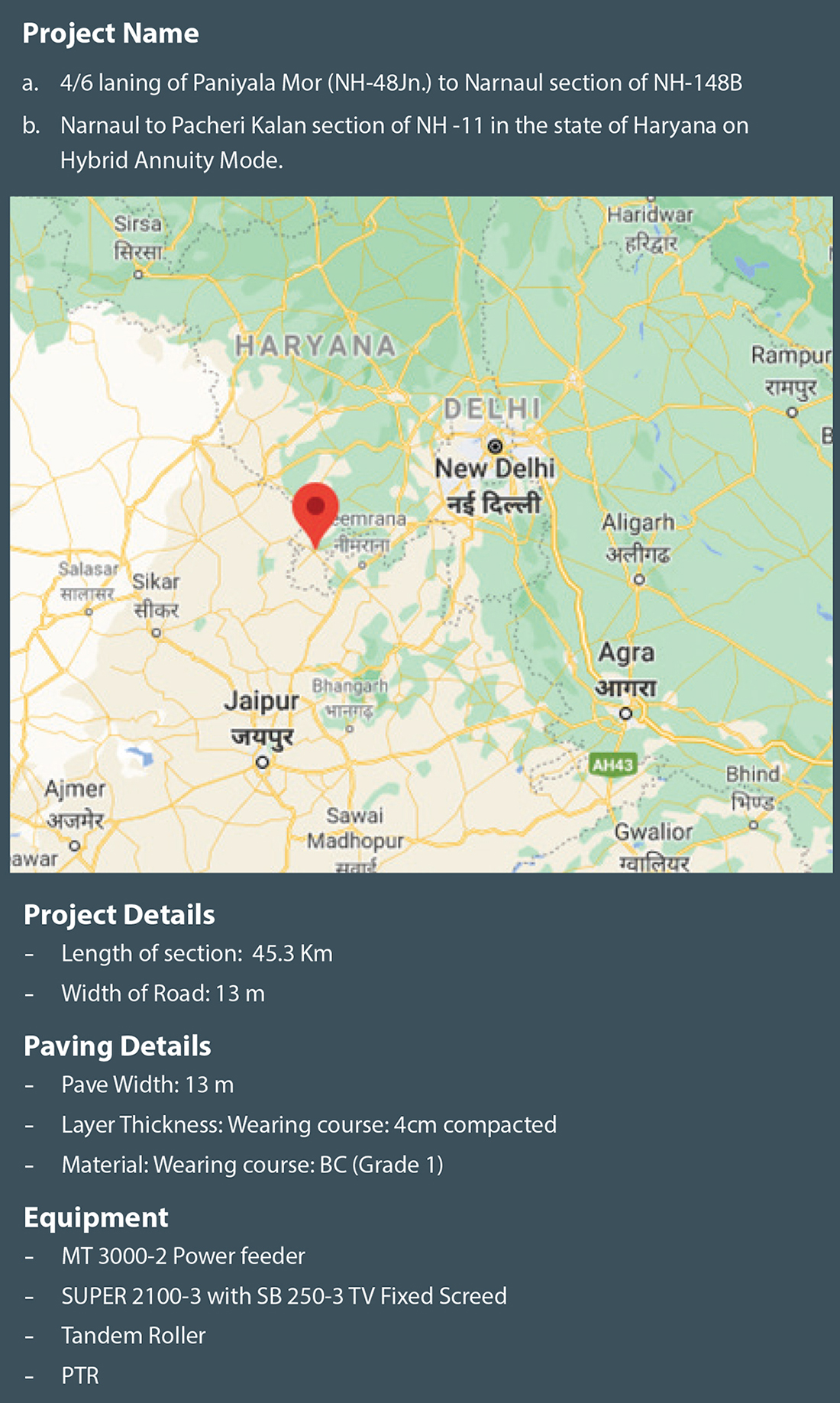
VÖGELE, the world market leader in Asphalt paving and offers a right paver for every application with various combination of different paving widths and also offers state-of-the-art Power Feeders especially for the large-scale job sites to offer reliable, uninterrupted transfer of mix to the pavers. Bharatmala Pariyojana is a prestigious infrastructure project of Government of India. The Voegele MT 3000-2 Power feeder along with the 13m Super 2100-3 paver and Hamm compactors were deployed by one of our esteemed customers, Gawar Construction Ltd. on NH 148B, the project in Haryana state.
Application Of Power Feeder
Large roads, such as motorways or trunk roads are the best applications for mobile feeders. The Power Feeder from VÖGELE is perfectly tailored for use when paving “hot to hot” with two pavers. The offset technology is also ideal for filling the spaces between safety barriers on motorways or long-distance roads quickly and economically. The mobile feeder also demonstrates its strengths when it comes to surfacing footpaths or cycle paths. With its pivoting conveyor, it can travel on the main road and conveniently transfer mix to a small or compact paver on the cycle path. The VÖGELE Power Feeder is also used in an InLine Pave train laying binder and surface courses “hot on hot” in a single pass. Its pivoting conveyor alternately supplies mix to the paver for binder course and the paver for surface course by way of a transfer module.
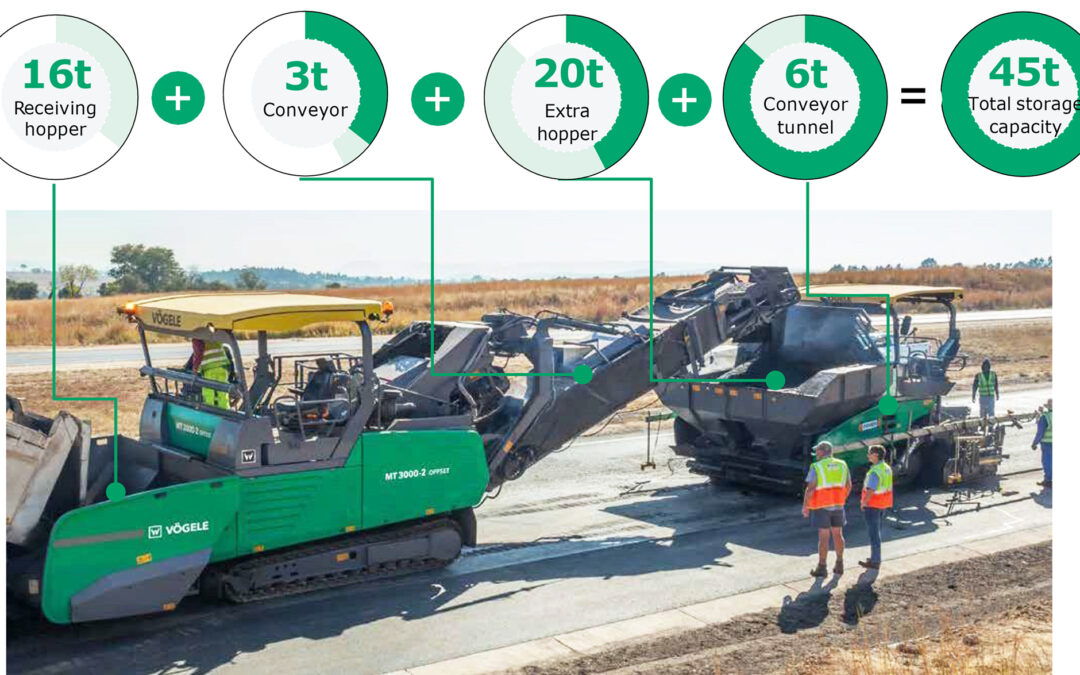
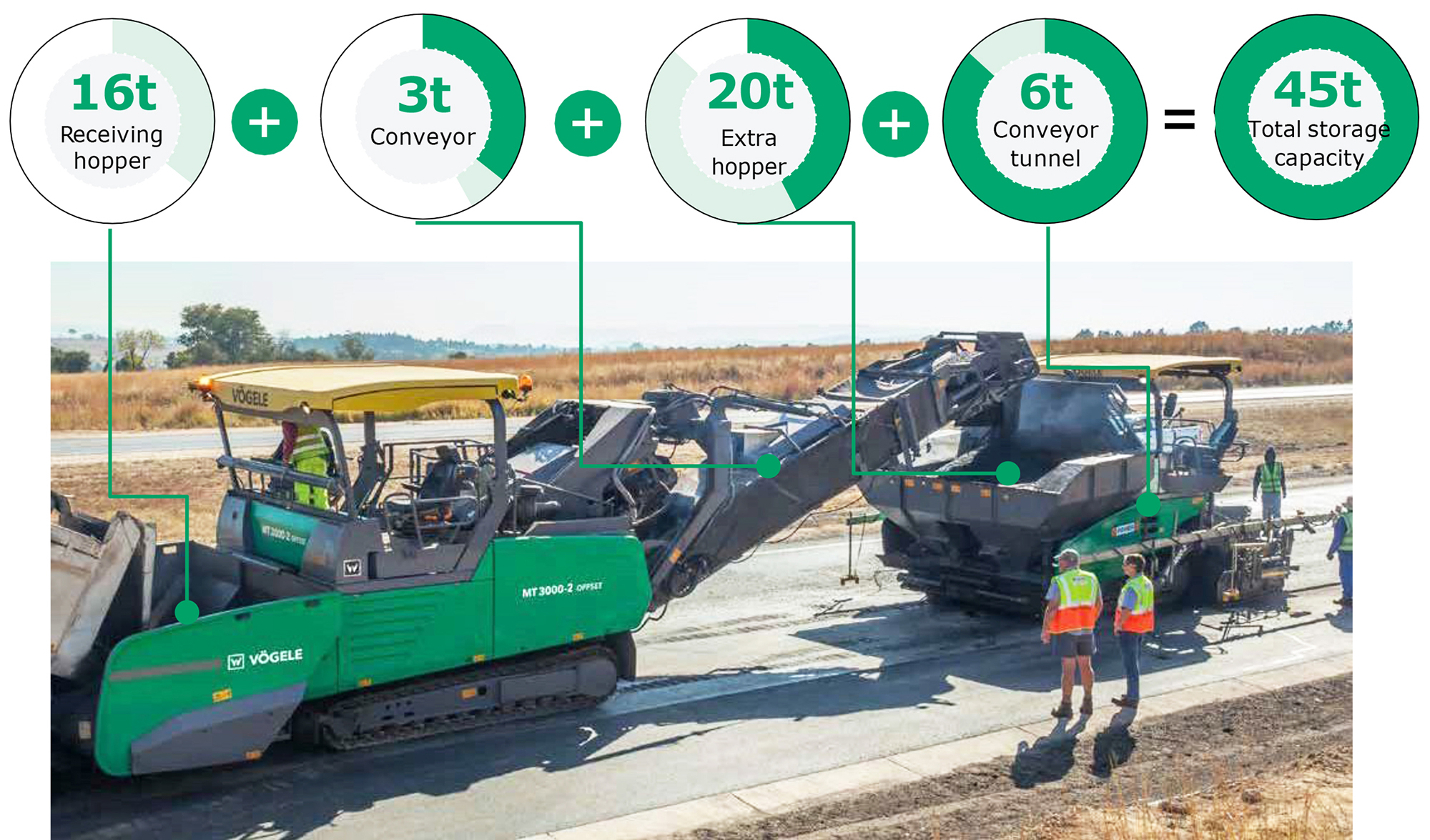
A non-stop, non-contacting transfer of mix achieved by the feeder is a decisive factor for perfect paving quality. With a peak conveying performance of 1200 tones/hour it can empty a full truck load in just 60 seconds. The on-board total storage capacity of 45 tones ensures uninterrupted paving, high quality matt finish and faster job completion. The excellent paving performance ensures cost saving to customers on account of fixed expenses and more revenues per day.
Highlights Of The VÖGELE MT 3000-2 Offset Power Feeder
- Uninterrupted paving thanks to a total storage capacity of 45t with a maximum conveying capacity of 1,200t/h.
- Non-contacting material transfer makes for maximum pavement quality.
- Homogenized material in the receiving hopper of the material feeder due to conical augers.
- Wide range of applications thanks to the pivoting and inclining conveyor.
- Reliable material transfer based on automatic distance control and anti-collision protection.
- Optimum overview and safety thanks to the convenient and practical ErgoPlus operating concept.
- Powerful Deutz Engine with 142kW at 2000rpm with ECO mode 139kW at 1800rpm.
- 550 conveyor pivoting angle with infrared heating panel.
- Backlit operating console.
Power Feeder Ensuring Uninterrupted Paving with 45 Tone Total Storage Capacity
New Generation Of Material Feeders From VÖGELE
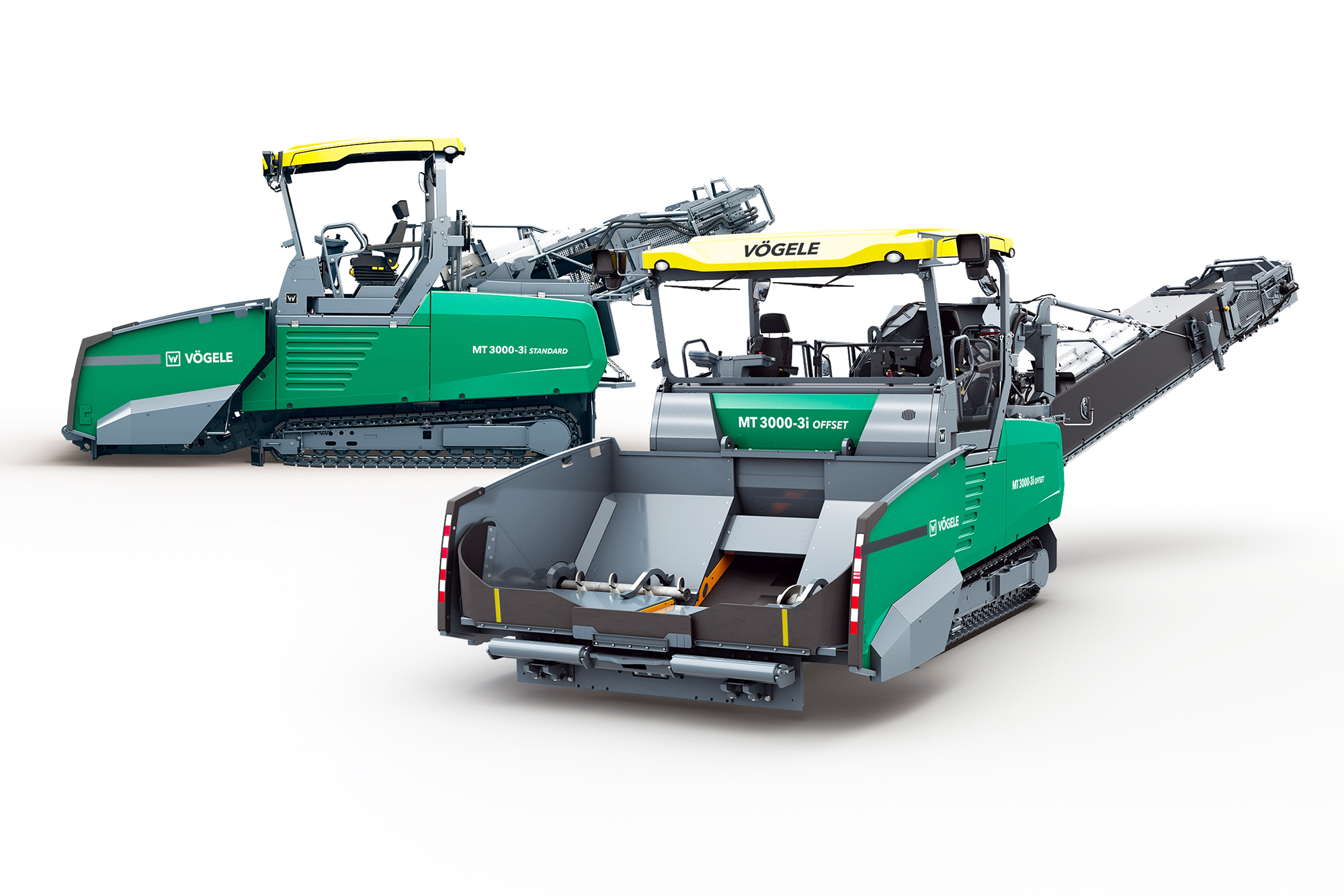
To increase the user-friendly nature and efficiency of the machines still further, JOSEPH VÖGELE AG has now comprehensively overhauled its former Dash-2 generation: the new MT 3000-3i Standard PowerFeeder and the MT 3000-3i Offset PowerFeeder with pivoting conveyor are equipped with the efficient and ergonomic Dash-3 machine concept. This includes, among other things, the ErgoPlus 3 intuitive operating concept, AutoSet Plus automatic functions and the PaveDock Assistant truck communication system. VÖGELE has also optimized the material handling concept, the new design of receiving hopper, the improved conveyor belt control and the effective belt heating system allow material to be unloaded and conveyed rapidly without loss – whilst simultaneously reducing wear. Maintenance and transport have likewise been simplified: users can now reach setting and cleaning points even more conveniently. The angle of inclination and the receiving hopper have also been optimized for transport on a low-loader.
For further information,
visit: www.wirtgen-group.com/india
by cecr | Jul 6, 2021 | Construction Chemicals And Materials
B.E. Billimoria Moving To Precast Concrete Technology
The company was established by Mr. Beji E. Billimoria and Mr. Laxmidas K. Kapadia in 1958. Mr. Jeet Kapadia, the Executive Director of Billimoria and the third generation of its founder, has recently started to follow his father’s footsteps to continue the family’s legacy in the construction business. “We cater to all sectors, and work with some of the biggest real estate developers, governmental organizations, and corporates. Our main model is to give the right quality, because today in India, the quality is the most important,” Jeet Kapadia says. While many factors have contributed to Billimoria’s success since its foundation, the company has always been the innovator and the true pioneer in the construction industry in India, from deployment of sophisticated building systems to the adoption of new construction technology, and to bravely pioneer the precast building technology in India.
A Growing Demand For High Quality Affordable Housing
With the rapid economic growth and unprecedented pace of urbanization, there is a staggering demand for affordable housing in India. The government has already set an ambitious project to build 20 million affordable houses and 98 smart cities by 2022. Precast concrete building technology will be the key enabler for that mission, as it can not only ensure faster completion of a project but also brings down its overall cost. The traditional construction methods used in India require a high amount labor for extended periods of time. This results in high costs, long duration of the construction project and quality variance due to human factors. Precast concrete as a building method allows for more control over an entire building project. “As we increase the size of the projects, as we go to megaprojects, the amount of labor required is a big variable. We wanted to avoid that variable, and try to bring everything into a factory, so we can have quality control, cost control and timeline control. The only way to go for that was to go for precast,” Jeet Kapadia says.
The Best Way To Move Forward
Even though there are some obstacles hindering the growth of precast concrete building technology in India, in Mr. Kapadia’s opinion, precast is one of the best ways to move forward. “Quality is the best benefit, because your slabs, beams, columns and walls are produced in a controlled environment. As a result, you are sure of the quality which you are getting. Speed is another big factor, because in the end, your financial depends on how soon you can complete your project,” Mr. Kapadia clarifies.
Billimoria Factory in Pune, Next to the Maharashtra Police Housing Project
Confidence Rooted In A World Class Partner
When evaluating suitable long-term partners among the many precast machinery companies, Elematic caught Billimoria’s attention. “We went through a lot of companies, who are doing precast, and felt with the increasing presence in India, Elematic will be able to support us the best in terms of after sales service, in terms of designing. We also felt that the machinery, which we got from Elematic will be for a longer period of time, and it will not give us a lot of trouble as compared to many of their competitors,” says Mr. Jeet Kapadia.
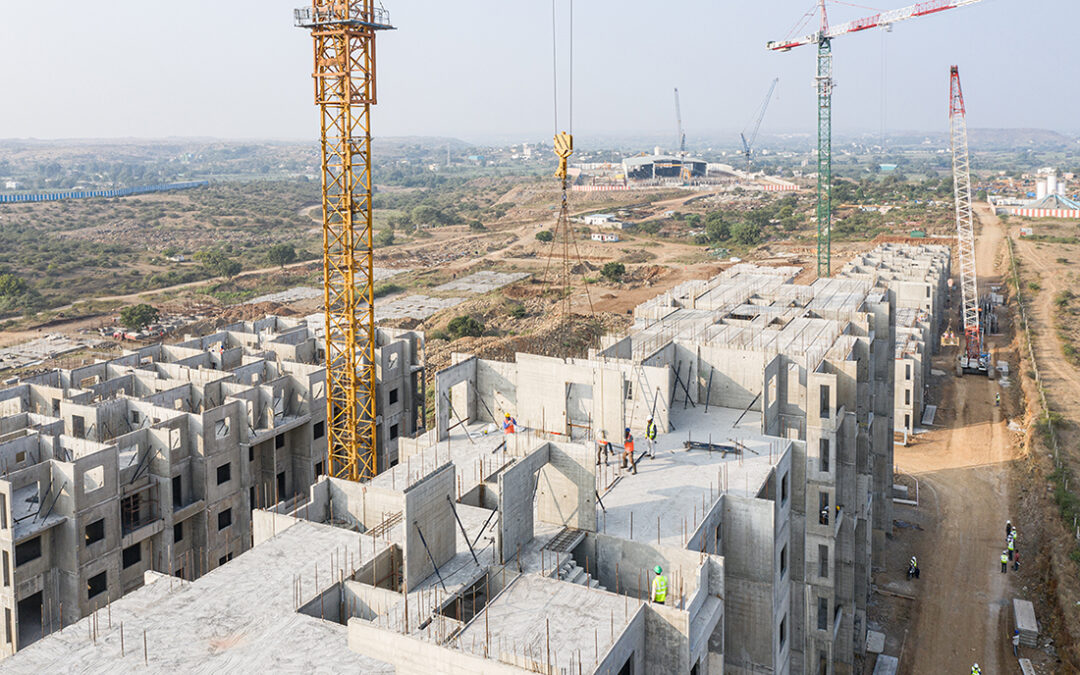
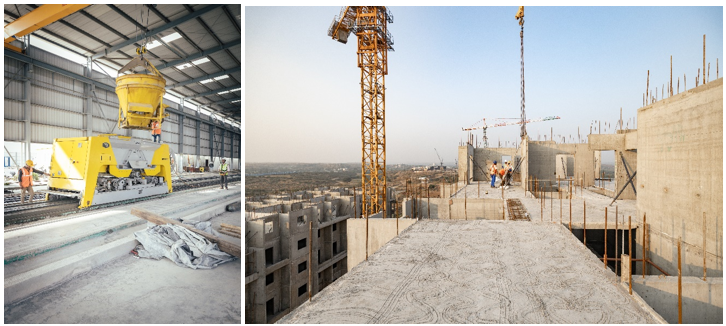
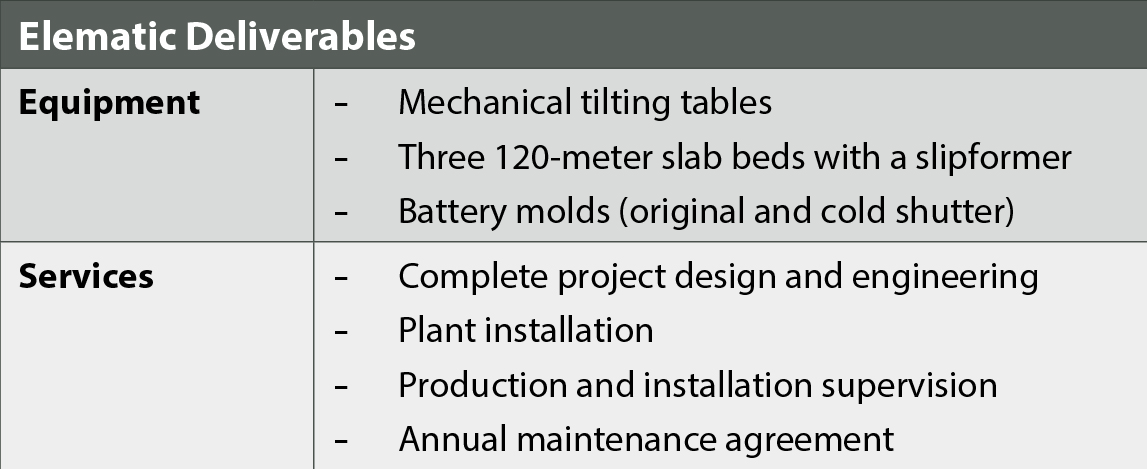
Billimoria’s precast factory is located within a 116-acre site in Pune. The 2-acre factory includes production and storage yard. It produces slabs, walls and staircases. The capacity is approximately 1.5 million sq.ft. of construction area in a year. “We have three slab beds which are 120m long; for the walls, which are mainly load bearing walls, we have battery molds and mechanical tilting tables; and molds for staircase walls,” Jeet Kapadia tells. “I think the whole set up works well. The shuttle basically supplies the concrete bed, but the same shuttle can also go to the battery molds. The logistics of that has been worked out very well by Elematic, as well as our engineers in cooperation with each other.” Mr. Jeet Kapadia continues.
The buildings feature a load bearing wall frame as their structural system
“Also, the way cranes were setup with the help of Elematic, in order to ensure the finished product was taken from the factory to the storage yard, the gantry cranes, the wagons, all of that, the whole setup has been excellent, and I’m very happy with that.” “There were a few hiccups as there are in any this kind of projects which we deal with, but I think overall, Elematic and Billimoria did a great job coming together, getting the products on site and delivering appropriately.” With the service agreement, Elematic’s team has been on site to provide support for any quality issues or machine issues. For example, when the thickness of the wall elements needed to change from 170mm to 160mm, a swift solution was needed. Elematic’s experts helped to refabricate, ensuring the production continued with 160mm without much of a lag. “I think the slab quality, which we are getting right now is beautiful and definitely helps us gain more confidence in precast,” affirms Mr. Jeet Kapadia.
The Project Proceeds with a Floor Cycle of 12 Floors in 12 Buildings in
12 Days, Basically a Floor a Day
No Quality Compromised In The Maharashtra Police Project
The Maharashtra Police housing project is aimed to build affordable houses for retired police. The total land is 180 acres, of which Billimoria started to develop approximately 40 acres for 5200 apartments, all of which must be completed within four years. “All of the buildings are ground plus 14 stories. And our aim is to ensure after the ground floor, all the other floors are done with precast. The building design is pretty simple, there are only few differences depending on the flat contributions.” Mr. Jeet Kapadia says. “We are very proud of the whole project, because we are doing
it for the Maharashtra Police. We aim to give them affordable prices with good quality, the quality they deserve after serving the state. That is our intention and that’s what I’m proud of.”
The Smartest Way To Build India
Mr. Sandeep Bedi, Managing Director of IQB Private Ltd., says that he is particularly proud of the partnership which they have created with Elematic, with their team, clients, and the eventual users. Because of that partnership, he says, they’ve created a very high-quality product, which will eventually offer a lasting home cherished by families for a long time.
“The Maharashtra police housing project is about 5 million sq.ft. residential development, comprising of about 60 towers and 5248 homes in all. We are building this entire development using Elematic precast equipment and methodology,” says Mr. Sandeep Bedi, Managing Director of IQB Private Limited.
IQB (Ingenious Quality Buildings Private Limited) is an innovative construction solution provider, with a specific focus on precast construction technology. They are India’s only end-to-end precast construction services provider, specializing in PMC, planning, production, logistics and installation services, and the principal contractor for B.E. Billimoria providing end to end precast services for MPMC. With a highly experienced and motivated team of over 100 precast professionals, IQB in on a mission introduce manufacturing efficiencies and culture in Indian civil construction sector. In Sandeep Bedi’s opinion, precast is probably the smartest way to build buildings in India or building India itself as 90% of the building can be made in a controlled factory environment, free of weather dependencies and reduced labor dependencies.
Direct Savings From Speedup Construction
Onsite precast plant minimized the crane requirement. The Maharashtra police housing project uses 4 tower cranes, each of them handling three buildings at a time. “The ingenious part is that we are using one tower crane on three different buildings. The three buildings are at different points in the lifecycle: if we are installing walls in one building, the other building is at the stage for steels, the second needs services for the structural toping, and on the third building, we are in the process of laying the screed,” Mr. Sandeep Bedi explains. With the optimized way of working, enabled Sandeep Bedi and his team to get a floor cycle of 12 floors in 12 buildings in 12 days, basically a floor a day. The speed of construction is the key, because it also ends up to the costs. The interest rates for real estate projects in many developing countries are very high. “The costs of money are staggering in India. In real estate, the interest cost is between 18-20% annually. So, If I can reduce the construction cycle by six months, that is a direct saving of almost 10%.” Mr. Bedi states.
Not Just An Equipment Vendor
“The journey thus far has been extremely interesting, huge amount of learnings. And being with Elematic has been delightful.They bring in a wealth of experience, which is global, but they also have pretty much the maximum amount of information on Indian precast as an industry.” “Elematic has held our hands and helped us beat every challenge. So, it’s been like Elematic is not a vendor from whom we’ve bought an equipment. They are actually a partner that holds our hand in every challenge that we are facing, be it a production challenge, an installation challenge and even if we talk about manpower training.” “I’m particularly proud of the partnership which we created with Elematic, with our team, clients, and the eventual users. Because of that partnership we’ve created a very high-quality product, which will eventually offer a lasting home cherished by families for a long time.” Mr. Sandeep Bedi concludes.
|
Solid Slab Production at the
Billimoria Factory with an
Elematic Slipformer Machine
|
With Precast, 90% of the Building can be Made in a Controlled Factory
Environment, Free of Weather Dependencies and Reduced Labor Dependencies
|
The Potential of Precast in India
Technavio, a global technology research and advisory firm, has released a report claiming that the global prefabricated construction market is expected to grow at a CAGR of 6-7% until 2020.
However, in India the uptake of modular technologies continues to remain slow and so far, prefabricated buildings comprise only 1% of India’s $100 billion real estate market.
Elematic provided all structural design to the Maharashtra project as well The precast products used in the
project include load-bearing walls, solid prestressed slabs and staircases
“I think as the demand is increasing, as it is increasing every year, a lot more people are willing to take a chance on precast. As more and more people get educated, I think the field will gain traction, people will get into it, and I feel very positive about the outlook. Especially with the government now trying to get a lot of projects offering precast solutions. So, there is a bright future for precast in India for sure,” Mr. Jeet Kapadia reckons.
According to Mr. Jeet Kapadia, Executive Director of B.E. Billimoria & Company, quality is the best benefit of precast. The slabs, beams, columns and walls are produced in a controlled environment, and as a result, you are sure of the quality which you are getting.
Buildings are designed for 50 years as per design requirement for RCC structure in IS codes. Precast products life can easily be assumed more than 50 years, as the production is done in controlled environment resulting in good quality.
Check out the project via this link: http://mpmcpune.com/index.html
by cecr | Jul 6, 2021 | Construction Equipments
Layher Group produces high-quality scaffolding systems in Germany. Layher has worldwide presence with more than 30 sales subsidiaries. The products are being used by industries like Construction, chemical plants, power plants at shipyards and offshore.
More Possibilities – Layher Products And Services
Layher’s present product characteristics and services help customers achieve long-term success and increase the profitability of their companies. The Layher Allround Scaffolding has been established as a synonym for modular scaffolds on the market. The Allround Scaffolding offers unsurpassed versatility to be used in construction sites, chemical industry, power plants, aircraft, shipyards, event sector, theatres and arenas.
Layher Allround shoring TG 60: The False Work Frame – Even More Possibilities In Allround Scaffolding
Allround scaffolding uses a simple, unique and bolt free connection technology. Sliding the wedge head over the rosette and inserting the wedge into the opening immediately secures the component. There is still sufficient play to secure the other end of the ledger. A hammer blow to the wedge transforms the loose connection into a superbly strong structurally rigid one. The face of the wedge head is now precisely positioned against the standard.
The new Layher Allround false-work frames have been developed as an extension of the Allround Scaffolding Systems. With three new additional parts, we can assemble false-work towers even faster higher and sturdier. The shoring frames TG 60 are available in three sizes: 1.00 x 1.09m, 0.50 x 1.09m and 0.71 x 1.09m. The base frame H = 0.71m is equipped with Allround rosettes at the top and the bottom and has no spigot.
The false work frames are made of steel tube of high strength and are stiffened with 2 small diagonal braces. Every vertical standard can be loaded with up to approx. 6 tons. The ends of the welded ledgers and diagonal brace are fattened. This makes the Allround rosette fully useable. To transfer pulling force, every frame is secured by locking pins or bolts to each other. In this way the tower can be assembled on the ground and placed by crane.
The product innovation is assembled out of the newly developed Allround Shoring Frame TG 60 as well as Allround standard parts like ledgers and diagonal braces. In this way the advantages are intelligently combined: Quick assembly and dismantling thanks to reduced number of components, light component weight, and screwless wedge lock connection technique and optimum material utilisation as a result of variable bay lengths. These can be adapted flexibly to the existing loads and the grid dimension of the formwork beams. Scaffolding companies increase assembly speed with it due to their day to day experience and moreover offer an attractive full package: They implement requests of the building contractors no-site without any difficulty with the Allround construction kit – whether they are exact adaptations to difficult building geometries, extensions like production stages and stair towers or supplementary solutions, for example concreting platforms and bracing scaffolding.
Application of Allround Shoring TG 60
For the greatest possible efficiency in the construction of the 46m long and 28m wide shoring tower structure, the scaffolding company considered all three construction phases already during the planning: setting up the moulds for the down stand beams, laying and concreting of the semi-finished ceilings as well as creation of the upper floors. In accordance with specifications the scaffolders utilised the material-saving 1.09m wide and 1.57m long tower versions, which sped up the procedure and simplified logistics. In longitudinal direction they connected the shoring towers at the head of the tower with two 1.09m scaffold bays each and one built-in Allround ledger. With the aid of the system components, elaborate calibration was obsolete: After erecting the shoring tower for the first beam axis, the further assembly resulted from the dimensions of the system components and the automatic rectangularity.
On the one hand the scaffolders adapted the 6.5m high shoring tower structure exactly to the grid of the down-stand beams and at the same time created ideal prerequisites for the second and third construction phase. The reconstruction work was therefore reduced to the minimum: As a support for the concreting of the semi-finished ceilings, the shoring tower structure was simply raised to the bottom edge of the semi-finished ceiling by inserting a 2.5m high Allround standard onto the Allround standard already integrated in the connecting bays. The loads were absorbed by the intermediate bay and transferred directly into the adjoining shoring towers by means of diagonal braces, which made the assembly of additional shoring towers underneath the ceiling obsolete. When building the upper floor, load concentrations were absorbed by square shoring towers the scaffolders had erected here and there in the intermediate bays. Around 100 tons of scaffolding material were used altogether – exclusively Allround standard parts with well-thought-out screw-less wedge lock connection.
To assemble the 600sq.mt. structure, scaffolding company, this helped to speed up assembly to its experience. In view of the heavy loads, the scaffolding experts chose square shoring towers with a ground plan of 1.09 x 1.09m, linked to Allround ledgers and diagonal braces by wedge head connectors and braced – meaning without additional connections using tubes and couplers. The combining of frames, in order to increase load-bearing capacity in the area of the almost seven metre high wall slabs too, was achieved using Allround ledgers with short intermediate bays. During measuring of the shoring towers, the use of standard Allround Scaffolding components likewise permits a considerable time saving. After assembly of a single tower, the distance to the next tower results automatically with the system dimension from right-angled positioning of Allround ledgers on the ground.
Allround TG 60 for Support of Heavy Structure
The scaffolding solution was also persuasive when it came to flexibility: the Allround Shoring TG 60 was able, thanks to its two shoring frames of differing height and by the spindle extension length, to compensate for height differences in the angled ceiling and in the slightly sloping ground. The width of the shoring was precisely adapted to the tapering form of the wall of the inlet and outlet structure by intermediate bays of variable width made from Allround equipment, or by extensions in the edge area using Allround standards. It was also possible using simple Allround brackets to build the working levels for the formwork on the wall slab and binding beam, or to construct the site accesses quickly using Allround stairway towers. 150 tons of scaffolding material were used in all, which Layher delivered to the site right on schedule and in a very short time when requested.
The safe assembly sequence for Allround Shoring TG 60 automatically provides scaffolding erectors with all-round side protection, even without additional components, during upright assembly. This allows the valid safety regulations to be met in full for the first time. The use of the new Allround Shoring TG 60 thus ensured crucial advantages for Scaffolding Company: compliance with the tight schedules required by project planning, optimum working conditions for the formwork and a high degree of safety during assembly work.
by cecr | Jul 6, 2021 | Construction Equipments
|
Dr. Helena Keller
Schleibinger Geräte
Teubert und Greim GmbH
Germany
|
The ever-growing demands on the concrete are closely linked to the development of self-consolidating concrete (SCC). There are increasingly becoming the focus in additional to the usual vibrated concretes. With the development of high-performance additives such as super plasticizers, the SCC can be adapted very precisely to the growing requirements. This associates with a high sensitivity of the SCC to fluctuations in the quality of the starting materials, e.g. admixtures. The setting window of these self-consolidating concretes is very narrow and the handling therefore complicated and difficult. The robustness of the SCC is significantly lower in comparison to conventional concretes, which means that the acceptance in practice is quite moderate.
In addition to the high requirements for the hardened concrete, e.g. durability, compressive strength and improved surface quality, the characteristics of the fresh concrete are important in terms of processing ability, stability against sedimentation and the ability to vent. Over time, many empirical methods have been developed to determine the properties of fresh concrete such as slump test, flow table or V-funnel.
Depending on the requirements, fresh concrete is very different and should always be tested before installation. In addition to the test on hardened concrete in the laboratory, tests on fresh concrete according to the valid standards and regulations are carried out. While these tests are sufficient for the characterization and classification common vibrated concrete, in most cases these are unsatisfactory for characterizing SCC. The characterization of the rheological properties of the SCC is only possible to a limited extend using the existing standardized methods.
The properties of the fresh SCC are strongly influenced by the inter-particular interactions that determine the rheological behaviours of the cementitious suspensions. A suitable additive can interfere with the inter-particle interactions and thus strongly influence the rheology of fresh concrete. As a result, even small fluctuation in the water content can lead to major changes of the fresh concrete behaviours, which are reflected in the changed flow ability, different aeration behaviour and especially in decreasing mixture stability and segregation. For better understanding this problem, new measurement methods must be developed that deal with the rheology of fresh concrete.
The most important rheological parameters are the yield stress, viscosity and thixotropy. The yield stress describes the behaviour of a fluid which behaves like an elastic solid body up to a certain load (= flow limit, yield stress) and above like a liquid with plastic viscosity. The viscosity describes the toughness of concrete and the thixotropy (and also rheopexy) as a time-dependent reversible process the change of the yield stress and the viscosity as a function of load.
The knowledge of flow mechanics and rheology is very important not only in the area of concrete development, but also for quality control in the construction laboratory or directly on the construction site in the case of concrete deliveries. The investigations of the rheological properties must be carried out. This leads to a necessity in the development of rapid and uncomplicated processes for measuring of rheological behaviours of fresh concrete suspensions.
Rheological Measurement Of Concrete
For the determination of the rheological properties of fresh concrete, a large number of measuring instruments and measuring systems are currently available. A few of these rheometers were adopted from other branches of industry and are often not suitable for measuring suspensions. The most common rheometers are rotational rheometers which based on the laminar flow of the investigated fluids. However, a laminar flow does not exist for the concrete due to their high inhomogeneity. A further problem of these rheometers is the occurrence of the lubricating layer at the interface between the sample and the surface of the sample container, which leads to the measurement of an apparent lower shear stress. The main problem is however considerable influence of the flow characteristics and the particle migration and particularly particle segregation during the measurement. In addition, a partial permanent and often excessive shear from the rheometer destroys the inner structure of the cementitious samples and thus affects the stiffness and setting behaviours of the concrete as well.
Concrete Rheometer eBT-V
The mobile rheometer for fresh concrete, eBT-V, was developed from Schleibinger Geräte particularly for the measurement of the suspensions with the particle size up to 32mm (fig. 1). The device is battery driven and water proof and can be used in the laboratory and at the construction site for research and development but also for the quality control. The device is cable-free and will be operated via the mobile app. The control via smartphone allow fast and easy operation of the device as well as a transmission and display of the results.
Fig. 1: The Mobile Rheometer eBT-V
Due to the built-in variable speed drive, different speed settings are possible to realize. The measurement program can be set and saved individually as a ramp or step profile. In addition, the device offers a not negligible practical advantage – the measuring probe and the sample container are easy to clean.
With the maximum torque of 10Nm the concrete rheometer eBT-V can be used to characterize both very fluid and very stiff concretes as well. The rheometer can be operated in two different modes, which are called P-mode and V-mode. The schematic representation of operating modes is shown in fig. 2.
Fig. 2: Schematic Representation of the Operation Modes of the Mobile Rheometer eBT-V
Operation In P-Mode
Operation in P-mode is particularly suitable for the fluid and stiff mixtures where the measurement must be carried out in a non-sheared mixture. Only one revolution of the device is enough for the investigations of the properties of fresh concrete. For the measurement a cylindrical or spherical probe is attached to the measuring device. After the device has been placed on the centering rod of the sample container, the rheometer rotates according to the measurement profile. The drag-force on the probe is measured independent of the insertion depth. The data from the probe will process into a flow curve considering the different angular speeds and the distance to the centering rod. After evaluation of the measured data according to Bingham model the relative yield stress and the relative viscosity can be determined. From the evaluation of the stationary force at constant low speed equilibrium shear stress can be obtained.
Using a profile based on one revolution the measurement is performed in non-sheared fresh mixture at any time. As a result, problems such as segregation and structural break down during the measurement are greatly minimized. The measurement time can be adjusted to less than one minute.
Operation In V-Mode
Operation in V-mode is particularly suitable for the fluid and very fluid mixtures such as SCC. For the measurement a vane probe will be used. In recent years, the vane geometry has gained popularity as a simple and effective measuring tool for non-Newtonian fluids. Once widely used in the food industry, this probe geometry is increasingly used for the investigations of the cement-based systems.
Using the vane probe minimizes damage to the sample structure during the measurement. Due to the star arrangement of the wings, the sliding on the wall of the probe is almost completely prevented. The wall slipping on the container surface can be prevented by using a device holder with integrated anti-slip rods.
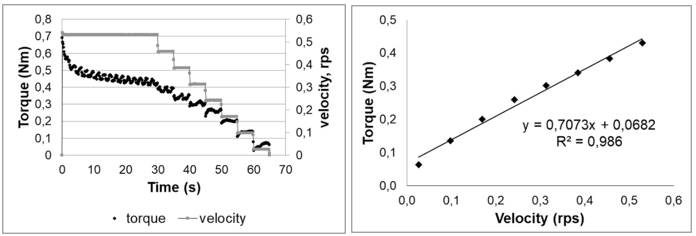
Fig. 3: Measurement with eBT-V in Vane Mode: SCC Mortar with Particle Size Up to 4mm
Measured with Step Profile (left) and Data Evaluation According Bingham Model (right)
The device is fixed on the device holder and the Vane probe is attached on the drive shaft. The measuring container is filled with the sample and the instrument holder with the device mounted on it is placed into container. The rheometer measures the torque on the vane probe as a function of the speed. The plastic viscosity and the yield stress are calculated from the angular velocity and the measured torque according to Bingham model. The calculation from torque to shear stress can be done by the mathematical model using the Reiner-Riwlin equation. As an example, the measurement results of a SCC mortar with maximum particle size of 4mm are shown in fig. 3. The measurement results for SCC concrete with the maximum particle size of 20mm are shown in fig. 4.
Fig. 4: Measurement with eBT-V in Vane mode: SCC Concrete with Viscosity Agent and Particle Size up to
20mm Measured with Step Profile (left) and Data Evaluation According Bingham Model (right)
Conclusion
The growing demands on the material are accompanied by the growing demands on measurement technology. Particularly within the area of concrete production and rheological measurements, there have so far been insufficient measurement possibilities. The company Schleibinger Geräte has developed a mobile rheometer which records the rheology of the fresh concrete and in particular of fresh self-compacting concrete and thus offers new possibilities in the field of concrete development and quality control as well.
The measurement profile can be set individually and the test can be carried out within a minute. The device is cable-free and will be operated via the mobile app, which allows the results to be transmitted and displayed quickly. The rheometer is robust and mobile and can also be used in the laboratory and in the construction site.
For further information,
visit: www.aimil.com
by cecr | Jul 6, 2021 | International News
A consortium led by Italian contractor Webuild has won a design-and-build deal worth €1bn to build a 28km section of the Napoli-to-Bari high-speed rail line between Orsara and Hirpinia. Webuild will work with contractor Pizzarotti in a joint venture 70% owned by Webuild, following the same arrangement used for an 11.8km section of the same line between Orsara and Bovino.
It will be carried out on behalf of state-owned rail operator Ferrovie dello Stato Italiane. When work on the Naples-to-Bari line is complete, it will cut the travel time between the cities from four hours to two, and reduce the time taken to travel between Milan and Bari to six hours. The line is part of corridor five of the Trans-European Transport Network, which will ultimately link Finland and Malta.










 The false work frames are made of steel tube of high strength and are stiffened with 2 small diagonal braces. Every vertical standard can be loaded with up to approx. 6 tons. The ends of the welded ledgers and diagonal brace are fattened. This makes the Allround rosette fully useable. To transfer pulling force, every frame is secured by locking pins or bolts to each other. In this way the tower can be assembled on the ground and placed by crane.