by cecr | Jul 14, 2020 | Construction Equipments
|
Ramesh Palagiri
Managing Director & CEO
Wirtgen India |
The National Highway network in India – constitutes less than 5% of the total road network, but caters to around 70% of the total traffic and thereby, leads to a huge stress on pavements.
India has constructed 132,000 km of National Highways over the last 5 decades and is likely to construct another 40,000 km in next 8-10 years. If we add another 50,000 km added by state Highways, we are looking at 180,000 km of assets constructed and another new addition of 50,000 km. Both the situations pose a big challenge to Indian Authorities.
The construction of a new 4-lane highway requires approx. 12,000 tons aggregates per km, meaning approximate 500 truckloads of fresh aggregates and the unbound layers like GSB and WMM consume 80% of the total requirement of fresh aggregates. The conventional method of pavement construction requires significant amount of materials and energy. To reduce consumption of fuel and aggregates, green eco-friendly technologies like cold milling, cold recycling and stabilization of pavement layer are being adopted for cost-efficient and sustainable roads, thereby improving long-term performance and reducing lifetime cost of modern, heavily-trafficked pavements.
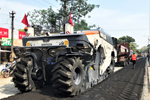
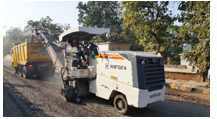
WIRTGEN GROUP offers innovative technologies for sustainable pavements. Asphalt and concrete pavements can be cost-effectively removed with Cold Milling machines. The range of applications extends from the complete removal of asphalt and concrete to the layer-by-layer removal and levelling of asphalt and concrete surfaces. With WIRTGEN Cold Milling machines, it is possible to machine working widths from 35 cm up to 4.40 m and working depths up to 35 cm in a single pass. Cold Milling technology is used for – partial, layer by layer, or complete removal of distressed pavements with varying depths. This technology can also be used for correction of irregularities in pavement surface, improvement of skid resistance and creation of surface textures of a pavement.
|
|
Wirtgen Cold recyclers are used to prepare asphalt pavement on site. In this process, the existing pavement is granulated with the milling and mixing rotor, and prepared by adding precise amounts of bituminous binding agents, cement and water. The result is a homogeneous material that can be used to directly repave the surface. Soil stabilisers use the milling and mixing rotor to mix pre-spread binding agents such as lime or cement into the existing, less stable soil and transform it into a high-quality material directly on site.
With the aggregates depleting fast, even the rural roads have started adopting the technology of cement based stabilization to fast pace the connectivity of rural roads.
Today Indian Highway Authorities, namely NHAI/NHIDCL/PWD/PMGSY are the drivers of these green technology, which leads to faster construction and also saves nation huge amount in terms of natural resources, biofuel and associated emissions.
The technology of stabilization, Cold Milling, Cold and Hot Recycling are used across Indian highways by contractors and are supported by IIT and CRRI, by well-researched design and performance standards laid by IRC.
For further information,
visit: www.wirtgen-group.com/india
by cecr | Jul 14, 2020 | Construction Equipments
|
Mithilesh Kumar
Director
Layher Scaffolding System Pvt. Ltd.
|
Layher produces high-quality scaffolding systems in Germany. The company has worldwide presence with more than 40 sales subsidiaries. The products are being used by industries like construction, chemical plants, power plants, as well as at shipyards, offshore, events sector, theatres and arenas. Nowadays for demanding and complex scaffolding applications, i.e., wherever conventional scaffolding technology falls short of optimal and cost effective use, Layher Allround Scaffolding convincingly comes in with an unmatched range of advantages: unbeatably fast assembly, persuasive economic arguments and an extensive range of series-produced accessories.
More Possibilities – Layher Products And Services
Layher’s present product characteristics and services help customers achieve long-term success and increase the profitability of their companies. The Layher Allround Scaffolding has been established as a synonym for modular scaffolds on the market.
Allround scaffolding uses a simple, unique and bolt free connection technology. Sliding the wedge head over the rosette and inserting the wedge into the opening immediately secures the component. There is still sufficient play to secure the other end of the ledger. A hammer blow to the wedge transforms the loose connection into a superbly strong structurally rigid one. The face of the wedge head is now precisely positioned against the standard. Connections in quick to assemble and spanner less scaffolding systems make a unique combination: providing structural strength immediately on assembly and subsequent ultimate force transmission, while offering a choice of automatically right-angled or splayed connections with universal safety right from the start.
To transfer pulling force, every frame is secured by locking pins or bolts to each other. In this way, the tower can be assembled on the ground and then placed by crane.
Application Of Layher Allround Scaffold For Maintenance Of Column
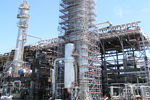
The multiple structured column with different sizes operated by Refinery, is currently being refurbished, and corrosion prevention experts have to treat the entire structure time to time. Safe access to all locations of main building is assured with the use of a modular scaffolding system. The use of Allround Scaffold gives rise to the possibility of complete maintenance on time as per requirement.
The advantage lies in the speed with which not only the right angle can be automatically obtained with the system, but also variable angles can be achieved if required. This is done by fitting the ledgers in rosettes each with four holes at right angles, with four further larger holes (usually used for diagonal braces) being used to facilitate variable angles. This means that the erectors can also make connections at any angle as dictated by the conditions on site. The Scaffolder can easily, thanks to the eight possible connections in every connector, make adaptions quickly and optimally for almost any application.
These advantages ensure the optimum conditions for effectively enclosing the circular and rectangular structure with safe and minimal time required to construct the scaffolding. Allround Scaffolding was easily adapted to follow the contour shape of the structure without difficult to access. The erectors didn’t need to create complex tube structures, saw off tubes all the time, repeat measuring of connections or constantly align the upright elements. The wedge head provides an all in one simple yet stable connection, coupled with a logical assembly sequence and integral safety. Hot-dip galvanisation and certified quality assure that Allround scaffolding top-quality products are extremely long-lived.
Layher Allround Scaffold used for maintenance of two large distillation columns standing 55 m and 37 m height. Approximately 80 tons of scaffolding material was used for this project. The Layher Allround Lightweight modular scaffold technology was the system chosen due to its fitting accuracy and speed of erection to gain access. The major challenge for this project was to erect Scaffolding during operation mode of Column the plant was live (working). The design needed to be free standing to withstand significant wind loads.
Several work levels were required plus a lift going up 40 m were required to be integrated into the scaffolding. The challenge set by this particular job was to follow as precisely as possible the double-curved surface of the tank. This was possible due to the extensive capability of parts Layher are able to offer.
The Layher Aluminium platform stairs were also an excellent addition for allowing the maintenance team to safely move up and down the columns. Thanks to Bruce Sinton, Project Lead, Fitzroy Engineering for the use of these photos.
Conventional anchoring to the column was not possible. The scaffold erectors were only able to make connections to the all-round steel profile – the runner rail for the inspection ladders – at the tank’s “equator” using scaffold couplers. Above and below this anchoring level, the scaffolding was secured by all-round steel cables. A Layher landing-type stairway tower allowed convenient access to the scaffold at various levels.
The top lift of the scaffold at the top of the structure called for Layher’s expertise. Following the increasingly safe scaffolding with proper access at all locations, Layher’s Technical Bureau designed a series of connected lattice girders to the topmost Allround standards, which made them converge in tension-resistant form. The scaffolders then placed the structure on the highest point of the Building using Allround standards.
Application of lattice girder was considered in design to construct cantilever projection on top to fulfil proper access. Construction of scaffolding to make approach for all required location was a major challenge during the shutdown, but it becomes easy when Allround Scaffolding Systems are considered.
Layher new Lightweight scaffolding is result of a major, multi-year R&D project with a clearly defined objective: to make scaffolding easier, safe and above all more cost effective for customer.
For further information,
visit: www.layher.co.in
by cecr | Jun 21, 2020 | Engineering Marvels
The first algae-powered building in the world
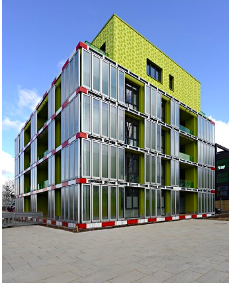
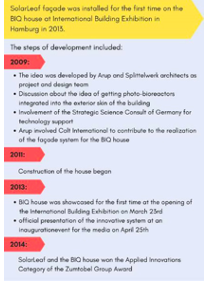
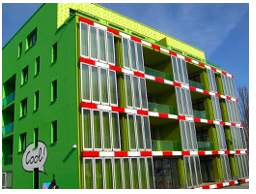
The world’s first algae-powered building in Hamburg, Germany, the 15-unit Bio Intelligent Quotient (BIQ) House, is a four-storey residential building, which was launched as a part of the 2013 International Building Exhibition. It was launched with the aim to test the world’s first ‘bio-adaptive’ façade, which uses micro-algae to shade the building as well as generate energy. The BIQ House is the first building in the world to have a bioreactor façade.
Construction
The structure, which features a bio-adaptive algae façade, was built by international design firm Arup in collaboration with Germany’s SSC Strategic Science Consultants and Austria-based Splitterwerk Architects. Arup is the design and engineering firm that brought the world the Centre Pompidou and the Sydney Opera House.
The apartment building was conceived as part of a European movement to design carbon neutral, self-sustaining, and renewably powered structures. The BIQ was funded in large part by the German government to incentivize the development of new adaptive, smart construction materials. Algae was selected as of all the technologies on display, algae power is perhaps considered with the finest pedigree and greatest potential.
The greenness of the façade, called SolarLeaf, shows that the algae are breaking down the carbon dioxide and processing it through photosynthesis. This renewable form of energy production is thus, visible from outside the building, and is an intentional part of the architectural concept.
|
| Sunlight Tracking Around a Vertical Axis |
Second Green Skin
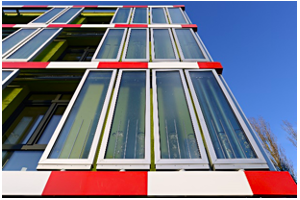
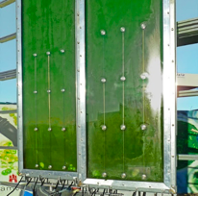
The sides of the building that face the sun have a second outer shell that is set into the façade itself. The micro-algae used in the facades are cultivated in these flat panel glass bioreactors that make up its ‘bio skin’, measuring 2.5 m x 0.7 m. In total, 129 bioreactors have been installed on the south-west and south-east faces of the building. This bio-reactive panelling is filled with 200 m2 of algae. The 200 m2 of integrated photo bioreactors algae façade comes with a net annual energy supply of about 4,500 kW/h of electricity more than an average household consumes in a year (3,500 kW/h per year).
|
While the north-east and north-west facades of the building are stylishly attention-commanding, the south-east and south-west façades feature panels of algae that produce heat and biomass to supply the building with energy from renewable sources. The algae are continuously supplied with liquid nutrients and carbon dioxide via a separate water circuit running through the façade. With the aid of sunlight, the algae can photosynthesise and grow. This process for generating sustainable, renewable energy creates a shimmering, dynamic green facade for the building.
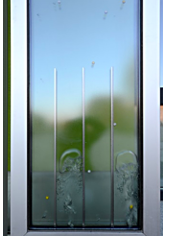
The panels can rotate along their vertical axis to track the position of the sun, and when fully closed, they form together a continuous outer skin providing a thermal buffer. The two inner layers form an 18 mm wide cavity with a capacity of 24 litres for the circulation of water and growth of algae. For safety and thermal insulation, the photo bioreactor is clad on both sides with laminated safety glass. Compressed air is introduced to the bottom of each bioreactor at certain time intervals. The gas emerges as large air bubbles and generates an upstream water flow and turbulence to stimulate the intake of CO2 and light by the algae. At the same time, the inner surfaces of the panels are washed by the mixture of water and air that is visible to the people.
|
| AirLift-System Bubbles Rising in the SolarLeaf Louvers |
|
|
|
Glass Photo-bioreactors Create
the Suitable Environment for Photosynthesis
|
Prototype of the Algae-filled Glass Louve |
The Holistic Energy Concept
The BIQ house captures all the energy needed to generate its electricity and heat from the sun, leaving fossil fuels untouched. The bioreactors not only produce biomass that can subsequently be harvested, but they also capture solar thermal heat – and both energy sources can be used to power the building. This means that photosynthesis is driving a dynamic response to the amount of solar shading required, while the micro-algae growing in the glass louvres provide a clean source of renewable energy.
Two Sides of the Building are Clad in Panels Containing Live Micro-algae
The bioreactors help to insulate the building and keep out noise. The heart of the system is the fully automated energy management centre, which controls each reactor. Here, solar thermal heat and algae are harvested in a closed loop to be stored and the reactors are turned towards the sun. Excess heat from the sun, unused by the algae, is either used directly for solar hot water or stored in tanks under the building for later use.
When the algae hits a certain rate of growth, some of the algae is harvested and taken into the building for processing, where the biomass is converted into biogas which can be burned to provide heat in the winter and electricity. The carbon dioxide from burning the biogas is then used to feed the algae. This façade is the first of its kind in the world and makes use of the very latest energy and environmental technology.
Diagram of the Energy Flow and Operating System Image
These innovative façades contribute to the reduction and removal of 2.5 tons of CO2 emissions from buildings each year. This remarkably sustainable energy concept is therefore capable of creating a cycle of solar thermal energy, geothermal energy, a condensing boiler, local heat, and the capture of biomass using the bio-reactor façade.
The apartment provides the option of ‘living on demand’, where the individual functions of the apartment can be swapped about or combined to form a ‘neutral zone. This innovative living concept is aimed at ensuring maximum design versatility for everyday life and gives us a glimpse into urban life in the future. With its innovative living concept, futuristic exterior, and “intelligent” algae façade, the BIQ is a highlight of ‘The Building Exhibition within the Building Exhibition’. The BIQ building shows that in the future façades will be able to serve a number of different functions and be much more than an aesthetic cladding to protect against rain and cold.
References
- https://pocacito.eu/sites/default/files/BIQhouse_Hamburg.pdf
- https://www.arup.com/projects/solar-leaf
by cecr | Jun 14, 2020 | Construction Chemicals And Materials
|
Abhishek D. Khupsare
Technical Officer,
Bajaj Reinforcement LLP |
Introduction
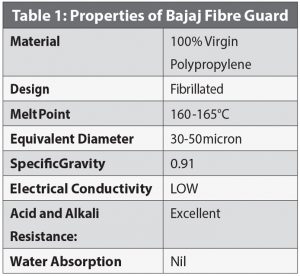
Polypropylene fibres have been applied for reinforcement of cement mortars and concrete for many years. They restrict crack propagation and affect many concrete parameters. Good results are obtained by application of fibrillated fibres with the net-like structure obtained from the polypropylene. The fibres are chopped to specified lengths and used for the reinforcement of concrete and cement mortars. The beneficial effect of fibres on the compressive strength of concrete is revealed after freezing and thawing cycles. For mortars reinforced with fibrillated fibres, a significant increase in the bending strength is observed by mechanical anchoring, which results from opening of the network structure and splitting of fibrillated fibres
The highest bending strength was registered for micro fibre ranging length of 20 mm and the fibre content of 0.1% of total concrete. By this length, during mixing of the mortar, the fibres remain straight and do not bend or tangle. Fibres have relatively large contact surface to form a sufficient number of adhesive connections with the mortar components and to provide high friction forces during pulling fibres ends out of the matrix.
PP Fibres added to the concrete improve the parameters of a fresh concrete. The beneficial effect of these fibres is revealed after freezing and thawing cycles. After multiple freeze/thaw cycles, the compressive strength of reinforced concrete exceeds the strength of plain concrete. Simultaneously, the reinforced concrete exhibits lower water absorbability.
Cracks play an important role as they change concrete structures into permeable elements and increase the risk of corrosion. Cracks not only reduce the quality of concrete, but also make structures out of service. Therefore, it is important to reduce the crack width and this can be achieved by adding polypropylene fibres to concrete.
The addition of fibres in cement concrete matrix, bridges these cracks and restrains them from opening further, as shown in Fig. 1. In order to achieve more deflection in the beam, additional forces and energies are required to pull out or fracture the fibres. This process, apart from preserving the integrity of concrete, improves the load-carrying capacity of structural member beyond cracking. This improvement creates a long post-peak descending portion in the load deflection curve as shown in Fig. 2. Reinforcing short discontinuous fibres have the advantage, however, of being uniformly mixed and dispersed throughout the concrete.
The major reasons for crack formation are plastic shrinkage, plastic settlement, freeze thaw damage, fire damage, etc.
Plastic shrinkage occurs when surface water evaporates before the bleed water reaches the surface. Polypropylene fibres reduce the plastic shrinkage crack area due to their flexibility and ability to conform to form. The addition of 0.1% by volume of fibres is found effective in reducing the extent of cracking up to 90%. The extent of crack reduction is proportional to the fibre content in the concrete.
|
| Fig.1:Bidging of crock.using polypropylene fthres |
Fig.2:Tropycal Load Elongation Response In Tension of FRC |
In case of high-rise structures, high rate of bleeding and settlement combined with restraint to settlement leads to settlement cracking. In case of PFRC, fibres are uniformly distributed and as they are flexible resulting in negligible restraint to settlement of aggregates.
Small addition of polypropylene fibres in concrete reduces the flow of water through the concrete matrix by preventing the transmission of water through the normal modes of ingress. The implications of these qualities in concrete technology with polypropylene fibre additions are that cement hydration will be improved, separation of aggregate will be reduced and the flow of water through concrete that causes deterioration from freeze/ thaw action and rebar corrosion will be reduced, creating an environment, which will enhance durability of high rise structures.
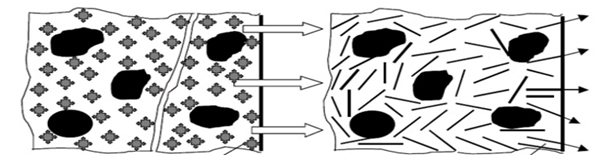
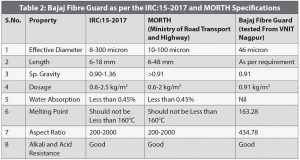
In high-rise buildings, heat penetrates the concrete resulting in desorption of moisture in the outer layer. Moisture vapours flow back towards the cold interior and are reabsorbed into voids. Water and vapour accumulate in the interior, thereby increasing the vapour pressure rapidly causing cracks and spalling in the concrete. The polypropylene fibres melt at 160°C, creating voids in the concrete. The vapour pressure is released in newly formed voids and explosive spalling is significantly reduced as shown in Fig. 3.
|
| Spalling of Homogenous Structure of Concrete due to Insufficient Capillary Pores |
Developed Explosion Channels due to Melting of PP Fibres |
| Fig. 3: Flowing out of steam Pressure through the Melted PP Fibres in the Case of Fire |
Properties Of Polypropylene Fibres
Before mixing the concrete, the fibre length, amount and design mix variables are adjusted to prevent the fibres from balling. The aspect ratio for the fibres are usually restricted between 100 and 200, since fibres, which are too long tend to ‘ball’ in the mix, and create workability problems. As a rule, fibres are generally randomly distributed in the concrete; however, placing of concrete should be in such a manner that the fibres become aligned in the direction of applied stress which will result in even greater tensile and flexural strengths. There should be sufficient compaction so that the fresh concrete flows satisfactorily and the PP fibres gets uniformly dispersed in the mixture. The fibres should neither float to the surface nor sink to the bottom in the fresh concrete. Chemical admixtures are added to fibre-reinforced concrete mixes primarily to increase the workability of the mix. Air-entraining agents and water-reducing admixtures are usually added to mixes with a fine aggregate content of 50% or more. Superplasticizers, when added to fibre-reinforced concrete, can lower water-cement ratios, and improve the strength, volumetric stability and handling characteristics of the wet mix.
Polypropylene fibres are used in two different ways to reinforce cementitious matrices. One application is in thin sheet components in which, polypropylene provides the primary reinforcement. Its volume content is relatively high exceeding 0.5%, to obtain both strengthening and toughening. In other application, the volume content of the polypropylene is low, less than 0.15% by volume, and it is intended to act mainly as secondary reinforcement for crack control, but not for structural load bearing applications. The performance and influence of the polypropylene fibres in the fresh and hardened concrete is different and therefore, these two topics are treated separately.
Effects On Fresh Concrete
The slump values decrease significantly with the addition of polypropylene fibres. The concrete mixture becomes rather clingy, resulting in increasing of the adhesion and cohesiveness of fresh concrete. During mixing, the movement of aggregates shears the fibrillated fibres apart, so that they open into a network of linked fibre filaments and individual fibres. These fibres anchor mechanically to the cement paste because of their large specific surface area. The concrete mixture with polypropylene fibres results in the fewer rate of bleeding and segregation as compared to plain concrete; this is because the fibres hold the concrete together and thus, slow down the settlement of aggregates. Due to its high tensile and pull-out strength, the PP fibres even reduce the early plastic shrinkage cracking by enhancing the tensile capacity of fresh concrete to resist the tensile stresses caused by the typical volume changes. The fibres also distribute these tensile stresses more evenly throughout the concrete. As the plastic shrinkage cracking decreases, the number of cracks in the concrete under loading is reduced. If shrinkage cracks are still formed, the fibres bridge these cracks, reducing at the same time their length and width. Moreover, as the rate of bleeding decreases, the use of polypropylene fibres may accelerate the time to initial and final set of the concrete as this leads to a slower rate of drying in the concrete.
Effects On Hardened Concrete
The addition of polypropylene fibres in the concrete do not significantly affect the compressive strength and the modulus of elasticity, but they do increase the tensile strength. Splitting tensile strength of PFRC approximately ranges from 9% to 13% of its compressive strength. Addition of PP fibres in concrete increases the splitting tensile strength by approx. 20% to 50%.
Conclusion
Innovations in concrete technology and construction design engineering, which often call for new building materials, have made polypropylene fibre-reinforced concrete applications. In the past several years, an increasing number of constructions have been taken place with concrete containing polypropylene fibres, such as foundation piles, pre-stressed piles, piers, highways, industrial floors, bridge decks, facing panels, flotation units for walkways, heavyweight coatings for underwater pipe, etc. This has also been used for controlling shrinkage and temperature cracking.
Due to enhance performances and effective cost-benefit ratio, the use of polypropylene fibres is often recommended for concrete structures. Polypropylene FRC is easy to place, compact, finish, pump and it reduces the rebound effect in sprayed concrete applications by increasing cohesiveness of wet concrete. Being wholly synthetic, there is no corrosion risk. The use of PFRC provides a safer working environment and improves abrasion resistance in concrete floors by controlling the bleeding, while the concrete is in plastic stage. The possibility of increased tensile strength and impact resistance offers potential reductions in the weight and thickness of structural components, along with reducing the damage resulting from shipping and handling.
For further information,
visit: www.bajajreinforcementsllp.com
by cecr | Jun 14, 2020 | Construction Equipments
Tarmat Ltd. eagerly took on the reconstruction of the Cochin Airport runway, but that doesn’t mean the Indian construction company expected it to be easy.
“There is no greater test of men and machines than an active runway construction,” said Jerry Varghese, the founder of Tarmat, based in Mumbai. “It is tough and demanding work that requires meticulous planning and timely execution with stringent quality assurance.”
The project required 3,000 tons of asphalt mix to be placed daily – and in a five-hour working window. The resurfacing also included a profile correction of the runway at the airport, located in the city of Kochi in the state of Kerala, India.
“We were issued a timeframe of eight months to complete the project but have managed to execute over 90 per cent of the work in four months,” Varghese said.
The crew must be productive to accomplish so much in such a tight timeframe. Varghese pointed to plant and machine uptime as the force behind the productivity.
“One of the key success factors is that we did not miss out on our productive hours by even a minute,” Varghese said. “I would attribute this high productivity, which was instrumental to our success on the Cochin Airport runway project, to Ammann India and its employees.”
Tarmat utilized several key Ammann products on the project, including two Ammann ABC 140 ValueTec Asphalt-Mixing Plants and an Ammann sprayer.
Varghese further stated that, “People make all the difference.” He said the Ammann team offered help in some specific ways during the project.
- Customer support. “The Ammann customer support team has been very cordial and co-operative in extending on-site parts support,” he said.
- “Ammann India deployed trained operators and technicians at the site, which helped us significantly in becoming productive instantly.”
- “Ammann engineers have been monitoring the condition of ABC ValueTec batch plants and machines on a regular basis, almost daily.”
- “The plants and machineries were maintained pro-actively, ensuring zero breakdowns.”
- “The best part is, the maintenance routines were scheduled by Ammann India in such a way that our productive hours were not impacted at all,” Varghese said. “The suggestions given by Ammann India towards pro-active maintenance were very helpful and gave our team a new perspective on how to achieve more with Ammann products.”
Tarmat
Tarmat, established in 1986, is an infrastructure construction company that often engages in the building of highways and runways. The company is headquartered in Mumbai with operations spread across the states of Maharashtra, Tamil Nadu, Karnataka, Kerala, Mizoram, Gujarat, Delhi and Jammu and Kashmir.
Tarmat has mainly provided engineering, procurement and construction services for infrastructure projects sponsored by the central and state governments. In 1988, the company landed its first major contract for construction of roads and the container yard for the Nhava Sheva port. “We completed the project within the stipulated period of 24 months,” Verghase said.
Tarmat has an abundance of airport experience, including resurfacing, extending, strengthening, and constructing runways, gates, and aprons. Work has been completed at multiple airports, air bases and helipad sites across India.
Some of Tarmat’s noteworthy projects are the MES Arakkonam Naval airport, which has one of the longest runways in India; Jamnagar Airport; AAI Mumbai International Airport; and Delhi IGI International Airport. More projects are coming – and some are already underway. “We are currently executing major runway and airfield construction works at Chennai, Tuticorin, Trichy, Rajkot and Pathankhot,” Varghese said.
For further information,
visit: www.ammann.com