by cecr | May 21, 2020 | Engineering Marvels
A Landmark for the New Millennium
Amrita Batra
Associate Editor
Civil Engineering and Construction Review
History
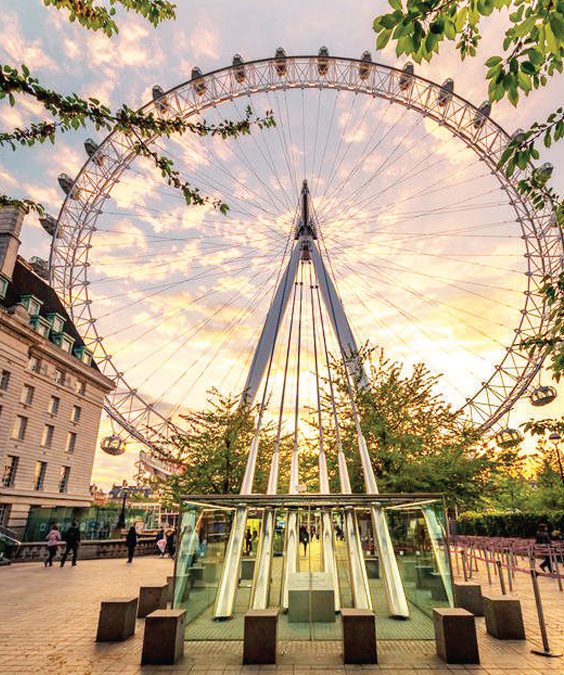
London Eye, formerly Millennium Wheel, is Europe’s tallest cantilevered revolving observation wheel, situated in London, on the
South Bank of the River Thames in the borough of Lambeth. The structure is United Kingdom’s most famous paid tourist attraction:
an admission fee is charged. The London Eye has been accredited with initiating a global resurgence of Ferris wheel construction.
Standing at an overall height of 443 feet (135 metres), the London Eye was the world’s tallest Ferris wheel from its construction in 1999,
until 2006, when it was surpassed by – the 160 metre Star of Nanchang, in Nanchang, China; by the 165 metre Singapore Flyer in 2008; and by
the Las Vegas’ 167 metre tall High Roller in 2014. The Eye is described by its operators as ‘the world’s tallest cantilevered observation wheel’,
as it is supported by an A-frame on one side only, unlike the taller Nanchang and Singapore wheels.
The project is depicted as an ‘engineering triumph’ and has done more to raise the profile of construction engineers with the general public at the beginning of this century, than the other initiatives by bodies representing engineering.
Design And Construction
The London Eye started off as an entry shared by David Marks and Julia Barfield of Marks Barfield Architects in 1993 to a contest, for a new landmark in London to honour the millennium. The project was largely funded by British Airways.
The construction of the observation wheel took more than a year and a half to complete. The construction began in 1998, and was ceremonially
‘opened’ by Prime Minister Tony Blair on December 31, 1999; the first paying passenger was however, admitted on March 9, 2000.
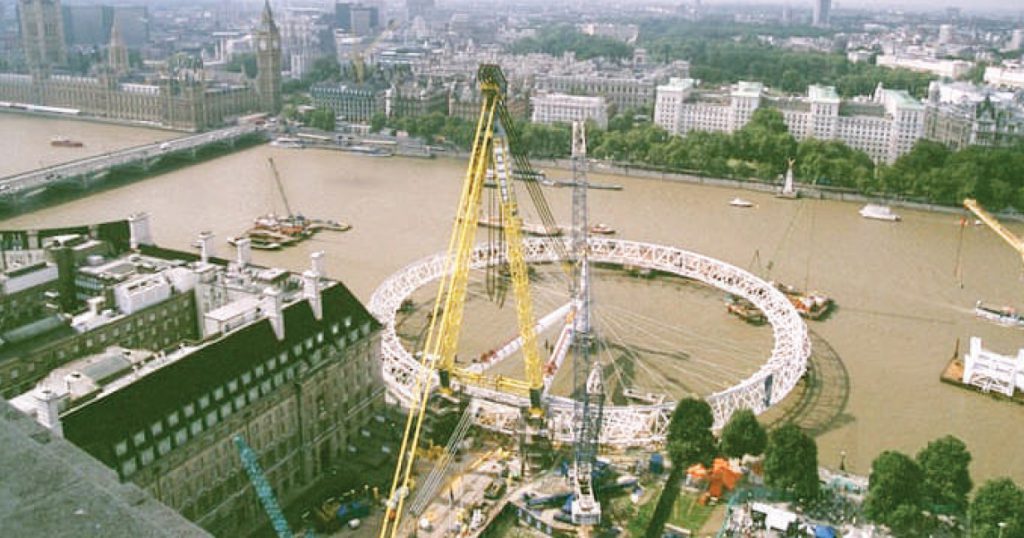
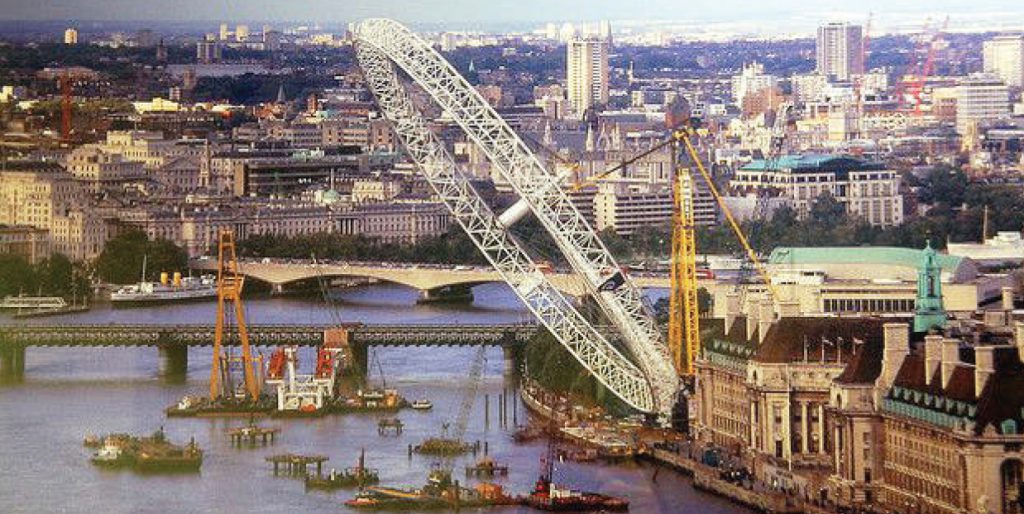
The main components were built offsite; post this, barges transported them one by one up the River Thames to the construction site on the South Bank. The workers assembled the structure horizontally on a temporary support platform over the river. The hydraulic lifts and cables then slowly raised the 1,322 ton structure over the course of one day, until it reached a 65° angle. Once it was in final position, the 32 capsules were attached to the rim, which took eight days.
The Eye, initially planned to be dismantled after five years, was kept in place owing to the persistent popularity. In 2006, an attractive LED lighting system was also put in to make the wheel more eminent after dark.
Structural Details
The London Eye is an outstanding example of a frame structure. The wheel has a diameter of 394 feet (120 metres) and resembles a bicycle wheel, with a spindle and hub linked to the rim by 64 cables, or spokes, which carry the main structural load from rim to hub. The rim, which has a diameter of 400 ft (122 metres), is an open triangularsection truss, fabricated from several steel tubes welded together.
The wheel is supported by the frame on one side only (cantilevered), and it is the frame that holds the wheel over the river. The 82 ft (25 metres) long spindle is a significant part of the structure. It acts as a single component cantilever carrying the wheel’s self weight (approximately 1,600 tonnes), with the worst storm wind loading (blowing in from the east); this wind nearly doubles the over-turning moment from self-weight. The spindle takes the form of a massive hollow tube of steel made in 8 separate ‘slices’ – 7 from cast steel and 1 from steel plate rolled into a tube.
The wheel’s steel design resembles an ‘A’, with two large pointed legs at the base: 65 feet (20 metres) apart and each over 190 feet (58 metres) long. These legs bend over the river at an angle of 65° (from the horizontal). Further, the six cable backstays anchored to the top of the frame and buried in a concrete foundation on the riverbank involving 40 piles, each 108 feet (33 metres) deep, maintain the frame from tilting into the river.
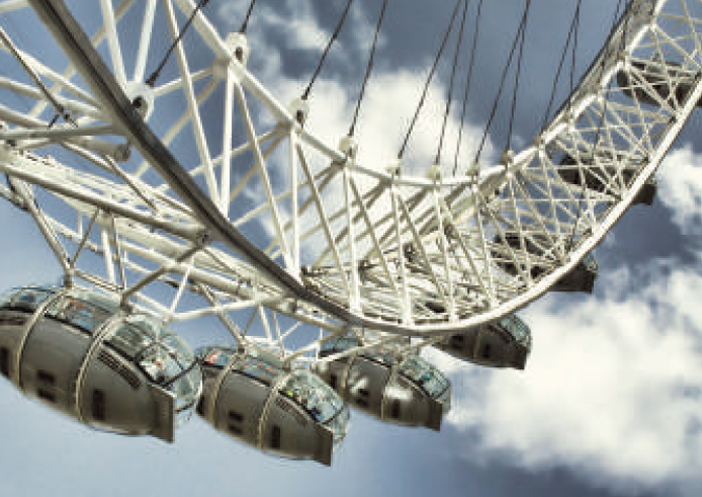
Erection of London Eye |
Spindle, Hub and Spoke Cables |
Rim and Capsules |
Inside View of the Capsule |
Hydraulic Motors
The Eye goes around the hub like the wheel of a motorized bicycle. The hydraulic motors, driven by electric pumps, give energy to rotate the wheel. The power to turn the wheel is transmitted to the rim through rubber tires that are mounted on the base of the structure along the rim of the wheel, which act as friction rollers. The drive systems are positioned in two towers, one at each end of the wheel’s boarding platform. Subsequently, the hydraulic motors turn the tires, and the rotation of the tires turns the wheel. In addition, 16 additional rotation cables are attached to the hub at an opposing angle to ensure there’s no lag between the turning of the rim and the turning of the hub.
Challenges
The wheel is very light, which makes it defenceless against wind excitation. To neutralize this and restrict any lateral movements that might cause sickness, the rim is installed with 64 mass dampers, which are set to the rim’s natural frequency.
Further, during design, thought was given to the consequences of the main bearing jamming, considering that the rim edge is being driven, and this might lead to a catastrophic damage. To assure against the likelihood, excluding the use of high quality bearings, an acoustical monitoring system has been set up to regularly test the bearing condition.
The technical challenges of the wheel also include, namely:
- cantilevers out over the River Thames, i.e., the spindle is supported at one side only, and
- the capsules are supported on rings outside the rim, and passengers are free to move around in the capsule, so an active floor levelling system is required.
Capsule Structure
As part of the paid service for the London Eye, the visitors enter a capsule (8 metres long and weighing 500 kg) on the turning wheel, which ultimately provides a panoramic view of the city from a height of about 415 m. The futuristic looking egg-shaped capsules accommodate up to 25 passengers, and take about 30 minutes for each rotation. These capsules were transported from France by train through the Chunnel.
Though there is a lightweight steel frame forming an underbelly chassis and a basic framework for the exterior skin, the panels of the coated double curvature glass (2 x 6 mm sheets with a 1.2 mm interlayer) provide in-plane stiffness to limit deflections and increase rigidity. The glass panels are prefabricated to a high degree of optical quality and secured to the steel frame with a cured polysulphide based adhesive. Further, the full size panels were load tested in advance, both for impact and ensuring they had the capacity to carry the load from the passenger weight.
Changing The London Skyline
A noteworthy accomplishment of design and engineering, the London Eye offered London’s skyline a spectacular addition and has been providing the guests a new perception of London ever since. Originally intended as a temporary structure that would be dismantled and transported to a new location, had planning permission for just five years. But, with millions visiting it each year, its popularity encouraged its lease to be extended. Today, it is a permanent fixture on the London skyline and a beautiful icon of modern London.
References
- en.wikiarquitectura.com/building/london-eye/
- www.britannica.com/place/London-Eye
- www.londoneye.com
by cecr | May 21, 2020 | Engineering Marvels
A Hydraulic Wonder
The Rolling Bridge is a kind of curling moveable bridge, completed in 2004 by Heatherwick Studio, which was commissioned in 2002, to design a pedestrian bridge to span an inlet as part of the Grand Union Canal office and redevelopment of Paddington Basin, London. The new bridge would offer an access route for workers and residents across a narrow inlet of the main canal, while also letting the boats pass when required.
Construction And Design
The property development company Chelsfield invited the Heatherwick studio to design one of three bridges, as part of redevelopment process. The studio, founded by acclaimed English designer Thomas Heatherwick, could have selected a more traditional option, such as a swing bridge, a lifting bridge, or a rigid retractable bridge. But, Heatherwick had the vision “of a steel pedestrian bridge rising up over a canal inlet and curling into a ball on one side to allow passing water traffic through.” Today, this structure is the only bridge of its kind in the world.
The idea of the design is inspired by the dinosaur Apatosaurus from the movie Jurassic Park, and how the animators replicate the animal’s flesh and copy the natural movement and flexibility with steel mechanisms covered in silicon rubber.
The Rolling Bridge, designed to open in 180 seconds, employs a curling action to move forward and backward across the distance of the canal. The extension and retraction is describable as a magnificent organic motion, similar to a leaf unfurling, or a caterpillar curling up, or the fingers of a human’s hand closing to form a fist. Moreover, the bridge closes in near silence, which adds to its elegance, and can also be stopped at any point through its extension or retraction. Once fully retracted, it looks like a sculpture rather than a bridge, and like an old water wheel.
Extensively modelled in CAD and exported to Robot analysis software, bridge models were employed for the stagnant examination and authentication of the geometry. Also, using animation tools, a virtual working model was created to validate the motion and permit component measurements in any arrangement.
The structure wasn’t constructed on-site; it was built at Littlehampton Welding on the Sussex coast and then, floated through the Grand Union canal, before being raised into place at Paddington and attached to the hydraulic system which powers its movement. Besides, to develop the final design as planned, the studio closely worked with the fabricator.
The bridge was originally planned to unfold across the canal every Wednesday and Friday at midday, and every Saturday at 2 p.m. Now, however, its operation is limited to Fridays at noon.
Structural Details
The Rolling Bridge is about 39 feet (11.8 metres) long and spans an 8.5 metre canal inlet; however, its inventive design makes up for its miniature stature. The structure comprises eight timber-and-steel triangular sections hinged at the pavement level and linked above by two-part links that can be collapsed to the deck by hydraulic cylinders arranged vertically between the sections. When extended, it resembles a regular steel and timber footbridge.
The Rolling Bridge Under-Construction
Each bridge segment is made-up in three sections, two welded side frames and the deck. It was initially planned that the segments would be fully welded frames, but to achieve the required machining tolerances, a bolted connection was introduced between the side frame and deck.
Interestingly, the structure is attached to only one bank; the remaining seven bays, powered by hydraulic rams, push the handrails upwards to allow the passage of boats. The movement activates the hydraulic pistons and set into the bridge’s balustrade, causing the triangular sections to raise and draw near. As the bridge opens the handrail pushes through the horizontal, this initial movement momentarily extends the top boom causing the bridge to arch. As this happens, the bridge curls up as it moves towards the bank. The two ends eventually meet, creating an octagonal shape measuring one half of the waterway’s width at that point, and then rolling it back to form an enclosed ball.
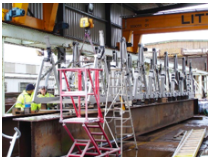
Construction at Littlehampton Welding
In its unrolled ‘bridge’ state, the handrails function as the top boom of a simple truss. They are pulled below the horizontal to lock the bridge in position, which guarantees that a small component of the compression load is directed downwards ensuring the stability of the bridge under load. The handrail is afforded lateral restraint by the U frame nature of each segment. To relieve the large forces that would otherwise be generated by the movement of the handrails, the ‘fixed’ segment of the bridge is mounted on a rocker permitting the essential rotation.
The movement of the handrail is followed by the upward movement and the structure transforms from a simply supported truss to a cantilevered truss with the obvious load reversal between top and bottom booms. During this time, the hydraulic rams act as an integral structural component with several segments again witnessing load reversal as the bridge rolls over centre.
Triangular Sections
In the enclosed ball condition, stops mounted at the top of each hydraulic cylinder bear the static load of the bridge. The hydraulic team achieved the delicate control of the bridge through pure hydraulics. A hydraulic pump drives a master cylinder, which is mechanically linked to 14 slave cylinders. In turn, the slave cylinders drive the bridge cylinders. Ensuring all the cylinders are driven at a constant rate is significant for the operation of the bridge.
Polytetrafluoroethylene (PTFE) infuse dry bearings were used for dimensional stability, longevity and a maintenance free operation. The bearings and (Duplex) stainless steel pins were fitted to a tolerance +/-0.016 mm, with a tolerance between pin centres of just +/-0.15 mm.
It Resembles a Regular Steel and Timber Footbridge
Challenges
In addition to the usual bending, shear, deflection and dynamics checks common to all structures, the unusual nature of the bridge directed various interesting and esoteric engineering challenges as the design had to compete with the ever-changing geometry and load conditions related to the movement.
- The project required precision bearings and pins with challenging fabrication tolerances.
- Fabricated with grade S355 hollow section steel tubes, the structural frame has a hardwood timber deck to both faces of the base.
- The void within the deck is used to route the hydraulic feed and return hoses to power the rams.
- The fabrication proved equally challenging, as to achieve the geometry in bridge configuration, and more especially in its closed form, required fabrication tolerances were normally found only in the domain of mechanical engineering.
- When closed, the handrail components converge in the centre of the bridge with a little less than 10 mm clearance between them.
Attached to One Bank
“Rolling” As A Name
Despite the implication of its name, the “Rolling” bridge is more accurately described as “curling”. While its designer refers to this particular structure as “The Rolling Bridge” on his website, this should perhaps be considered as the name for this particular bridge rather than a term to refer to its type, which could be more correctly described as a “curling bridge.” At present, this curling bridge is the only one of its type known to be in existence.
Awards
The Rolling Bridge won a number of awards, including an Emerging Architecture Award, and a Structural Steel Award, with the judges noting that the bridge was a “joyful addition to the [Paddington Basin] development area that has all the appearance of a Leonardo sketch when in the ‘rolled’ position.”
References
- 1. heatherwick.com/project/rolling-bridge/
- en.wikipedia.org/wiki/The Rolling Bridge
- www.visitbritain.com