by Sawon Banerjee | Jan 15, 2021 | International News
Bouygues Construction’s subsidiary VSL International has launched the first phase construction of North-South Commuter Railway (NSCR) in the Philippines.
The rail project was awarded by Taisei Corporation and the D.M. Consunji, Inc (DMCI) group.
The contract, worth €100m, will also cover the precast and installation of the bridge segments.
The North-South Commuter Railway is a new 148 km-long transit line, which will link New Clark City, in Tarlac province, to Calamba City in Laguna province.
The scope of the contract will include the construction of the 16 km-long elevated viaduct, which forms part of an important transport infrastructure project.
With offices in 30 nations, VSL contributes to the construction, maintenance and repair of major technical structures.
by Sawon Banerjee | Jan 15, 2021 | Uncategorized
A consortium led by Vinci Construction has secured a contract worth €388m from the Gambia River Basin Development Organisation to construct the Sambangalou dam in Senegal.
The consortium includes Vinci Construction’s subsidiaries VINCI Construction Grands Projects and VINCI Construction Terrassement, and the other partner is an Austrian turbine manufacturer Andritz.
The new 91 m-high dam will be constructed in the south-east of Senegal, close to the Guinean border.
It will have a generating capacity of 128 MW and will improve farmland irrigation and supplying drinking water for the surrounding districts.
Upon completion of the project, the drinking water treatment facility, which is set up for the project, will remain in operation and the worksite buildings will be donated to schools.
by Sawon Banerjee | Jan 15, 2021 | Construction Chemicals And Materials
| |
Premankur Bhattacharya
Technical Head,
ANN WORLD |
SYLOCON® has made a specification to keep your top floor cool. Many insulating materials in modern technology and SYLOCON have made the most effective insulation, which is natural and building-friendly. The methodology is made following the LAW OF THERMODYNAMICS.
We are aware of the importance of insulation since the prehistoric period. Then, animal skin was used as a thermal insulating material. Fur and plant materials like flax, reed soil, and straw minimize the heat ingression as they can hold a large amount of air between molecules that create an air cavity to reduce heat exchange. But in the later stages, people realized that the organic material could not exist for a longer period. Since that time, people have started hunting for alternative durable components for more effective thermal insulation. At the beginning of the 19th century, people noticed the disadvantage of natural materials due to their degradation. Since then, people’s attention was towards artificial components for durable thermal insulation like rock wool, fibreglass, foam glass, and hollow bricks.
The Importance Of Thermal Insulation
Thermal insulation is an essential factor in buildings. Sufficient thermal insulation is a fundamental task that ensures a healthy indoor environment and protects against structural damages. It is also a reason for dealing with high energy consumption. Good insulation can reduce the heat flow through the building envelope. Good thermal insulation can also bring the following benefits to the building:
- That prevents building damage due to the moisture formation on the inside of the building envelope. Good thermal insulation never allows temperature to fall inside the room surface below a critical level. Hence, condensation and mould formation is avoided.
- Good thermal insulation offers a comfortable and healthy living.
- Insulation reduces unwanted heating or cooling energy input and reduces the heat exchange through the building envelope,
Solar radiation is a vital source in making the buildings hot in summer and cool in winter. It is noticed that 80 per cent of the heat comes from the rooftop through the R.C.C. slab. Due to the heat flow from top, the air temperature inside the room is raised.
Air gaps have a thermal resistance to heat flow. This is denoted by R. R-value, in terms of insulation, refers to the thermal resistance of a different type of materials. The higher R-value shows better insulation. It depends on the type of material, thickness, and density. The above technical properties have helped to fix a specification of best insulation with SYLOCON®.
A Modified Traditional Specification Of Thermal Insulation Of Roof Using Sylocon®.
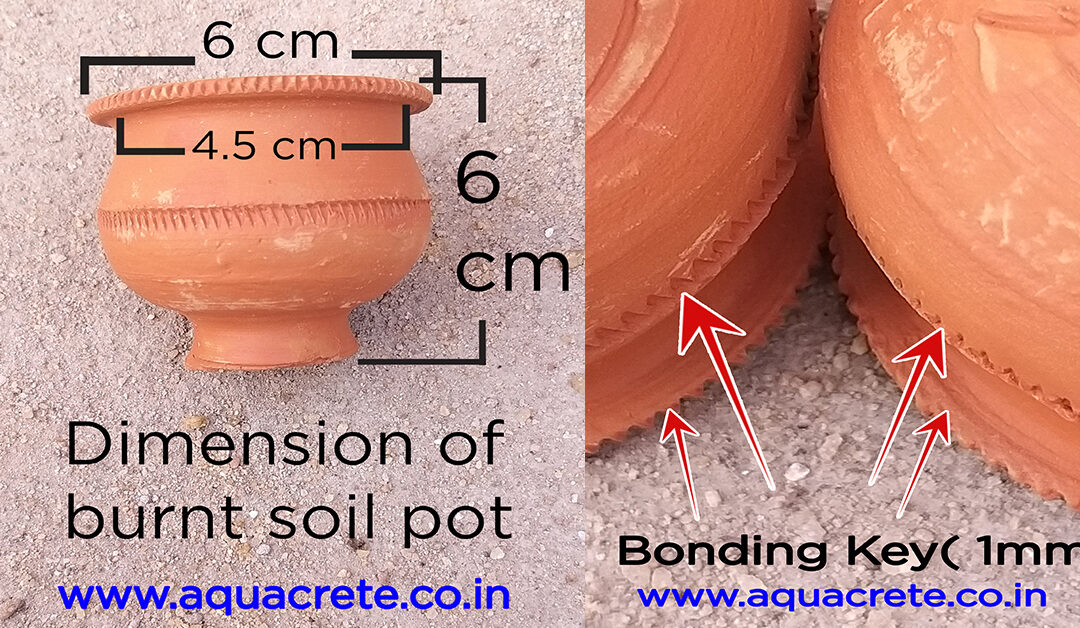
- Hollow burnt clay pot is selected for thermal insulation. The clay was chosen because of its low conductivity of heat and porosity. It is very cheap and abundantly available. The outer surface of the pot is designed in a pattern of the key to grip the next pot.
- Weight- 70 g. Inside diameter- 4.5 cm. Outside diameter- 6 cm. Height- 6 cm.
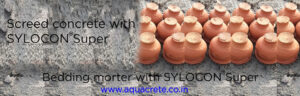
- The open mouth of pots are placed on a 6 mm cement sand mortar bed (1:4) on roof slab. The mortar is prepared with SYLOCON® SUPER @ 1 litre per
50 kg cement
|
|
4. After placing the inverted earthen pots, laying and filling the gaps between pots with 1:2:4 concrete using SYLOCON® SUPER @ 1 litre per 50 kg cement.
5. Screed concrete should be laid in slope for easy draining out of stormwater.
6. Stand pool water curing is mandatory.
The above specification provides excellent thermal insulation and waterproofing for the long term. You can fix broken tiles on top of the screed.
Please refer to the following images for better understanding. You can contact www.aquacrete.co.in. You will get more information regarding the availability of soil pots and SYLOCON® SUPER.
This is an excellent thermal insulation and waterproofing system, which is durable and building-friendly.
SYLOCON® SUPER is the perfect choice to make screed concrete waterproof, and it makes concrete shrinkage crack free. Mostly in screed concrete on top of the roof is cracked due to the thermal expansion and contraction. The underneath polymer waterproof coating is decayed due to the bacterial attack. Any synthetic insulating material has no bonding property with concrete. That is why the screed concrete is cracked. Once the screed concrete is cracked, water accumulation starts inside the screed concrete. The heating and cooling cycle of the atmosphere causes the crack propagation in screed concrete. Once the crack is developed, water leakage is the most common problem. So, roof treatment is a very sensitive part of building construction. The heat generated due to solar radiation causes different problems in buildings. Crack is one of the major problem, which is very difficult to rectify. Any solution like crack sealants lasts for certain period. Water leakage starts in monsoon through the developed cracks. So, thermal insulation and proper waterproofing of roof is of high importance after all the building construction activity is over.
SYLOCON® SUPER can eliminate both the problems. Nano fibres and nano tubes in the composite does not allow any shrinkage crack on the surface. This is inorganic, so compatible with concrete.
When the soil pots come in contact with SYLOCON® SUPER added mortar, nano tubes of SYLOCON® SUPER impregnates through the soil wall and make it waterproof, enhancing the bond strength between pots. This also provides the non-shrink property between the mortar and soil pot. This is the most effective and durable method of roof treatment. Thermal conductivity indicates how easily heat will flow through a material, whether it is a brick or a layer of insulation. This measurement doesn’t relate to the thickness of the material; the number is the same, whatever the thickness. The thermal conductivity of the material is used to calculate R values. The inverted soil pot is an air-filled porous hollow space. Thermal conductivity is very low, less than 0.0333 –k- W/ (m k), Btu/ (ft. h F).
…To be continued in Part XIV
by Sawon Banerjee | Jan 15, 2021 | Construction Chemicals And Materials
Bentley Integrates iTwins with Azure Digital Twins for Single Pane of Glass IoT Application
The concept of digital twins is finding new application in the way that we interact with our critical infrastructure like roads and highways, improving reliability and safety, increasing the movement of people and goods, and creating better value for every dollar spent.
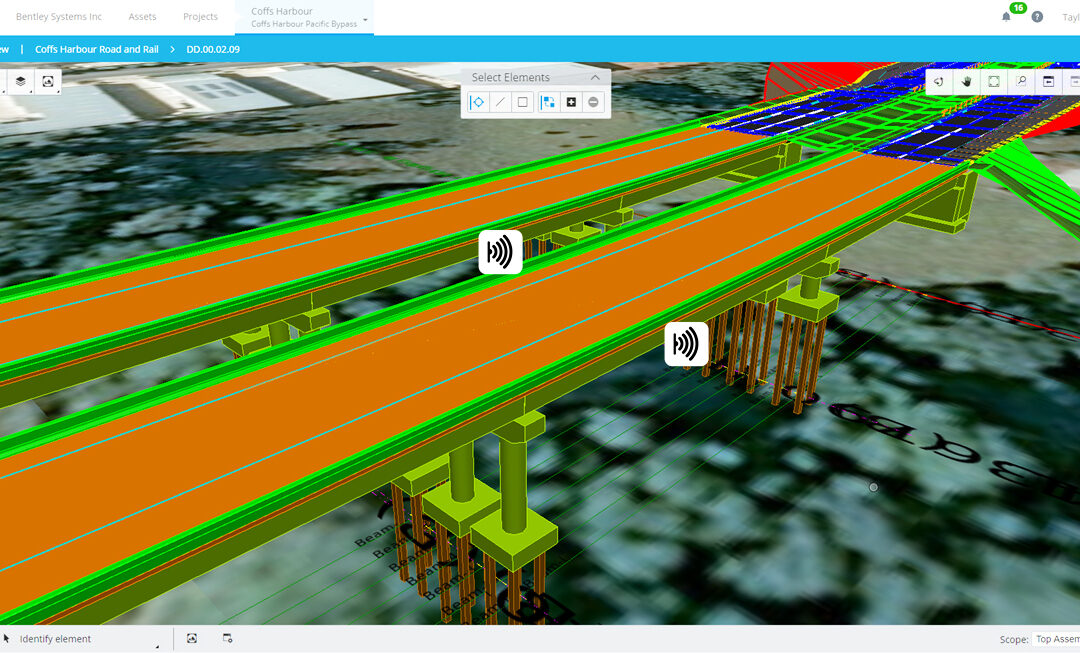
For the Microsoft Build 2020 developer conference, a team from Bentley Systems and Microsoft explained to software engineers and web developers how to federate civil engineering data with Internet of Things (IoT) data to create a “connected highway.” By integrating Bentley’s iTwin Platform and Microsoft’s Azure Digital Twins, the team was able to combine real-time data from air quality and traffic monitoring devices with civil engineering models, maps, and terrain data to create a living digital twin. This helped in real-time monitoring of critical infrastructure for safety hazards and traffic incidents.
From 0 To 60 In Less Than Three Weeks
The Bentley-Microsoft team initiated the project with a virtual one-week hackathon that wired up Azure Digital Twins with Bentley’s iTwin Viewer and iModel.js open-source programming libraries. Next, they federated a model of a section of highway with a reality mesh of the surrounding terrain that had been created from photographs captured by a drone survey. They then connected the IoT data layer to give access to real-time and historic data and analytics. The result: in less than three weeks, the team had a geometrically accurate, visually intuitive and immersive web application accessible from anywhere 24/7 that gives instant access to live highway conditions and sets off alarms when thresholds are exceeded.
Pavan Emani, Vice President, iTwin software development for Bentley Systems, said, “iTwin Platform is a developer platform-as-a-service that has a lot of synergies with Azure Digital Twins and complementary capabilities. Users visualize IoT data in our digital twin viewer and generate insights in Power BI dashboards and Teams. Microsoft’s cloud-first philosophy aligns with ours, and our platforms enable developers to create and deploy digital twin applications in record time. For our integration with Azure Digital Twins and Azure IoT Hub, we went from zero to 60 in three weeks
Under The Hood
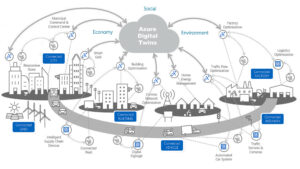
Bentley’s expertise is in aggregation, alignment, and 3D visualization of complex engineering data and the tracking of change. The front-end of the “connected highway” digital twin run in a standard web browser and relies on Bentley’s iTwin Viewer for 3D visualization. The back-end cloud services run in Azure and bridge data from multiple data sources. The back-end ingests and normalizes data from 2D computer-aided design (CAD) files, 3D building information models (BIM), and geographical information systems (GIS). Projects typically start with the model of their physical environment and then federate data from IoT devices to the model. Azure Digital Twins abstracts the IoT layer and provides APIs, making it easy for developers to integrate live data.
A significant benefit of the iTwin-Azure Digital Twin integration is the simplification and time saved by automatically generating from the iTwin the digital twin definition language (DTDL). This language is required to create the spatial intelligence graph in Azure Digital Twins.
Sam George, Corporate Vice President, Azure IoT for Microsoft, said, “Bentley makes it easy to build digital twin-based applications for critical infrastructure, smart grid, smart cities, construction, roads, and automotive. Bentley’s iTwin Platform, open APIs, and open-source programming libraries run on Azure and integrate seamlessly with Azure Digital Twins and Azure IoT Hub. Bentley’s iTwin Platform handles complex engineering data, supports 3D visualizations, and can revolutionize the way these projects are planned, built, and operated.”
|
|
Connected Highway – iTwin Showing Bridge Vibration
and Deflection Sensors |
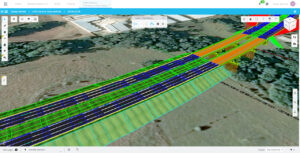
Connected Highway – Digital Twin Built with Bentley’s iTwin Platform
and Azure Digital Twins |
Are You Twinning?
The complexity (and associated engineering density) of transportation, utility, and industrial assets makes them ideal for digital twins. A 3D (or, better yet, 4D) model is a game-changer for a highway, an underground metro system, or an industrial plant. More importantly, during design and construction and throughout the asset’s operating life, the 3D model changes over time. Logging that change on the asset’s timeline is vital to understand who-changed-what-and-when. Digital twins provide a foundation for predictive and prescriptive analytics, enabling users to respond quickly to incidents with confidence and even anticipate them and head them off before they arise.
Digital twins have the potential for many use cases, and no single vendor can address all those use cases or foresee how those use cases will evolve over the next five years. So, developers need to design their applications with flexibility in mind. In software terms, that means open.
Pavan Emani, Vice President, iTwin software development for Bentley Systems, said, “What differentiates Bentley is its open approach. Open data and open-source mean that users retain control and flexibility. We like to say that the greater the engineering density, the greater value we add. But often, there is a great value from simply visualizing engineering data in context. Bringing layers of data together into a single pane of glass, or a single view of truth provides an intuitive way for many people to understand and interact with very complex information.”
Combining ET, IT And OT
Bentley Systems is a leading global provider of software solutions to engineers, architects, geospatial professionals, constructors, and owner-operators to design, construct, and operate infrastructure.
Solution Architecture of iTwin – Azure Digital Twins Integration
Bentley has a strategic partnership with Microsoft. Monthly active users of Bentley’s cloud-provisioned applications, including digital twins, made Bentley one of the top 25 consumers of Azure in 2019. In both 2018 and 2019, Microsoft named Bentley as Partner of the Year in its CityNext category
Jerry King, Vice President, Strategic Channel for Bentley Systems, said, “Many of Bentley’s users choose Azure as the cloud platform to manage their data. There is a significant overlap in our user base, so it made sense for us to integrate iTwin and Azure Digital Twins and capture synergies. Our goal is to be the infrastructure digital twin platform company. That means combining engineering technologies (ET) with information technologies (IT) and operational technologies (OT) – think of combining CAD, BIM and GIS data with ERP, EAM data and IoT data to form a digital twin. We surface that IoT data using Azure Digital Twins and Azure IoT Hub.”
Editor’s Notes
Bentley’s iTwin Platform is a platform-as-a-service (PaaS) that comprises cloud microservices for managing infrastructure data. It includes cloud microservices for project delivery and asset operations workflows, reality data management, and components catalogues.
An iTwin is an infrastructure digital twin, enabled by technologies from Bentley. An iTwin incorporates different types of data repositories – including drawings, specifications, documents, analytical models, photos, reality meshes, IoT feeds, enterprise resource and enterprise asset management data – into a living, evergreen digital twin.
iTwin Services are a set of cloud services running in Azure that enable engineering teams and owner-operators to create, visualize, and analyze digital twins of infrastructure assets. iTwin Services enable digital information managers and BIM managers to incorporate engineering data created by diverse design tools into a living digital twin, align it with reality modeling and other associated data, visualize the asset, check status, perform analysis, and generate insights to predict and optimize asset performance.
Azure Digital Twins is a platform-as-a-service (PaaS) targeted at in-house and commercial software development organizations that want to accelerate and simplify the creation of digital twin solutions that require IoT spatial intelligence. Azure Digital Twins enables developers to create models of physical environments, such as office buildings and factories, and the interactions of people, spaces, and devices.
Azure IoT Hub provides a cloud-hosted solution back-end to connect virtually any device. It enables developers to use device-to-cloud telemetry data to understand devices’ state and define message routes to Azure services.
For further information,
visit: www.bentley.com/en
by Sawon Banerjee | Jan 15, 2021 | Construction Chemicals And Materials
|
Hasan Rizvi
Sr. Vice President,
STP Ltd
|
Since thousands of years, various kinds of adhesives and sealants have been in use. Early hunters may have seen improvement in their aim by bonding feathers to arrows with beeswax, a primitive adhesive form. The Tower of Babel was probably built with mortar and tar or pitch as a sealant. Carvings in Thebes (circa 1300 BC) show a glue pot and brush to bond the veneer to a plank of sycamore. Until recently, most adhesives and sealants evolved from vegetable, animal, or mineral substances. In the early 1900s, synthetic polymeric adhesives began displacing many of these naturally occurring products due to stronger adhesion, greater formulation possibilities, and superior resistance to operating environments.
Presently, there are various types of sealants available in the market: polysulphide sealants, polyurethane sealants, silicone sealants, coal tar and bituminous sealants, and many more. STP Ltd, a subsidiary of the Berger Group, is a company known for developing innovative products. It is among the largest manufacturer of sealants in India.
Movement Accommodation Factor (MAF)
Most of the sealant manufacturers assign a movement accommodation factor (MAF) to each of their products to provide a value for calculating joint dimensions. But so far, there is no universal definition for this factor.
The movement accommodation factor means the total movement range between the maximum compression and the maximum extension that a sealant can accommodate. It is expressed as a % of the minimum design joint width.
Application- Sealing Of The Joints
- Examination of the Joints: The contractor should examine all joints’ joint size and condition and report all technical/practical difficulties that are not acceptable to the main contractors. The joints shall not be wet.
- Cleaning of Joints Faces: The joint faces should be cleaned by wire brush and dust to be removed thoroughly. If there is oil, then it has to be cleaned with xylene or toluene.
- Installation of Back-Up Material and Bond Breaker: The back-up material and bond breaker shall be placed in the joints to allow the placement of the sealant to the desired depth, the surface of which should be recessed by not less than 3 mm below the pavement surface.
- Priming: Apply primer in two coats as recommended by the manufacturers. Avoid brushing on the bond breaker tape. Allow the primer to dry as per the specification.
- Apply the masking tape on the edges of both the joint faces. Tape shall be removed immediately after the tooling.
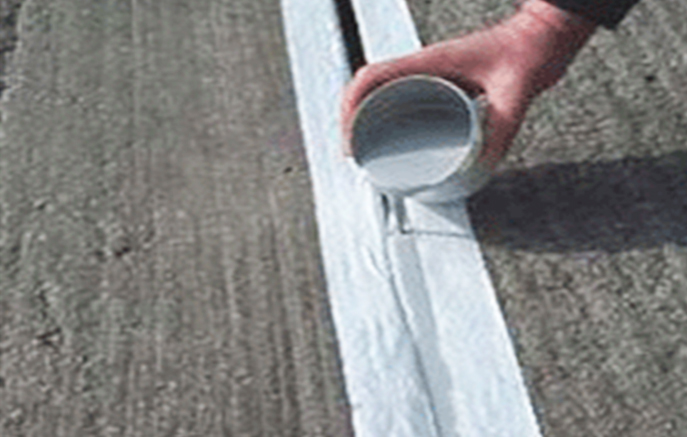
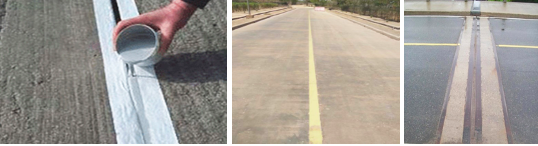
- Sealant Pouring: Fill the sealant in the ready joint by hand or machine. Use a spatula for filling into joints. Fill some extra material and then do the tooling with a knife blade and pull down the sealant surface level. After tooling, remove the masking tape. The material will self-level.
- Curing of Sealant: Allow the sealant to cure as per the manufacturer’s recommended specification before starting any other operation.
- Cleaning of Tools: Clean the tools and equipment immediately after applying solvents such as xylene or toluene.
Major Sealants Available In The Indian Market
Two-component, polysulphide polymer-based sealants like ShaliSeal® PS PG UV resistant, flexible, tear-resistant, rubbery, self-levelling, pourable, non-staining sealant, which adheres to most of building materials like cementitious substrates, aluminum, glass, wood, mild steel, etc. ShaliSeal® PS PG cures at ambient temperature have excellent recovery characteristics after extended period of compression/elongation with outstanding resistance to most chemicals, weather conditions, aging and shrinkage, and other sealants ShaliSeal® PS PG 30 having Movement Accommodation Factor (MAF) of 30%, for butt joints.
Two-component Polyurethane sealant like ShaliSeal® PU 2K PG is a modified PU, which cures to form a durable, flexible, watertight bond with most building materials and can accommodate dynamic joint movement.
Method Of Application Of Sealants
Ensure that all joints are completely dry and free from all traces of dirt, dust and grease. Clean the surface thoroughly by wire brushing, either hand or machine operated.
Ensure dried and cleaned bonding surface in all joints to be sealed. Preferably, all joints should be parallel and straight for better sealing. Repair spalled joint with ShaliFix EM.
Ensure the depth does not exceed the width; use back-up material to avoid third face adhesion and to avoid contact between forming board and sealant.
Use the primer on the joint’s vertical side faces by ShaliPrime S to ensure strong bonding between substrate and sealant by using a clean, dried brush.
Providing & Pouring ShaliSeal® PU 2K PG (modified two-component polyurethane sealant) into Joint.
Government focus to speed up infrastructure like power, ports, roads, freight corridors, industrial hubs, etc. is the driver for the sealant and adhesive, as well as the construction chemical industry. Due to COVID-19, it will still take some time for the market to pick up. The way India does business will change. The interactions are getting virtual. Apart from this, a strong network of authorized applicators has been trained by the company. To execute the jobs and provide after-sales service, supported by the company team of Engineers and technical operators would be the emerging trends.
For further information,
visit: www.stpltd.com







 Pavan Emani, Vice President, iTwin software development for Bentley Systems, said, “iTwin Platform is a developer platform-as-a-service that has a lot of synergies with Azure Digital Twins and complementary capabilities. Users visualize IoT data in our digital twin viewer and generate insights in Power BI dashboards and Teams. Microsoft’s cloud-first philosophy aligns with ours, and our platforms enable developers to create and deploy digital twin applications in record time. For our integration with Azure Digital Twins and Azure IoT Hub, we went from zero to 60 in three weeks
 Solution