by cecr | Apr 7, 2021 | Construction Chemicals And Materials
More Than 15 Years Of Successful Result In Producing Durable Concrete Lining
|
Premankur Bhattacharya
Technical Head,
ANN WORLD
www.aquacrete.co.in
|
History Of Sprayed Concrete
Dr Akeley wanted to make an equipment which can spray mortar mixture on concrete surface to make parent concrete durable. He made a special chamber working as a pressure vessel which can spray the mortar mixture on the R.C.C. wall surface. The seed concept of today’s sprayed concrete was born more than one hundred years and was known as “CEMENT GUN”. This unique method became popular within a short period that was patented in 1911, which was owned by Cement Gun Company.
Based on this concept different technical modification enriched the system and worked better than the past.
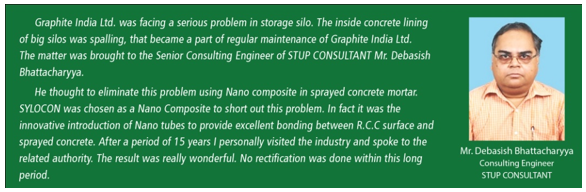
In this case study we will focus on an innovative idea of sprayed concrete in Graphite Storage Silo, which could prove its outstanding durability for a longer period. The technical analysis will be presented accordingly.
How SYLOCON worked to enhance durability of the lining?
In ancient time it was believed that a complex material containing clay with nanopores into which indigo dye was combined chemically to create an environmentally stable pigment. Based on this concept a corrosion resistant azure pigment was produced, known as Maya Blue in AD 800. It was discovered in the pre-Columbian Mayan city of Chichen Itza.
Today’s Nano technology can meet several requirements in different industry. Nano tubes in SYLOCON® has opened a new window to solve the major problems of debonding between sprayed mortar and parent R.C.C. structure in tunnel lining. SYLOCON® is a complex of different Nano tubes. The bonding of Carbon nanotubes are due to the carbon atoms linked in hexagonal shapes, with each carbon atom covalently bonded to three other carbon atoms. The tensile strength of carbon nanotubes is approximately 100 times greater than that of steel of the same diameter. There are two things that account for this strength. The first is the strength provided by the interlocking carbon-to-carbon covalent bonds. After mixing of SYLOCON in concrete the Nanotubes are widely distributed in the cement mortar.Moreover Carbon Nanotubes have capacity to hold maximum weight. It has a low density for a solid of 1.3 to 1.4 g/cm3, its specific strength of up to 48,000 kN·m·kg−1 is the best of known materials, compared to high-carbon steel›s 154 kN·m·kg−1.Its reaction with cement is more intense than that of the larger fibers. Nanotubes in SYLOCON possess a high modulus of elasticity, tensile strength, and yield strain. Those characteristics make SYLOCON an effective reinforcing material for cement mortar that makes concrete durable. The basic technology of SYLOCON is presented here to understand the dispersion and bond linkage of Nano tubes in SYLOCON.
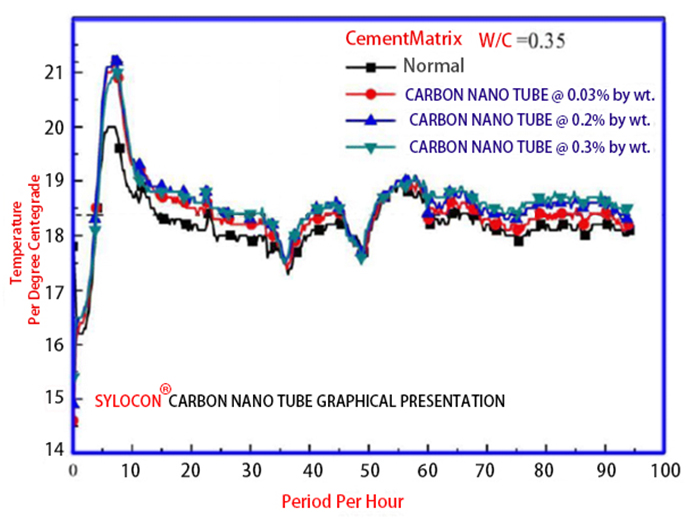
Similarly the ductility, flexural strength and permeability of concrete is of great importance in view of durability. The change in volume of concrete has also a great impact on durability and other utilities of concrete. This is termed as autogenous shrinkage. Different cracks are observed in concrete leads to rejection in quality due to the autogenous shrinkage. SYLOCON contains the nano particles to overcome this problem. The following graphical presentation shows the result by SYLOCON’S control mechanism to reduce this adverse effect of concrete. Different quantity of nano tubes are used to examine the autogenous shrinkage behaviour of concrete. Temperature of concrete due to heat of hydration is recorded with time. This tool helps to design most effective formulation of SYLOCON. SYLOCON containsCarbon nanotubes which are seamless, carbon cylinders which have unique mechanical and electronic properties. The length is varied with single wall or more than one wall. Young’s modulus of those are five times and eight times (theoretically 100 times) the strength of steel, with 1/6th the density. The major advantages are mechanical durability as well as prevention of cracks in concrete. This is well established 15 years back that SYLOCON can produce an impermeable, crack free and durable concrete. Use of SYLOCON in Graphite India Limited storage silo is one of the authentic examples to know its effect. So, this is clearly understood that SYLOCON is the perfect additive for sprayed concrete in tunnel lining.
Detailed morphology of SYLOCON and cement compound strand was studied using TEM. it was verified from this test that there was a physical bonding between cement matrix and CNT. The diameter of the cement compound strand was almost the same as that of CNT.
Water and soluble contaminants penetrate through the pores of the structure and causes gradual degradation of the concrete.
The degradation appears in the form of efflorescence, laitance, spalling concrete and cracks. These facilitate active ingression of water with various ion contaminants transported from higher concentration to lower concentration within the inner pores of the concrete. This ingression can be avoided blocking the pores of concrete. SYLOCON® produces the crystal on hydration reacting with un-hydrated free calcium oxide present in the cement, which blocks the pores and makes concrete stronger, impermeable and durable.
Reaction And Its Result
Four phase cement reaction-
- Cement before hydration.
- Surface products like C-S-H grows outward with connected gel pores.
- Pore products as calcium hydroxide is polycrystalline and fully dense with no connected pores.
- Capillary pores- the water filled space between the solid phases.
As soon as water is added to cement, rapid heat evolution takes place. Within few minutes, this is decreased and remains constant in plastic stage up to 3-5 hours until the concentration of the ions in the solutions before starting the precipitation of products of hydration.
When the maximum heat is evolved, CH crystallizes from the solution and a slow coating process of C-S-H product is started, which covers unreacted C3S grains. As the hydration goes on, this coating becomes thicker and does not allow water to contact the un- hydrated core particles.
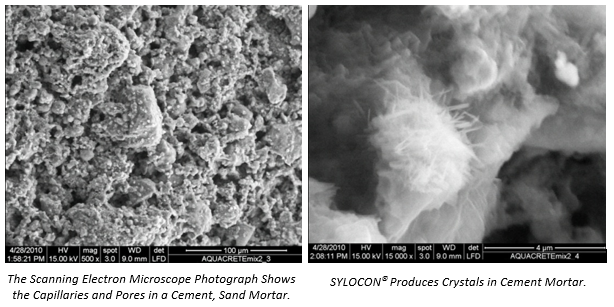
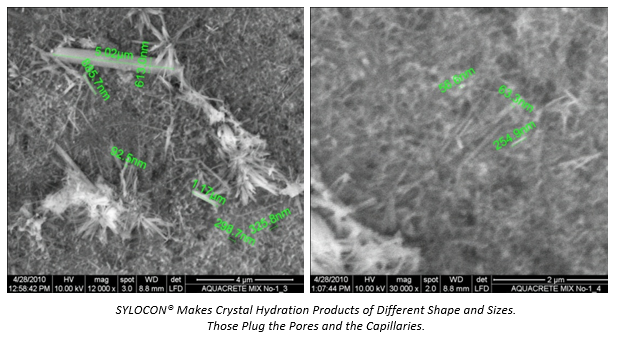
Nano particles of SYLOCON® contacts all the particles of cementing material and produce the crystal products under controlled hydration, which fill up pores and capillary pores The capillary pores are known to be responsible for the impermeability of concrete. The size and number of pores are greatly reduced. As a result, the strength of concrete is also increased.
Scanning electron microscope shows the pores in concrete, development of different sizes of crystal in cement mortar after hydration. Nano particles are observed in the scanned photograph.
Scanning Electron Microscopic Views Of The Mortar With And Without SYLOCON®
The sample is prepared without any additive.
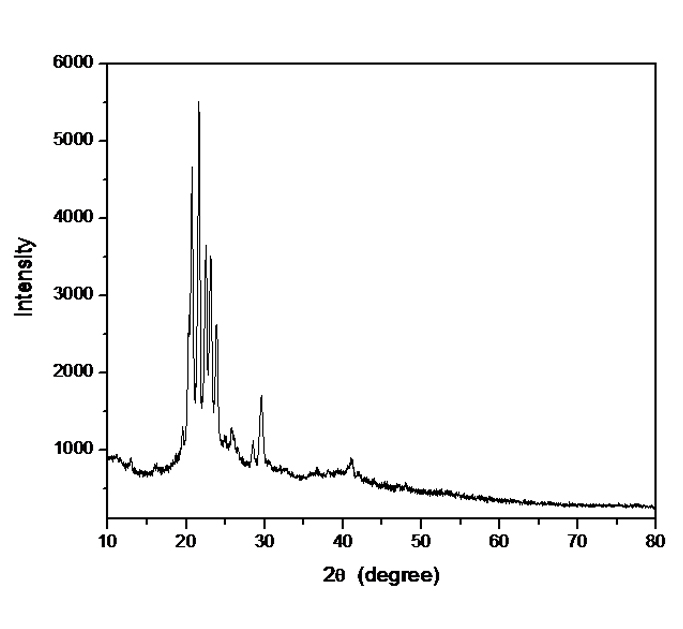
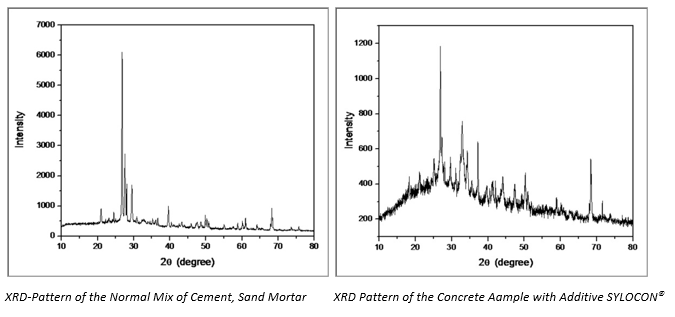
X-ray Diffraction Test Of SYLOCON
XRD-Pattern of the Product SYLOCON®
After the product is added to the cement mortar, a different pattern is observed. This indicates the growth of the new hydration products in the concrete.
The crystals developed as hydration products fill up the capillaries. The following diffractograph shows the new properties developed after hydration.
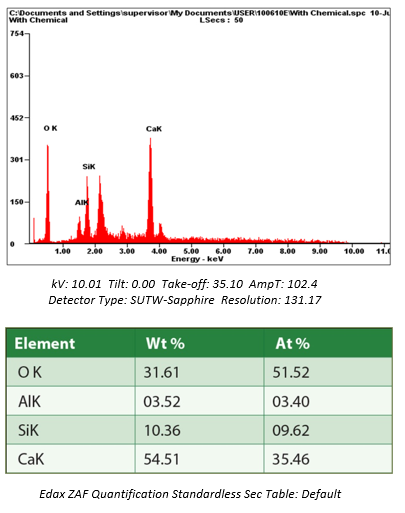
Microanalysis Study On The Products Of Hydration With And Without SYLOCON®
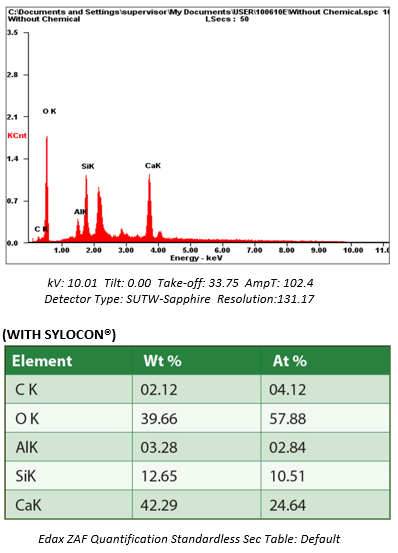
The microanalysis report of the mortar specimens show no development of any new product after hydration. A foreign carbon particle from any external source is present in the concrete without SYLOCON®. But, the chemical composition of the concrete is unchanged after the reaction of cement and SYLOCON®. So, the waterproofing properties developed in the treated mortar are due to the presence of the same nature of crystal formed in the capillaries and the pores of the concrete. These crystals of different shapes and sizes plug the water ingression path without changing the basic properties of concrete. In the microanalysis report this is very clear, only the percentage of the elements are changed.
(WITHOUT SYLOCON®)
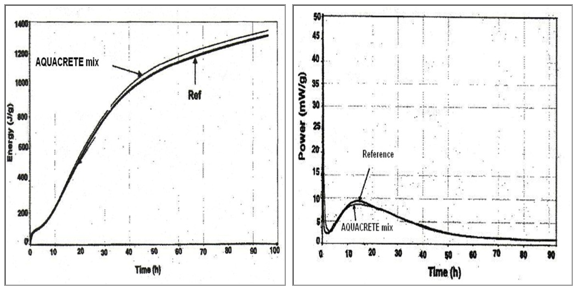
Heat evolution during hydration
Heat evolution during hydration is plotted here.
The rate of heat evolution curve in the presence of SYLOCON® is slightly lower than the curve of a normal mix. Total heat evolved during the hydration is plotted here. This indicates the retardation of hydration.
From experimental results, it appears that in the presence of, mix some nano particles are formed, which the products of hydration are. The extremely nano size particles have some favourable characteristics. Those fill up the pores and increase the strength of concrete. The microstructures of interface of cement and aggregate are greatly improved. This hinders the water percolation through the concrete.
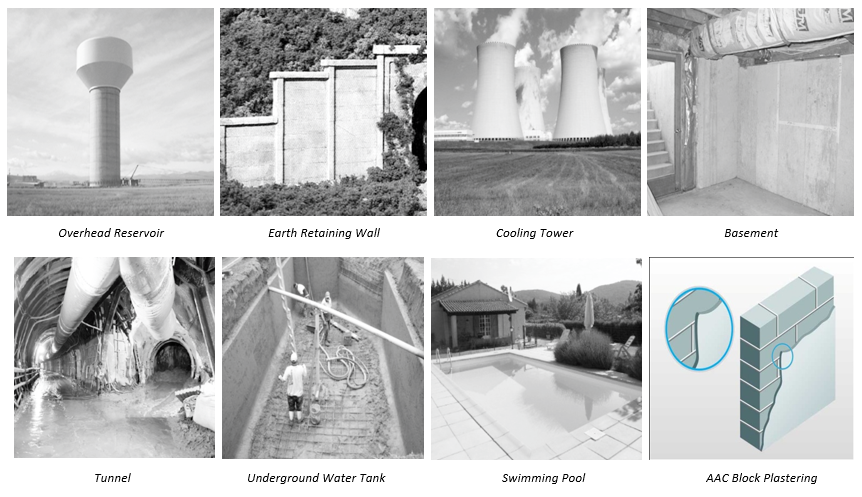
Uses Of SYLOCON In Structure
Conclusion
The practical examples and experiments has established that SYLOCON is the perfect combination for lining with cement mortar or concrete to enhance bond strength and durability of concrete tunnels and silos.
To be continued……………..
by cecr | Apr 7, 2021 | Construction Chemicals And Materials
With the increasing numbers of PQC Roads across the country, there are various issues in the PQC pavements which are cropping up and repair solution is the need of hour. In this direction STP Limited has come up with lot of new products in last few years for these repairs.
Repairs can be classified into following categories:
- Partial Depth repairs (Transverse as well as Longitudinal) of PQC.
- Repairs of longitudinal cracks by using U type anchorages / stitching.
- Repairs of the pavements especially for the areas where aggregates are exposed due to various reasons like after concreting sudden rain started or due to more tear & wear of concrete etc.
- Re-surfacing of Pavements by Fiber Reinforced Concrete / Mortar for betterment.
- Cross Stitching / stapling of panels / cracks: Repair the cracks by putting dowel bars with caps & tie bars so that it can have some space to have movements.
- Repairs of Potholes and corner spalls in concrete pavements etc
Repair Of Minor Cracks
These are very low (small) width cracks or hairline cracks. Such cracks generally do not affect the performance of road surface. Thus, these cracks, unless the severity level increases, need not be repaired. Further observe these cracks over a period of time for enlargement.
Medium Cracks (generally 1 to 5 mm wide)
If cracks are not moving then a very low viscosity epoxy resin may be used for its repair with or without fine sand to bond the crack faces.
- For crack up to 2 mm, clean the cracks using a compressor and pour the low viscosity epoxy resin in the cracks.
- For cracks larger than 2 mm, V shaped ‘joint wells’ are made with 3 to 5 mm saw blade. Also make 8 to 10 mm diameter grout holes at regular interval. Then pump the epoxy bonded into holes using a grout gun.
Partial Depth Repairs
The spalling of concrete occurs near the joints mainly due to adjacent slab load transfer related movement at the joint particularly in summer. The spalling will occur frequently in mid slab locations and other locations mainly due to high slump due to w/c ratio, poor construction or failure of earlier done repairs. Spalls are a localized problem and can be easily repaired with partial depth repair methods.
Full Depth Repairs
The full depth repairs are necessitated due to Transverse Crack in slab in full panel width. This crack may be in one lane or both the lanes. The reasons for such crack are:
- Locking of Transverse Joint.
- The joint does not function due to non-functioning of dowel bars. These dowel bars either get misaligned during construction or slurry gets into sleeves and prevents their movement.
- The intermediate crack may be caused due to too much resistance offered by rough surface of underlying DLC.
- The crack may also develop due to thermal changes coupled with large joint spacing.
In all such cases where cracks are more harmful, then the PQC Panel should be examined carefully, if the panel is to be repaired or removed. If it has to be repaired than use the technique of cross-stitching method. However, if that portion of panel is to be removed and then recast the panel as indicated by Removal of Existing Unsound Concrete.
Some Of These Repair Methods Are Described Here
I. Repair by Grouting of Low Viscosity Epoxy Material (ShaliGrout EI)
a. Equipment For Repair
Depending upon the method of repair the following equipments may be used.
-
- Grouting Pump of capacity about 5-10 Kg/cm2.
- Mechanical Grout Mixer
- Air Compressor
- Injection Ports.
- Hand Chisel, trowel, etc.
b. Preparation For Crack Repair
-
- On both sides of crack, the side edges are slightly chiseled to give a V-shape. If required do chiseling until a hard concrete is encountered.
- Remove loose material from crack area and blow out the dust and debris from the gap of crack by using a compressor or air blower.
- Drill holes in PQC surface in the line of Crack up to depth of about 150mm & 10 mm diameter @ 300 – 400 mm c/c.
Fix Injection ports (Nipples) of plastic or similar material ie nozzles of 6-8 mm in diameter and 100mm length into the holes. Keep the projection of nozzle outside the PQC to about 20 mm.
c. Repair Procedure
d. Finishing Of Repair Surface Of Crack
- If sagging on surface occurs during application to PQC surface, then Surface Correction material(ShaliFix SC 40) may be applied by trowel in smaller thickness in one or two layers.
- The applied mortar shall be finished with wooden floats.
- When the injection operation is over then cut the projected portion of nozzles and sealing the portion by Epoxy Mortar(ShaliGrout EP 10)
e. Curing Of Repaired Surface
- The repaired surface shall be cured by curing compound or water curing, if required or as recommended by manufacturer.
II. Repair By Stitching Or Cross-Stitching Of Cracks: Cross-Stitching is a repair technique mostly used for longitudinal cracks which are in reasonably good condition. The purpose of cross-stitching is to maintain aggregate interlock and provide added reinforcement for strength. The tie bars used in cross-stitching prevent the crack from vertical and horizontal movement or widening. This technique knits the cracked portions of the slab together and reduces the chances of crack to grow further.
Cross-stitching uses deformed tie bars drilled across the crack at an angle of 30-40 degrees. Deformed steel bars of 10-12 mm diameter are sufficient to hold the crack tightly closed and enhance aggregate interlock. Full depth holes of 18-20 mm diameter are drilled at a pitch distance of 300 mm with offset of about 150 mm from the crack. The holes are drilled alternately from each side of the crack so that it passes through the crack from left to right, while the next from right to left. After drilling, the holes are flushed with high pressure air to clean out any residual dust. Then a high strength epoxy gel adhesive is injected into the hole. Immediately after injecting epoxy, deformed steel bars are inserted into each hole. The crack is sealed at the top with epoxy modified sealant.
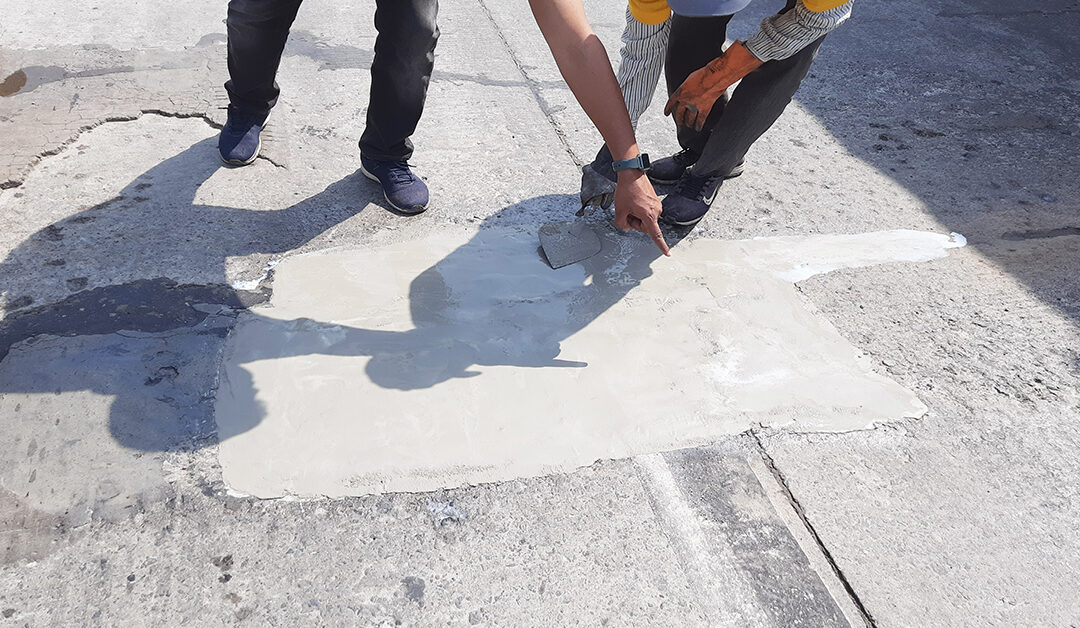
III. Surface Repairs Of The Pavements: especially for the areas where aggregates are exposed due to various reasons like after concreting, sudden rain started or due to more tear & wear of concrete:
a. A suitable surface repair Mortar (ShaliFix SC 40) may be used followed by wetting of Surface and application of Primer (ShaliSBR Latex).
b. Surface shall be cured using a suitable curing Compound/Water curing.
Material that are used in these repairs are:
- ShaliGrout EI
- ShaliGrout EP 10.
- ShaliPrime PUM
- ShaliSeal PS GG
- ShaliFix SC 40
For further details and live demo please get in touch with STP Limited’s technical team.
For further information,
visit: www.stpltd.com
by cecr | Mar 8, 2021 | Uncategorized
A Trusted Global Partner with a Commitment Towards Sustainable Growth for Making India – Atmanirbhar Bharat1
Caterpillar®, the world’s largest manufacturer of construction and mining equipment, enters the 50th year of manufacturing in India. The company has a long history of equipping its machines with leading-edge technology to increase the safety, productivity and efficiency of its operational sectors. Globally, Caterpillar has more than 95 years of product support expertise, a large installed base (approx. 2 million assets), and a robust worldwide dealer network serving 193 countries with approximately 160,000 employees.
While the company has been active in India since the 1930s, Caterpillar now has an established footprint with six state-of-the-art manufacturing facilities, two R&D centers, five subsidiary entities, eight Caterpillar brands and numerous global support organizations. The company’s strategy reflects the legacy and unparalleled commitment to meet its customers’ needs in India and around the world with the best-in-class product solutions and service innovation. Caterpillar and its strong dealer network employ more than 11,000 people directly and even more with its local supply base in India.
“Caterpillar has been part of India’s growth story for many decades. We have been a key partner since the 1930s, and it is remarkable to witness the progress in this great nation over the years,” said Caterpillar Chairman and CEO Jim Umpleby. Umpleby, who is also a board member on the US-India Strategic Partnership Forum, said our India team’s dedication and commitment to providing service excellence to our customers has been pivotal in reaching this milestone anniversary.
“This year denotes the golden jubilee anniversary as we enter into 50 years of manufacturing in India,” said Caterpillar India Country Manager, Bansi Phansalkar. “It is remarkable to note that Cat® equipment was used in the construction of Bhakra Nangal Dam back in 1948. Caterpillar has been supporting the growth in mining, construction, transportation, power generation and infrastructure development throughout India,” he further added.
Talking about Caterpillar’s commitment towards the sustainable community Mr. Phansalkar said, “We pursue various CSR [corporate social responsibility] initiatives focused on quality education, access to clean water, sanitation, hygiene and skills development for the betterment of the communities where we live and work.”
Caterpillar is one of the largest exporters of construction and mining equipment and remains focused on providing world-class products and after-market service solutions to its customers in India and around the world.
About Caterpillar India
Caterpillar has been active in India since the 1930s. Today, together with our dealers, we employ more than 11,000+ people in India, representing nearly every part of Caterpillar’s business. Our India presence includes state-of-the-art manufacturing facilities, high tech research and development, and numerous global support organizations. Caterpillar employees, dealers and facilities are located at hundreds of locations to serve and support our customers and respond quickly to their needs. To know more visit: caterpillar.com/india
About Caterpillar
With 2020 sales and revenues of $41.7 billion, Caterpillar is the world’s leading manufacturer of construction and mining equipment, diesel and natural gas engines, industrial gas turbines, and diesel-electric locomotives. Since 1925, we’ve been driving sustainable progress and helping customers build a better world through innovative products and services. Throughout the product life cycle, we offer services built on cutting-edge technology and decades of product expertise. These products and services, backed by our global dealer network, provide exceptional value to help our customers succeed. We do business on every continent, principally operating through three primary segments – Construction Industries, Resource Industries, and Energy & Transportation – and providing financing and related services through our Financial Products segment. Visit us at caterpillar.com or join the conversation on our social media channels at caterpillar.com/social-media.
*Caterpillar is defined as Caterpillar Inc. and its subsidiaries and affiliates.
For further information,
visit: www.caterpillar.com
by cecr | Feb 3, 2021 | Construction Equipments
The MT 3000-3i Standard and MT 3000-3i Offset Power Feeders from world market leader VÖGELE guarantee constant, smooth transfer of material and now give paving teams numerous practical new features. They are integrated with the latest Dash-3 machine concept and an optimized material handling and maintenance system.
|
Durgesh Upadhya
Sr. Journalist, Media Advisor,
UPEIDA
|
The development of any state can be judged through its infrastructure. Better the infrastructure, more the possibility of investment, resulting in creation of employment at large scale across the state. The present Yogi Adityanath led state government has emphasized on developing a huge network of expressways to cater better connectivity and provide quality road network to the people of Uttar Pradesh.
The state government has successfully created amicable environment for investors, which was never witnessed earlier. They are working continuously in smoothing the traffic flow by developing expressways with world class amenities.
The Yogi Adityanath led state government took the reign of development of state in March, 2017. Afterwards, the state witnessed a massive development in terms of infrastructure. Earlier, there were only two expressways across the state, but Yogi Adityanath government’s vision to upgrade the infrastructure of the state is visible after the successful implementation of developmental projects in these four years. When Prime Minister Narendra Modi visited Varanasi to inaugurate the cultural event on the occasion of Dev Deepawali, he praised the efforts of Chief Minister Yogi Adityanath and termed Uttar Pradesh as ‘Express State’.
Uttar Pradesh Expressways Industrial Development Authority (UPEIDA) is speedily working on Purvanchal Expressway, Bundelkhand Expressway, Gorakhpur Link Expressway, Ganga Expressway and Defence Corridor under the visionary leadership of Chief Minister Yogi Adityanath and under able guidance of Industrial Minister Satish Mahana. Senior IAS and Chief Executive Officer, UPEIDA Awanish Kumar Awasthi is the man who is working to bring these projects on the ground.
More than 75 per cent work of Purvanchal Expressway is complete and the state government is planning to open from March, 2021 for public. Simultaneously, works of Bundelkhand Expressway and Gorakhpur link Expressway is also under progress. The Chief Minister is going to gift Purvanchal Expressway in New Year to the natives of Uttar Pradesh.
It is worth mentioning that Bundelkhand region was always overlooked by earlier state governments, but CM Yogi Adityanath is developing it as a new centre of development. It is a matter of great pleasure that two nodes of Bundelkhand Expressway and Defence Corridor, i.e., Jhansi and Chitrakoot fall in Bundelkhand region. The authorities have geared up the works of Bundelkhand Expressway as more than thirty percent civil work is completed on ground.
The visionary chief minister Yogi Adityanath has announced about the development of Ganga Expressway in grand Kumbh 2019. Now, the process of land acquisition for the same is going to start soon from Meerut to Prayagraj. The cabinet has given its nod for the same and the authorities have started the initial process of land acquisition for the same. This will smoothen the traffic between Meerut to Prayagraj via Varanasi. The foundation laying ceremony for Ganga Expressway is scheduled in the month of June in year 2021. The construction work of Ganga Expressway will create a huge employment opportunities across the state.
The construction work of Expressways is in full swing providing employment to migrant labourers at large scale amid corona crisis. UPEIDA has successfully created employment opportunities at large scale during pandemic.
It must be noted that Uttar Pradesh has gained the top most position in developing Expressways at pan India level and in creation of employment. The state government has initiated the process of land acquisition in six districts, i.e., Chitrakoot, Jhansi, Kanpur, Lucknow, Agra and Aligarh for Defence Industrial Corridor. UPEIDA has signed 45 MoUs, which will attract huge investment resulting in creation of employment opportunities at large scale across the state.
Uttar Pradesh is heading towards being self-reliant in Defence sector by attracting huge investments through Defence Industrial corridor in 2021. The Aligarh node of Defence Industrial Corridor is already acquired by investors and 23 MoUs have been signed regarding same. UPEIDA has allotted land to 14 companies and they are about to initiate work in a short span of time. Moreover, Kanpur node has also attracted the huge investment as investors have shown their interest in establishing their units at the said node. Huge investment in Defence sector will increase the possibility of creation of job opportunities across the state.
It can be said that Construction of Expressways in Uttar Pradesh has seen a phenomenal progress ever since the present Government has taken the reins of State in year 2017. What started as a trickle in the shape of Agra-Lucknow Expressway, has now expanded multi fold with Purvanchal Expressway nearing completion, Bundelkhand Expressway and Gorakhpur Link Expressway progressing at an envious pace, Ganga Expressway at Land acquisition stage and Balia Link Expressway on detailed project report stage. All these expressways are crisscrossing the state from North to South and East to West promising to provide unhindered and fast Traffic movement to a majority of districts in the state. Researches have proved that 1% growth in infrastructure, leads to an equivalent growth of 1% in the GDP. With this in mind, Government of Uttar Pradesh aims to have Built Expressways totalling approx. 940 km by 2021 end with another 700 km in coming years will tremendously boost the GDP of the State. No wonder that Prime Minister Modi termed Uttar Pradesh as Express Pradesh.
For further information,
visit: upeida.in
by cecr | Jan 30, 2021 | Bridge




 “Caterpillar has been part of India’s growth story for many decades. We have been a key partner since the 1930s, and it is remarkable to witness the progress in this great nation over the years,” said Caterpillar Chairman and CEO Jim Umpleby. Umpleby, who is also a board member on the US-India Strategic Partnership Forum, said our India team’s dedication and commitment to providing service excellence to our customers has been pivotal in reaching this milestone anniversary.
 “This year denotes the golden jubilee anniversary as we enter into 50 years of manufacturing in India,” said Caterpillar India Country Manager, Bansi Phansalkar. “It is remarkable to note that Cat® equipment was used in the construction of Bhakra Nangal Dam back in 1948. Caterpillar has been supporting the growth in mining, construction, transportation, power generation and infrastructure development throughout India,” he further added.

 The Yogi Adityanath led state government took the reign of development of state in March, 2017. Afterwards, the state witnessed a massive development in terms of infrastructure. Earlier, there were only two expressways across the state, but Yogi Adityanath government’s vision to upgrade the infrastructure of the state is visible after the successful implementation of developmental projects in these four years. When Prime Minister Narendra Modi visited Varanasi to inaugurate the cultural event on the occasion of Dev Deepawali, he praised the efforts of Chief Minister Yogi Adityanath and termed Uttar Pradesh as ‘Express State’.