by Sawon Banerjee | Oct 7, 2021 | International News
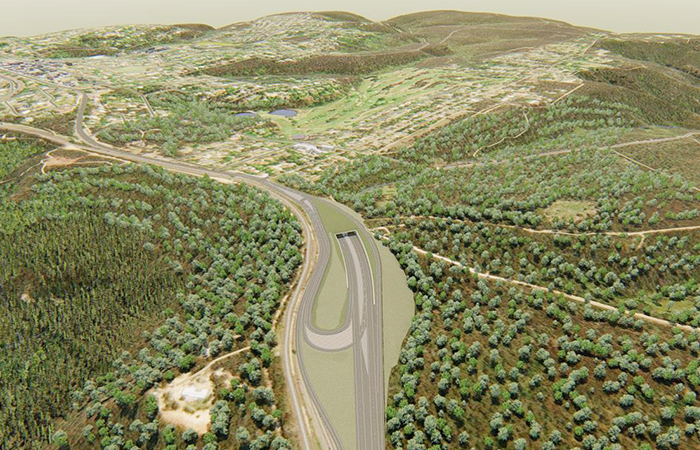
Aecom Australia had been selected in a competitive tender process to work on the proposed 11 km tunnel, a central component of the Great Western Highway upgrade between Katoomba and Lithgow said Deputy premier and minister for regional NSW John Barilaro. “This project will transform journeys between the Central West and the East Coast, delivering a safe and more efficient journey for locals, truckies and tourists,” said Barilaro.
“Aecom Australia will now need to ensure that the project includes appropriate measures to protect the Blue Mountains’ natural heritage,” said Paul Toole, Minister for regional transport and roads. “This critical work will focus on continuing the detailed environmental investigations to confirm the feasibility of a tunnel in this location, and will provide the basis for the environmental impact statement, due for extensive community consultation next year,” he added.
Construction of the tunnel is due to begin in 2024 and is set to be Australia’s longest road tunnel.
by Sawon Banerjee | Sep 7, 2021 | Interviews
|
Rajeev Gupta
Business Head
ECMAS Construction Chemicals Pvt. Ltd.
www.ecmas.in |
|
The ECMAS Group is a multi-brand conglomerate that produces a broad range of construction chemicals, unsaturated polyester resins and speciality chemicals. With innovation, quality, flexibility and R&D, the ECMAS Group not just provides the market with products and services but innovates for their customers to improve their process, their end product and often, their bottom line. Mr. Rajeev Gupta, Business Head, ECMAS Construction Chemicals Pvt. Ltd., in conversation with CE&CR, shares his views on the innovative technologies, growing demands, future prospects and much more.
CE&CR: ECMAS’ diversified and innovative range of chemical solutions is well known in the industry. What is your approach toward R&D?
Rajeev Gupta: Being one of the leading manufacturers of chemical solutions and products for construction, we work closely with the industry. ECMAS offers broad spectrum of end-to-end solutions for modern high-rise structures, industrial and infrastructure projects. Our products include Admixtures for high-performance concrete and SCC, a wide variety of Waterproofing solutions, Repair & Strengthening solutions, Floorings, Sealants, Adhesives, Thermal insulation, Protective coatings, Synthetic structural fibres, meeting specific project requirements and enhancing durability of construction.
ECMAS is a research and technology driven company where innovation is key success factor. Our continuous focus is on offering eco-friendly and green products to our customers promoting sustainable construction. We emphasize and invest heavily on developing and acquiring new technologies to deliver innovative solutions. We are working in close associations with renowned industry experts, research institutes and laboratories to offer budget friendly, yet technically superior solutions to our clients. We are on a constant look out for emerging market requirements of the industry and keep ourselves updated to deliver the need specific quality solutions. We observe more than 70% of our turnover through our innovations and new products.
CE&CR: How do you see the market for Repair and Strengthening products in recent years?
Rajeev Gupta: The deterioration to concrete structures is occurring at an alarming rate globally. It is an established fact that even if the structural design abides by all the specific building codes like the concrete quality, cover etc., there is still a high risk of deterioration of concrete and corrosion of steel reinforcement. Steel corrosion is the most severe cause of deterioration of reinforced concrete that can create cracks, spalling of the concrete cover, reduces the effective cross section area of the reinforcement and may lead to collapse of the structures if not addressed in time.
In the current situation, more than 40% of the highway/rail bridges are structurally deficient or functionally obsolete or both need immediate actions to improve the service life and performance level. A huge no. of other infrastructure, building and industrial structures need structural enhancement, repairs and retrofitting every year.
No country whether developed, developing can afford to demolish all the weak and old structures and reconstruct new one as it is economically not viable and it leads to huge wastage of national resources and money. Therefore, the demand and market for repairs, strengthening and retrofitting solutions is growing at a rapid rate over the last two decades. The main objective of any repair/rehabilitation or strengthening work is to enhance the performance of the structure, extend the service life or increase the load carrying capacity.
CE&CR: ECMAS strives for continuous innovation. Given that, what are the new and unique technologies ECMAS is offering to Repair and Retrofitting applications?
Rajeev Gupta: There is an increasing demand for high performance solutions that supports sustainability, overall systems cost reduction, and reduced project delivery time. A variety of construction chemicals and advanced materials ranging from concrete admixtures to polymer composites are increasingly being used in the buildings and construction industry. Many benefits including enhanced performance & integrity and overall systems cost reduction accrue to a construction or building project by using these solutions. Although, ECMAS offers a very wide range of repair solutions including High Strength Mortars, Micro Concrete, Rust Removers, Protective Coatings, Bonding Agents, variety of Injections, etc. but ECMAS WBD solutions and FRCM Technology are two very unique solutions introduced by ECMAS to the Indian Construction Industry.
We have recently added a wide range of locally manufactured Polyurethane Injections to effectively control heavy water leaks and handle challenging situations in underground constructions which received an encouraging response from the clients.
CE&CR: Can you little elaborate about these technologies? What are the unique features?
Rajeev Gupta: ECMAS WBD Solutions – Plastering and Waterproofing in one step. ECMAS WBD Solutions are extremely waterproof, breathable and drying plasters which act as strong waterproof barrier; while staying breathable at the same time. Proprietary WBD Component is the key component that ensures waterproof characteristic of the product. ECMAS WBD Systems offers a permanent waterproofing solution by eliminating the problems of water penetration, dampness, efflorescence, etc. The plaster is produced from natural materials and does not contain any harmful or inflammable ingredients and it is environment friendly, making it suitable in both new constructions and for repair projects for applications like waterproofing of Basements, Water tanks, UG Sumps/STPs, Wet Areas, External Walls, etc.
Advantages
⦁ 100% Waterproof
⦁ Breathable – Air and Vapor permeable allowing trap moisture to evaporate
⦁ Dehumidifying – drying out the internal/entrapped moisture
⦁ It is possible to apply to wet surfaces
⦁ Prevention against salt crystallization/efflorescence
⦁ It can be applied manually (trowel) or with a spray applicator
⦁ No need for additional waterproofing membranes or protection plasters
⦁ Excellent cohesion and bonding strength with Concrete and Brick Masonry
FRCM Technology – now a days externally-bonded fiber reinforced polymer (FRP) systems have become one of the preferred technologies for repair and retrofitting of concrete and masonry. FRP systems have features such as high tensile strength, light weight, relative ease & flexibility of installation, and resistance to corrosion, etc. However, FRP also has limitations, which can preclude their use in many critical applications. For instance, high temperatures compromise the efficiency of FRP systems, conventional FRP system using Carbon Fiber reinforced with Epoxy Resin make them not suitable for UV exposed or Fire rated applications. So, in the event of a fire, the FRP system degrades rapidly as the resin binder loses its chemical, physical and mechanical properties. Also, FRP applications are limited on moist/wet surfaces or at low temperatures and FRP systems typically act as a vapor barrier.
These drawbacks are all related to the epoxy matrix used to embed and bond the fibers. Thus, substituting the epoxy matrix with a cementitious matrix appeared to be the most reasonable solution to improve the overall performance of externally-bonded composite systems.
FRCM is externally bonded Composite Systems for strengthening of Concrete and Masonry Structures using PBO reinforcement with cementitious matrix. This new generation of composite systems is known as fabric reinforced cementitious matrix (FRCM). FRCM developed as an evolution of ferro-cement, where the mortar matrix is reinforced with open meshes of continuous dry fibers.
Main advantages of FRCM in comparison to FRP –
⦁ Fire resistant – Class A like concrete and mortar
⦁ Ductile failure and not brittle (like steel reinforced concrete)
⦁ Moisture/humidity resistant
⦁ High temperature resistant
⦁ High performance composite (like FRP)
⦁ Easy and faster application
⦁ ACI 549 design guidelines available for FRCM
CE&CR: What precautionary issues that should be considered while handling and using the chemicals? How should the chemicals be stored?
Rajeev Gupta: Now days, there is growing concern over associated risks and health hazards of using chemicals. One of the biggest challenges to protecting construction workers from chemical injury is building awareness. While protective gear and protocols shall always be followed while handling and using chemicals that have an immediate physiological impact, workers also need to be educated about long-term health risks to exposure and unsafe work practices are equally hazardous. To ensure safety at construction site and to reduce chemical exposure, contractors should ensure that each of their worker has undertaken the adequate amount of training for safety protocols.
As a general practices, all persons working at the project sites and handling chemicals shall wear proper mandatory PPE specially when working with chemicals specially with spray applied Polyurethane Foam Insulation, Polyurea, Polyurethane and Epoxy products.
Generally, appropriate PPE for high pressure applications includes chemical-resistant gloves, protective clothing, eye and face protection and respiratory protection. The specific types of PPE may vary depending on the conditions at the jobsite, such as whether the application takes place indoors or outdoors, the amount of ventilation, the specific components of the chemicals, etc.
Chemical Handling and Storage at Construction Sites – Safe storage of chemicals at construction sites is very important. Improper storage or exposure to environmental extremes may make the products unusable much before their designed shelf life.
- All construction chemicals shall be delivered to the jobsite in the manufacturer’s original unopened containers with legible labels and shall be protected from weather, sun and moisture.
- Most chemicals shall be stored in covered and cool environment protecting from direct sunlight, temperature extremes and moisture. Do not allow solvent containing materials to be exposed to high temperatures, open flames or sparks.
- Store liquid materials in their original undamaged containers in a clean, dry, protected location within the recommended storage temperatures.
- Follow manufacturer’s recommendations and material handling and storage specifications.
- Empty bags/containers shall be properly disposed promptly after use.
CE&CR: How has pandemic affected the construction industry growth? Is there any expected revival and more so, renewed growth expected from the Indian Construction Industry?
Rajeev Gupta: In the recent scenario, there is hardly any sector or place that has not been impacted or damaged by the COVID-19 pandemic. Almost all commercial, economic and social activities have suffered from the COVID-19 pandemic. Construction and engineering industries are no different, they have also suffered from this crisis. COVID has severely disrupted the entire value chain system. Availability of Construction materials and price inflation, labour shortages, transportation & supply chain disruptions and financial problems became major issues. The lack of timely execution of projects due to lockdowns and labour shortages contributed to cost overruns, significant delays and even the cancellation of projects. The cancellation and stalling of projects directly impacted the MSMEs.
But now construction industry has learnt to live and manage with this situation and is recovering rapidly. There has been great momentum and good demand from infrastructure and government sectors over last 6-9 months driving the growth of construction industry. Similarly, repair, retrofitting, rehabilitation and renovation projects are supporting this.
In response to the crisis, we witnessed a steady rise of start-ups creating technology enabled solutions for design, construction management, client management, material procurement & inventory management and sales.
Business-to-business (B2B) e-commerce platforms, contactless commerce is slowly becoming the norm as building material manufacturers and suppliers are adopting digital channels and opening direct to consumer (D2C) channels.
by Sawon Banerjee | Sep 7, 2021 | Engineering Marvels
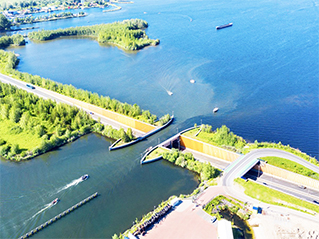
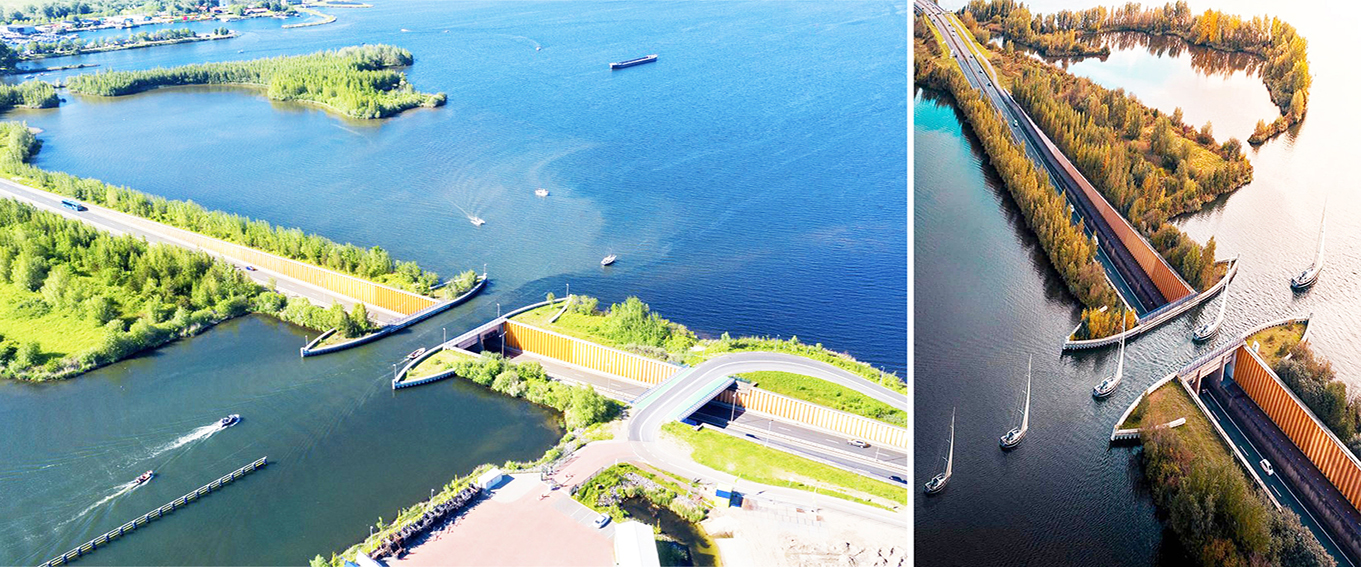
As unique as it looks, the Veluwemeer Aqueduct is the world’s shortest and most interesting aqueducts in the world. A stunning water bridge and a creative solution to the Veluwemeer lake crossing, the navigable aqueduct crosses N302 road, near Harderwijk, in the east of Holland, Netherlands. The aqueduct was named after the lake it serves, while the lake was named after the Veluwe region of Gelderland, which is due south of the lake.
The road, a scenic beauty and stunning work of engineering, connects mainland Netherlands to Flevoland — the largest artificial island in the world. Flevoland was constructed from reclaimed land in the region and is surrounded by three man-made lakes. This island is actually made up of two drained sections, Flevopolder and Noordoostpolder, which come together to make up the 374.5 square miles (970 square kilometers) province of Flevoland.
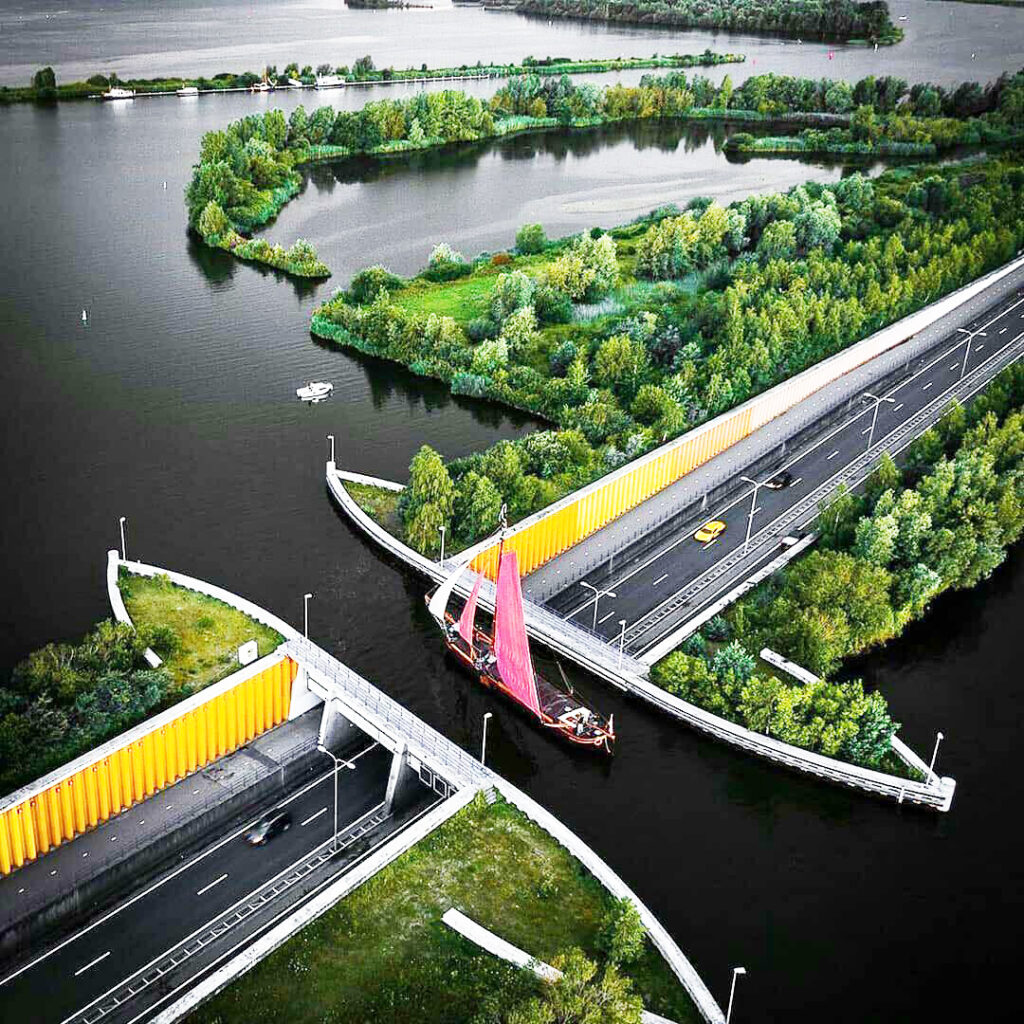
What makes this 25-meter long aqueduct stand out is the fact that people normally think of bridges as roads that cross over water but this one is the exact inverse. Veluwemeer aqueduct is a bridge for the passing ships while those driving in cars go through a tunnel underneath the bridge. In other words, it is an underwater tunnel where the ships sail on the top and the cars travel below it.
Design And Working
Dutch civil engineers and architects put in their creativity and came up with the brilliant idea of the aqueduct. In order to avoid spillage of water onto the road, aqueduct Veluwemeer uses 22,000 cubic meters of concrete to support the weight of the water above the roadway. It also uses steel sheet piling to prevent sediment from bleeding onto the highway. The bridge deck is made of prestressed concrete which allows the concrete beams to hold high loads of not only compression but also tension.
The aqueduct is 25 meters long and 19 meters wide with a water depth of 3 meters allowing small boats and other shallow-draft water vehicles to pass through, effortlessly. Along with the boats passage over the road, pedestrian walkways can be found on both sides, granting access for foot traffic to cross. The road itself also includes designated cycle lanes.
Unlike drawbridges or other roadway structures, the water bridge design allows for constant traffic flow both on the road and over the aqueduct. An average of around 28,000 – 34,000 vehicles pass each day underneath the aqueduct.
During the design process engineers considered building an underwater tunnel or a high bridge but for this specific case these types of design ideas were proving to be too expensive and/or too obstructive to the landscape. Also, the construction time would have been longer than the water bridge. The construction started in 1998 and took 4 years to finish. The bridge costs 53M Euros or 61M USD.
The lake system was originally constructed to help regulate water levels and the groundwater table in the surrounding areas. Now established, the lakes are also important nature reserves (especially for water birds) and recreational areas for local residents.
Tuhina Chatterjee
Associate Editor
Civil Engineering and Construction Review
by Sawon Banerjee | Sep 7, 2021 | Construction Trends
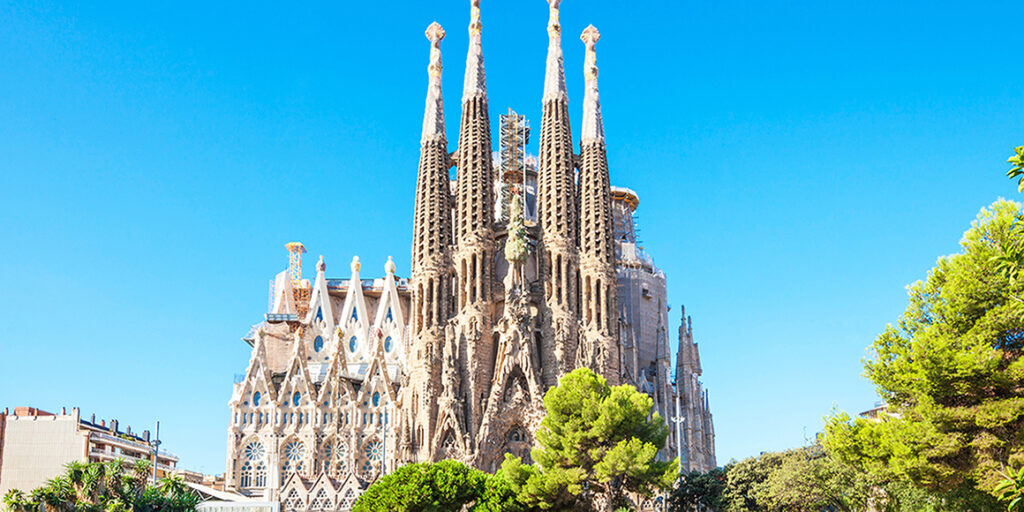
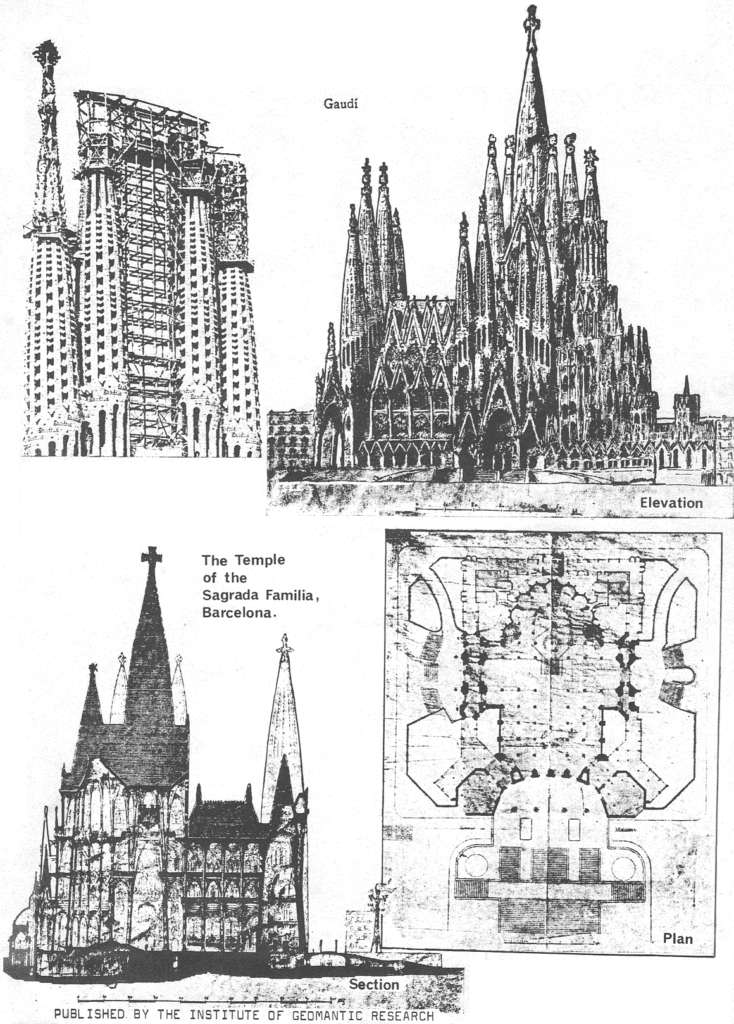
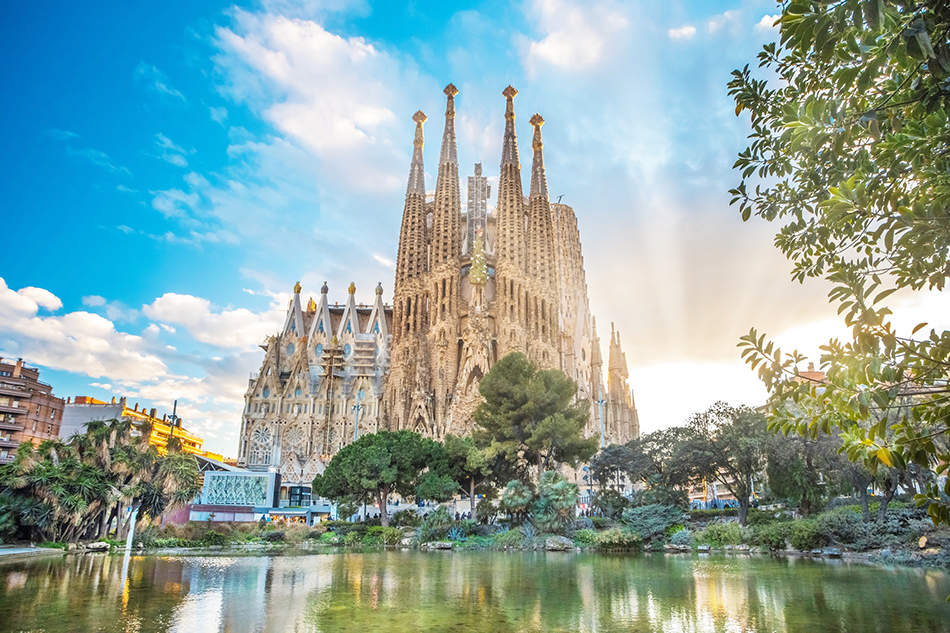
Originally Neo-Gothic formula styled, later commissioned in nature combining Art Nouveau, Catalan Modernism and Spanish Gothic designs, the Basilica de la Sagrada Familia, after more than a hundred years, remains unfinished but also the most important ecclesiastic building since the late eighteenth century.
Located in the Eixample district of Barcelona, Catalonia, Spain; Pope Benedict XVI consecrated the church and proclaimed it a minor basilica on 7th November 2010. The construction of the temple began in 1882 and its completion is expected in 2026. Aside from being the tallest church, Sagrada Familia is set to become the structure that has the longest time to construct with a record of 137 years and still counting. If the plan scheduled remains on track, it will be completed in a total span of 144 years which is around 10 times longer than the construction of the Great Pyramid of Giza and 123 years longer than the time needed to finish the Taj Mahal.
The basillica is considered to be Barcelona’s top economic contributor, supporting the economy with 4.5 million visitors annually who pay 17 to 38 euros to tour it. The current total estimated building costs stands at €374 million.
The Origin
Sometime in 1866, a congregation of devotees of St. Joseph headed by Josep Maria Bocabella envisioned a temple to honour him. Funded by private donation, the construction started and the foundation stone was laid in 1882, on March 19, in the middle of a land of 12,000 square meters. The first architect was Don Francisco de Paula del Villar y Lozano but soon abandoned the project because of disagreements.
A year later, in 1883, Antoni Gaudi became the architect and gave it a new direction. He worked on the project until his tragic death in 1926, in full anticipation he would not live to see it finished. Interestingly, Gaudí was never concerned about the speed of construction. He even once said, “My client is not in a hurry.” The architect was aware that the church would take generations to complete and kept his plans flowing.
“There is no reason to regret that I cannot finish the church. I will grow old but others will come after me. What must always be conserved is the spirit of the work, but its life has to depend on the generations it is handed down to and with whom it lives and is incarnated. ” This was Gaudí’s philosophy when it came to finishing his masterpiece. After his death, his disciple, Domènec Sugranyes took over the directions of the work.
Design and Planning
He maintained del Villar’s Latin cross plan, typical of Gothic cathedrals, but departed from the Gothic in several significant ways. Most notably, Gaudi developed a system of angled columns and hyperboloidal vaults to eliminate the need for flying buttresses. Rather than relying on exterior elements, horizontal loads are transferred through columns on the interior.
La Sagrada Familia uses three-dimensional forms comprised of ruled surfaces, including hyperboloids, parabolas, helicoids and conoids. These complex shapes allow for a thinner, finer structure and are intended to enhance the temple’s acoustics and quality of light. Gaudi used plaster models to develop the design, including a 1:10 scale model of the main nave measuring 5 meters in height and width by 2 meters in depth. He also devised a system of strings and weights suspended from a plan of the temple on the ceiling. From this inverted model he derived the necessary angles of the columns, vaults and arches. This is evident in the slanted columns of the Passion facade, which recall tensile structures but act in compression.
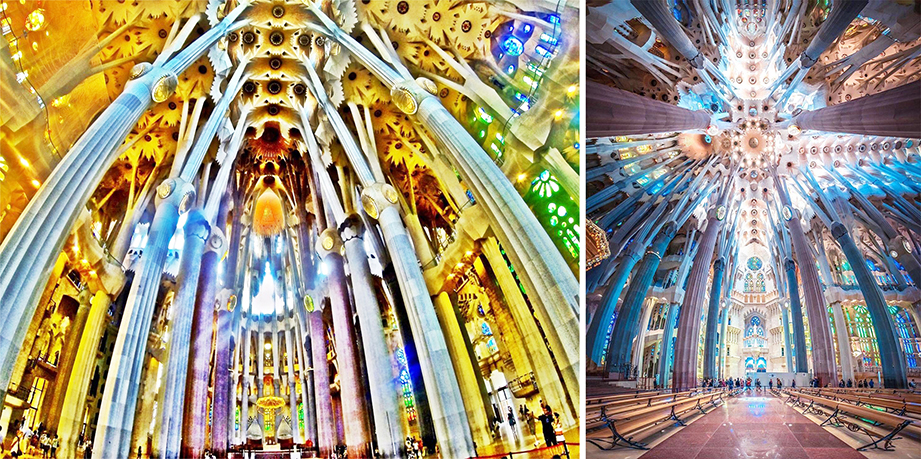
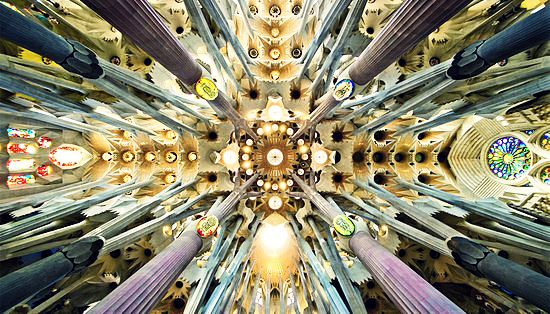
The central nave soars to a height of 45 meters and is designed to resemble a forest of multi-hued piers in Montjuïc and granite. The piers change in cross section from base to terminus, increasing in number of vertices from polygonal to circular. The slender, bifurcating columns draw the eye upward, where light filters through circular apertures in the vaults. These are finished in Venetian glass tiles of green and gold, articulating the lines of the hyperboloids.
After completion, La Sagrada Familia will have eighteen towers composed to present a unique view of the temple from any single vantage point. Four bell towers representing the Apostles crown each facade, reaching approximately 100 meters in height. At the north end, a tower representing the Virgin Mary will stand over the apse. The central tower will reach 72 meters in height and symbolize Christ, surrounded by four towers representing the Evangelists.
Interior
The church plan is that of a Latin cross with five aisles. The central nave vaults reach 45 meters (148 feet) while the side nave vaults reach 30 metres (98 feet). The columns are on a 7.5 metre (25 feet) grid. The crossing rests on the four central columns of porphyry supporting a great hyperboloid surrounded by two rings of twelve hyperboloids (currently under construction). The central vault reaches 60 metres (200 feet). The apse is capped by a hyperboloid vault reaching 75 metres (246 feet). Gaudí intended that a visitor standing at the main entrance be able to see the vaults of the nave, crossing and apse; thus the graduated increase in vault loft.
The columns of the interior are a unique Gaudí design. Besides branching to support their load, their ever-changing surfaces are the result of the intersection of various geometric forms. The simplest example is that of a square base evolving into an octagon as the column rises, then a sixteen-sided form, and eventually to a circle. This effect is the result of a three-dimensional intersection of helicoidal columns.
Three Distinct Facades
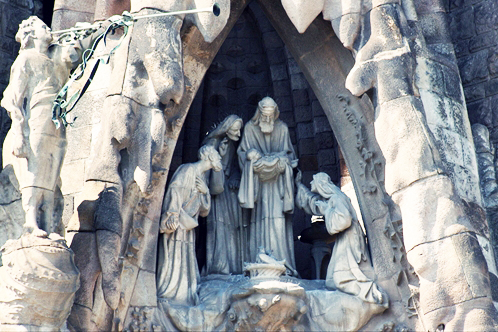
The first one, the Nativity facade, was completed in 1935 and is influenced directly from the Gaudí’s style. It is dedicated to the birth of Jesus with the symbolic sunrise to the northeast. The facade also shows elements related to the Nature and the creation of life. The second one is the Passion facade is simpler and dedicated to the suffering of Christ during his crucifixion. The facade was supposed to show the sins of human beings. Several architects worked on this facade and tried to remain faithful to Gaudí’s style while bringing their own style at the same time. The facade is directed to the West and faces the sun as a symbol for the death of Christ. The last one is the Glory facade, the largest facade which is still under construction. It is dedicated to the glory of Jesus and the road to reach God going through death, final judgment and glory.
Curved Lines
Antoni Gaudí decided to design the Sagrada Familia, like most of his works, with curved lines. According to Gaudi, straight lines did not exist in the nature, and this is why the temple – which reflects the nature, life and death – should not be constructed with straight lines. As a symbol of Nature, the columns of the Sagrada Famlia are built in a tree-shape to support the whole monument
In recent years, La Sagrada Familia has adopted comparatively new digital design and construction technologies. Architects and craftsmen use Rhinoceros, Cadds5, Catia, and CAM to understand the complex geometries and visualize the building as a whole. Plaster models are still used as a design tool, now generated by a 3-D printer to accelerate the process.
Reference
⦁ https://www.barcelonina.com/en/blog/the-origins-of-sagrada-familia/
⦁ http://www.apartime.com/blog/culture-tourism/the-secrets-of-sagrada-familia
⦁ https://www.re-thinkingthefuture.com/rtf-design-inspiration/a2080-sagrada-familia-barcelona-by-antoni-gaudi-the-unfinished-masterpiece/
⦁ https://www.archdaily.com/438992/ad-classics-la-sagrada-familia-antoni-gaudi
Tuhina Chatterjee
Associate Editor
Civil Engineering and Construction Review