by Sawon Banerjee | Feb 15, 2021 | Construction Equipments
Sustainability has been part of the roadbuilding conversation for decades. Yet, improvements that make the methods and machines more environmentally friendly continue to gain momentum.
Industry leaders increasingly see green practices as not only a way to better the world, but a tactic to improve profitability, too.
At the forefront of such sustainable efforts is Dr. Hans-Friedrich Peters, Executive Vice President of Ammann’s Plants Division. Dr. Peters recently provided an in-depth look at how asphalt production has become more sustainable – and a glimpse at what’s on the horizon, too.
Conversations about “green” roadbuilding always start with the use of recycled asphalt (RAP). Can these recycled materials really perform as well as mix made from virgin aggregate?
Yes, the conversation does start with RAP – and it should. The biggest reductions in indirect CO2 emissions result from the implementation of RAP.
We should not categorise RAP as waste material. It is a perfectly fine substitute for virgin materials. The aggregates in reclaimed asphalt show little aging and are mechanically and geometrically within the quality ranges of new material.
Bitumen holds up well, too. Its aging is limited and can be compensated by using small amounts of new bitumen. When utilising RAP you’re saving on both aggregate and bitumen costs – while reducing emissions, initially and over the lifetime of a road.
Our technology allows the use of RAP percentages up to 100%. In reality, the percentage is usually much less based on the amount of RAP that is available and the recipes defined by the authorities.
Governments continue to tighten emissions standards.
Are countries increasingly adopting recycling, or have we hit a bit of a plateau? And what about the earlier adopters – are they taking further strides or are they content to recycle at existing levels?
Many countries that did not initially adopt recycling are now moving ahead rather quickly. China is an example of this. The country is leveraging some of Ammann’s most advanced recycling plants and creating mix with extremely high percentages of RAP.
The earlier adopters are now recycling even more. That can result from governments lifting restrictions, but increasingly it’s because the asphalt producers see the value of RAP.
Whatever the motivations, the global community is benefitting. From an environmental perspective, all parties involved should increase their efforts to expand the percentage of RAP being used for new pavements.
The challenge with RAP is the heating of the materials. Hot temperatures damage bitumen. In some processes, virgin aggregate is heated, which mixes with the RAP to raise its temperature. But when making mix with 100% RAP, there is no virgin aggregate – and therefore no secondary heat source. How do Ammann plants heat the 100% RAP mix without damaging the bitumen?
On the high end of RAP utilisation is the Ammann ABP HRT (High Recycling Technology) Asphalt-Mixing Plant. As stated, it can produce mix with up to 100% RAP. No virgin aggregate is required.
There is considerable technology and innovation involved in the HRT concept, in particular the RAH100 counterflow drying process technology. Essential to the RAH100 is its gentle heating process. During the warm mix process, the dryer heats materials between temperatures of 100ºC and 130ºC. It also makes asphalt at 140ºC to 160ºC if a more traditional mix is desired.
The heating is usually where the complications with RAP material arise. RAP must reach its target temperature, but the valuable bitumen will be damaged if the material is heated too quickly.
The RAH100 eliminates that concern. It consists of two connected sections. One is a hot gas generator that contains a burner and forces air toward the second section, which is a counterflow dryer.
The RAP enters at the far end of the counterflow dryer section and moves toward the heat chamber. At the end of the counterflow dryer, RAP is transported to an accompanying silo. The heated RAP mix leaves the dryer before the temperature becomes excessive, so it never reaches the critical temperature where the bitumen is damaged.
One quick point about the ABP HRT: It’s an extremely advanced plant – I would say it’s clearly the industry leader. Yet, Ammann always strives for further improvement, so this system, created more than a decade ago, is constantly improved. That includes the hot gas generator, which has been upgraded on multiple occasions.
The appearance of the ABP HRT is unique, with the recycling system placed above the mixer. What is the purpose of that design?
The plant is designed around the incorporation of large percentages of RAP. What you see is a nod to the fact that the HRT plant has elevated RAP from a supporting role to the lead actor.
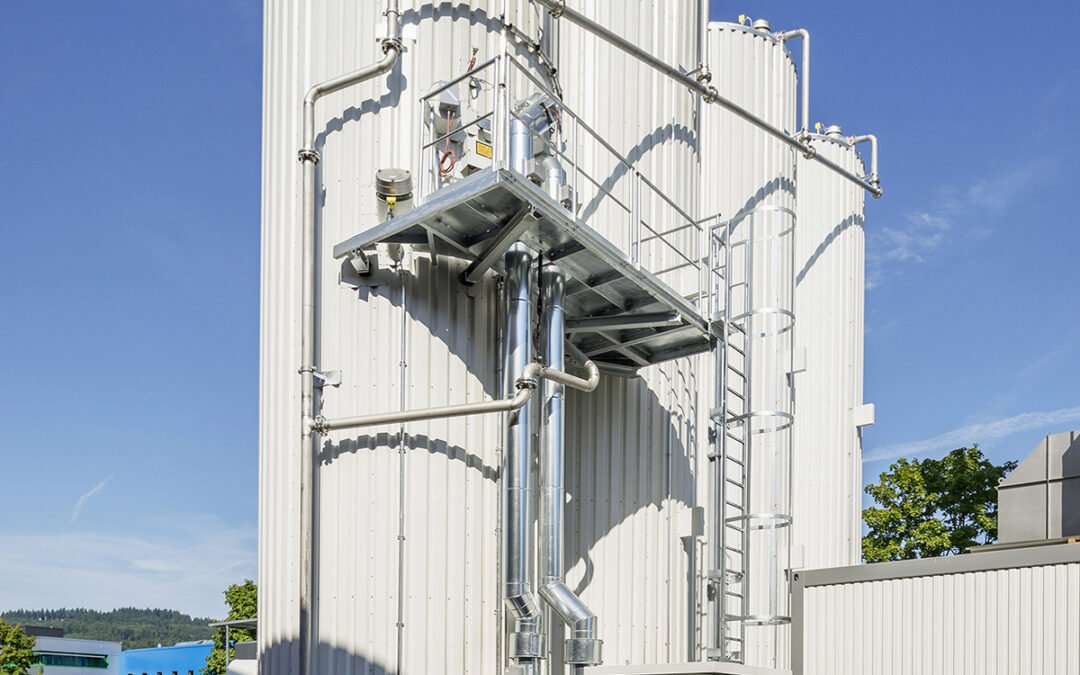
As you stated, the most striking difference is that the ABP HRT’s entire recycling system is arranged vertically, in direct line above the mixer. This allows materials to be dropped instead of conveyed, which minimises wear and optimises transport of the hot RAP. The HRT approach also means that there is enough room in the plant’s tower for additive feed components and for carrying out inspection and maintenance work.
Today the HRT concept is the smartest operational method for handling the specific properties of RAP.
Making mix that theoretically consists of 100% RAP is impressive. Yet many mix makers will utilise lesser amounts of RAP. What are the solutions for these customers?
Many of our customers fall into this category, and we most assuredly have products for them.
There are varied heating processes that depend on the amount of recyclables. The RAH60 is a parallel flow dryer where up to 60% hot recycled materials can be fed. The RAH50 is a middle-ring dryer that incorporates up to 40% hot recycled materials.
Recycling can occur at Ammann plants without these specific dryers. Up to 30% cold recycled material can go directly into the mixer, meaning almost every Ammann plant is capable of utilising that amount of RAP.
At some point, it would seem that manufacturers such as Ammann could only make so much more progress on emissions. Are there opportunities for further reductions?
There are. The newest is in regards to volatile organic compounds (VOCs). These compounds must be diminished in the clean gas stream to cut the total carbon value
We continually work to reduce CO₂ emissions. This can be accomplished by actively cooling the drum, increasing drying efficiency and utilising energy sources such as biofuels and wood dust. Ammann technology can diminish CO₂ by 10% or even considerably more, depending on the age of the plant and the technology chosen.
There are other somewhat hidden opportunities to trim CO2 emissions, including the bitumen tank farm. A traditional farm consists of horizontal tanks heated with thermal oil. Changing to an electrically heated, vertical tank farm results in considerable advantages. There is no oil consumption and therefore no emissions. Electric heating is cost-effective, too. In fact, electrically heated bitumen tanks have become standard in all of Europe and other parts of the world.
There are also other emissions like dust and odour. Their level of importance and the maximum values being allowed differs greatly from country to country and area to area. Our technology allows the lowest values for all of them (e.g. < 10 mg/m³ of dust) without causing any restrictions on the plant operations.
Low temperature asphalt (LTA) is another opportunity that is becoming more prevalent. While conventional asphalt is produced at around 170°C, the low temperature processes of today allow production temperatures of around 100°C. Lowering the manufacturing temperature eases energy needs, and therefore emissions, too.
LTA impacts the entire production process – including drying, mixing sequences and recycling. Ammann has focused our research and development on the complete manufacturing process for LTA.
The placement of plants in residential and commercial areas also raises noise issues. Why plants located in these areas, and what can be done to limit the noise?
A shortage of industrial land means that asphalt plants increasingly must be located closer to residential areas. Local governments can have very strict standards when it comes to noise, so we have to make the plants as quiet as possible.
Ammann has been very proactive on this front. We offer varied sound-suppression packages to meet our customers’ specific needs. Some customers need to lower sound a bit, while others have to take more substantial measures. The efforts start with equipping burners with variable speed motor drives, which are much quieter, and stack silencers, which control exhaust noise. We offer more and more sound-suppression options, all the way to cladding the entire plant.
That cladding, by the way, makes the plants look like commercial buildings. They are beautiful facilities that fit nicely in urban office parks. Passers-by would never guess there is an asphalt-mixing plant inside.
You referenced dust emissions earlier. This is becoming a bigger issue as plants must often be located in sensitive areas. Can anything further be done to limit the dust that results from these plants?
The conversation about dust emissions starts with the baghouse. Ammann Asphalt-Mixing Plants remove dust through a highly efficient baghouse filter. It actually lowers exhaust dust to less than 10 mg/m3, which is an exemplary benchmark. We are currently working on reducing this value significantly again, to < 5mg/m³.
People often focus solely on the dust resulting from the mix-making process, and what comes out of the chimney. They forget that all the logistical operations around an asphalt-mixing plant, and around equipment like trucks and wheel loaders, are creating much more dust than the plant itself. Fortunately, countries like China, and also some areas in Europe, are increasingly considering these other sources.
Ammann and our customers have together developed solutions to further limit dust. We focus on dust reduction points for further improvement. Taking measures at the cold feeder, load-out, skip hood, overflow silo, filler loading area, screen, belts and transfer points makes a big difference. That’s in addition to the efforts provided through the baghouse.
To summarise the current state of emissions, I would say the main focus is on trimming CO2, VOCs and NOx in the combustion process and on reducing the residual dust content after the baghouse. There are also markets in which, for example, the integration of pre-dosing into the dedusting process is also being promoted.
A shortage of industrial land means that asphalt plants increasingly
must be located closer to residential areas
Are local governmental requirements becoming stricter in general? We discussed CO2, sound and dust emissions, but what about odour – particularly given that the plants are increasingly placed in residential or commercial areas?
Overall yes, the requirements are becoming stricter – but they are extremely different from one country to the next.
We are eager to comply with all the regulations because it’s the law and because we want to be good neighbours, too. That means a lot more than shrinking carbon and VOC emissions. It also includes muffling sound, which we just discussed, as well as dust and odour.
In regards to odour … Bitumen fumes are the primary source of odour. Ammann offers different solutions to contain the fumes and the odour that can result. As with dust, we have reduction points – in this case the bitumen tanks, the skip and load-out levels and the stack.
There is a great deal of talk about alternative energy sources, including biofuels. But some mix producers who are contemplating a plant purchase might be hesitant to commit to such fuels, as they are somewhat unproven and their availability might not be as consistent as traditional sources.
Ammann biofuel burners can also utilise more traditional fuels such as natural gas, LPG, light and heavy oil and kerosene. This alleviates the concerns of customers who are hesitant to rely solely on newer fuels.
The use of these new fuels is another meaningful win on the green front. We are taking renewable energy sources or, in some cases, converting a waste product into fuel. This conserves natural resources and puts less pressure on landfills.
On the renewable front, we are very high on the wood dust burner. The burner transforms wood dust, a material that is available from local sources, into a renewable fuel. What makes this dust burner even more exceptional is its carbon neutrality. The carbon dioxide released when burning wood is offset by the fact the tree consumed that amount of carbon dioxide during its life. Therefore, this part of the emissions is carbon-neutral.
The burner has proven effective and is utilised on a number of Ammann Asphalt-Mixing Plants. It can be retrofitted on existing plants as well.
Biofuels of course are another initiative. They support climate protection and reduce dependency on mineral oil. Examples of these fuels are rapeseed and sugar cane. Tall oil, which is a waste product of cellulose sulphate production, can be used, too.
We expect that in the near future other fuel types such as hydrogen will significantly reduce gas emission values. These fuels will also be much more important in our industry. Ammann is already working on solutions to be prepared for this.
The biggest reductions in indirect CO2 emissions result from the implementation of RAP.
Plant owners might look at these comments and say, “These are great ideas, but I already own a plant.” How can an asphalt producer begin to make the change to a more green operation while utilising their existing plant?
Asphalt producers might be surprised by how much they can accomplish with their existing plant. A very easy first step is to upgrade the control system.
A modern control system can have a significant impact on efficiency, and that cuts across many parts of the process. Improved efficiency will lessen fuel usage, emissions and material waste. And the as1 is the best in the business at doing exactly that.
Training is another immediate step that can be taken. The best plant and control system in the world will underperform if the operator is unable to leverage the built-in value.
Another option is a more comprehensive retrofit. It still costs a fraction of the price of a new plant and is compatible with products made by Ammann and other manufacturers.
A retrofit has a host of options you can choose from, including recycling solutions. A retrofit enables the use of foam bitumen, waxes and other additives. Special bitumen and alternative mixing cycles can be utilised as well.
Again, the plant owner can determine the level of the commitment. Many retrofit customers incorporate a new dryer, which optimises heat transfer – and of course reduces emissions – and enables the employment of an expanded range of materials, including RAP.
A retrofit can include environmental upgrades to the bitumen tank and baghouse. It can incorporate noise reduction solutions, too. A host of technological improvements can be made – including revamped burners, mixers and the control system.
What is the next step for a business that wants to explore some of the solutions you referenced?
They should get in touch with Ammann sales or support teams. If they don’t have a specific contact, they can visit Ammann.com. There is a “Find A Dealer” link prominently displayed on the home page. The website also has a host of information on all Ammann products, including asphalt-mixing plants.
For further information,
visit: www.ammann.com
by Sawon Banerjee | Feb 15, 2021 | Construction Chemicals And Materials
India’s road system has grown rapidly over the past decades and is continuously expanding. The contribution by M/s. TAISEI INTERNATIONAL through their internationally recognised principals has introduced several latest art of technology, non-destructive, non-nuclear, on-spot testing, measuring, quality control, road safety and surveying instruments, which are regarded as global leaders in their respective product categories.
This introduction enabled the infrastructure industry to keep phase with the volume of work without any sacrifice on the QC /QA.
The products like ARRB Australia make Network Survey Vehicle Hawkeye 2000, Grontmij Carlbro make Falling Weight Deflectometer, Delta Denmark make Retro reflectometers, Transtech USA make Non-Nuclear Pavement Quality Indicator Model PQI 380, etc. have not only proved its efficacy in India, but are also followed as a mandatory standard like any other developed country.
MIT-SCAN2-BT is the new introduction by M/s. TAISEI INTERNATIONAL together with their German principals M/s. MIT Mess- und Prüftechnik GmbH, which has been successfully field assessed, is likely to be indispensable equipment for both executions as well as quality control officials.
The geometrically increasing thousands of kilometres of new concrete roads are the lifelines of a growing economy. Their long durability – based on high-quality paving – is essential for the effectiveness of the young road network and an indicator of the capabilities of the Indian construction industry.
But quality in road construction is no coincidence and can be measured comprehensively, objectively and reproducibly using modern electronic measuring systems. The aim of contracting authorities is to improve the road quality in terms of sustainability, safety and cost-efficiency in construction and maintenance. This is increasingly reflected in the demand for additional quality documentation. Construction companies, on the other hand, face increasing challenges regarding the speed of construction, cost-effectivity and quality requirements.
Joint zones, in particular, are critical areas with regard to the durability of a road. As the joints absorb the movements of contracting and expanding concrete slabs as well as the load of the traffic, they are exposed to stresses and strains. Dowels are embedded in concrete pavements to transfer the load across the joints and reduce their faulting. The proper alignment of dowel bars is critical to ensure the long-term intactness of the joint zone. If the bars are not adequately centred under the joint saw cut, the bars may not be effective in providing load transfer. Misaligned bars can lock up the joints and prevent them from opening and closing freely.
A dowel position scanner of the German manufacturer MIT Mess- und Prüftechnik GmbH (MIT) addresses the need to verify the placement accuracy of dowel and tie bars in concrete highways. MIT develops non-destructive measurement systems used for quality assurance in road construction. The company advances its NDT systems continuously to meet the increasing requirements of quality testing. Thus, it has become a reliable partner of the construction industry around the world.
The dowel position measurement system MIT-SCAN2-BT was introduced in India in 2016 and provides the rapidly advancing Indian road construction with a fast, comprehensive and non-destructive method for the assessment of dowel positions.
Dowel position testing can be used for the self-monitoring of contractors as well as quality assurance for acceptance purposes. Requirements for the acceptance are shown in ASTM E3013/E3013M-15, in various national standards, and since 2017, in the fifth revised version of the Indian Code of Practice for Construction of Jointed Plain Concrete Pavements (IRC:15-2017).
The dowel position scanner operates based on the pulse induction method. The device makes use of the magnetic properties of the dowel bars. Using the pulsating magnetic field, it induces eddy currents in the bars. The resulting electromagnetic response field is measured at a fast sampling rate by an array of sensors.
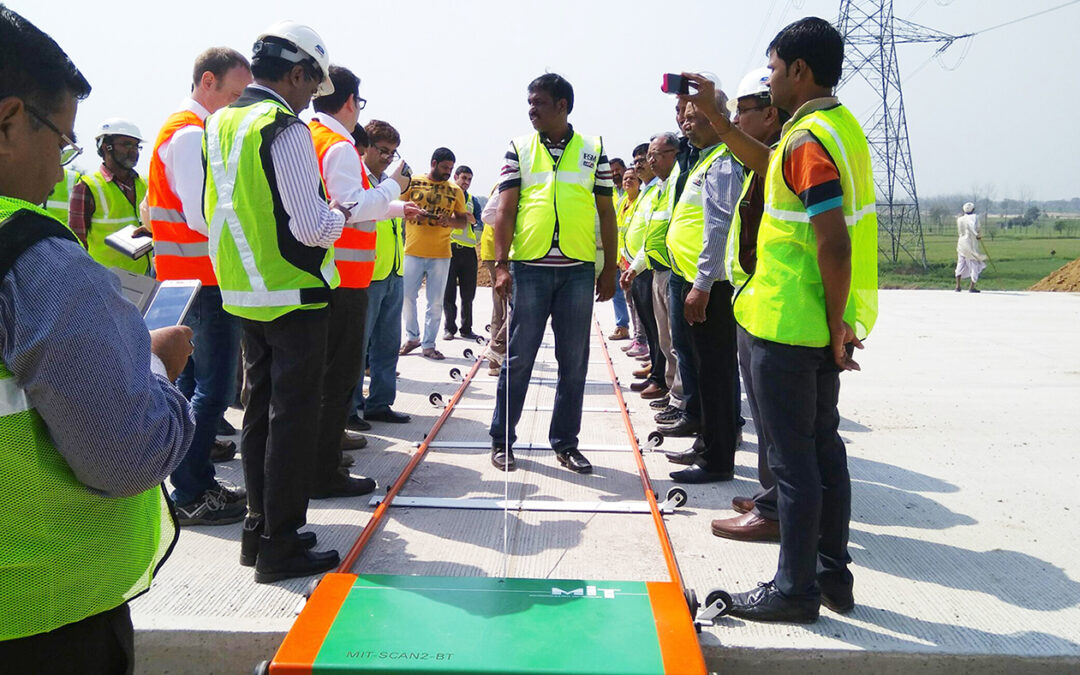
The measurement process is very straightforward. A mobile rail system is placed above the joint to be assessed. The measuring trolley is then pulled over the rails along the joint. It is controlled via a mobile computer that communicates wirelessly with the measuring device. During the measurement run, the computer displays the signal received and the distance covered. Due to automated signal analysis, the number of dowels as well as their spatial position and orientation are determined within a minute.
Different parameters that describe the deviation of a bar from its prescribed positions – namely the depth deviation, the lateral translation, the vertical and the horizontal rotation – are computed with a tolerance of just a few millimetres. Thus, this testing equipment is not only easy to operate, fast and non-destructive but also highly accurate and altogether, very economical. This becomes particularly clear in comparison with destructive methods, such as core drilling that impair the road surface, only allow random measurements and are very expensive to carry out. But the advantages compared to the non-destructive method, which is based on the reflection of electromagnetic waves (ground penetrating radar), are obvious.
The speed of propagation of the radar waves is influenced by the properties of the concrete, such as moisture, and needs to be determined by the use of a reference drill core before starting measurements or when deviations in the concrete’s properties occur. This severely limits the usability of ground-penetrating radar on wet roads and during the curing process. In contrast to this, MIT-SCAN2-BT can be used on the walkable ground, shortly after the concrete has been paved and is therefore useful for the adjustment of the equipment. Thus, the measuring system is used to improve the dowel bar positions during the paving process. Existing GPR-systems are less specialized in the specific measurement task and are thus, merely time-consuming, non-automatic analyses. However, the lateral displacement of the dowels cannot be calculated.
Parameters such as the lateral translation of the dowels are quite important. Installation errors, which experience has shown to be frequently observed, are joint cuts that do not coincide with the center of the dowels. The consequence of a faulty joint cut is the uniform lateral displacement of all dowels in relation to the cut joint. Another typical installation error is alternating depths that arise in connection with the compaction of the concrete and connection with its consistency. The detection of such systematic incorrect positions is only possible through the comprehensive, non-destructive measurement of the dowel positions. MIT-SCAN2-BT enables efficient inspections of large road stretches in one workday, which makes it a cost-effective instrument for contractors as well as for authorities.
|
|
The pulse induction method has been well-proven in other measuring devices of the German manufacturer, who also developed an instrument called MIT-SCAN-T3 for the non-destructive and accurate measurement of thickness layers in asphalt and concrete pavement like several superposed layers of asphalt pavement as well as unbound courses of the lower pavement structure (frost protection layer and aggregate base layer). Areas of use include new road construction, sub-base construction as well as pavement inspection and rehabilitation of existing roads. However, a prerequisite is the installation of a standard metallic reflector made of aluminium or steel at the base of the pavement layer to be measured. It serves as an antipole.
Layer thickness can be determined directly during paving (self-monitoring) or later as part of control inspections (external monitoring), performed for acceptance of construction work and calculation. To conduct a measurement, the MIT-SCAN-T3 is simply pushed over the measuring site. Within seconds, it accurately determines layer thickness. This way, based on a larger number of measuring sites, pavement thickness can be measured extensively and effectively. In Germany, MIT provides interfaces for the inclusion of layer thickness data in cloud-based building information management. Though this, it participates in the optimization and automation of building processes, and thus, the future requirements of road construction can be met.
For further information,
visit: www.taiseint.com
by Sawon Banerjee | Feb 15, 2021 | Construction Chemicals And Materials
|
Premankur Bhattacharya
Technical Head,
ANN WORLD
|
A Common Problem And Solution
Crack on plastered or putty finished surface on AAC Block is a common problem which spoils the look and change the aesthetical view of building. External and internal surface of the building are subjected to face different atmosphere. As the outer plaster/putty finished surface is subjected to adjust with external weather parameters like rain, sun heat, wind blowing and other stresses due to temperature and humidity variation, the internal plaster/putty finished surface is subjected to adjust other stresses like humidity, temperature variation and mostly the masonry surface.
AAC Block surface is the most common reason of crack development of plaster and putty finish on AAC Block masonry. Autoclaved aerated concrete (AAC) is manufactured using cement, fine aggregates and an aerating additive. The Aerating additive makes the mix lump into a dough. Mostly AAC Blocks contains a large amount of air. The prepared mix is put in mould and cut into desired dimensioned units. The major advantages of AAC Block is its light weight, insulation and easy installation with cost-effective benefit. Water ingression cannot take place through AAC Block. Water absorption property of AAC Blocks was investigated by capillary suction method. It was found that the inflow height (i) of water in aerated concrete by capillary suction effect was a function of the elapsed time (t), i. e. i=a + s × t 1/2. Based on the theory of Laplace and characteristics of aerated concrete, the physical implication of the parameter “a” and “s” in the formula and their influencing factors were discussed. The results showed that “a” was mainly depended on the pore radius of the surface layer of aerated concrete and “s” was determined by the total porosity, the quantity of connected pore and pore size distribution of aerated concrete. According to the observation of the profiles of macro pores in aerated concrete, the relationships between capillary absorptivity and connected pores, pore size distribution of aerated concrete were investigated, by which the theoretical analysis mentioned above was proved to be appropriate. The impermeable surface property of AAC Block has welcome the major disadvantage, which causes the crack development on plastered surface.
|
|
The reason is very simple. As the cement slurry is not absorbed by its surface, it can’t function as a key to hold the plaster on it. This phenomenon is the root cause of deboning between AAC Block surfaces and plaster or putty on it. The lack of bond between cement particles causes surface bond failure of plaster. But the expansion–contraction property is not at all similar to the plaster on it. Considering the above two factors in study, it is established to state that plaster on AAC Blocks definitely will crack.
There is a practice to limit this problem is introduced by using polymer adhesive based system. But, that has a limitation of bonding due to its reduced durability under weather action. The kind of polymer used for the purpose is degraded under weather action, mainly the storm water affects its structure. Low pH of storm water slowly degrades the molecular structure of the bonding polymer in this case. As a result, the plaster on it or with the polymer is degraded and cracks are developed at random and surrounding the degraded polymer. This has raised a big question to the advantage of AAC Blocks.
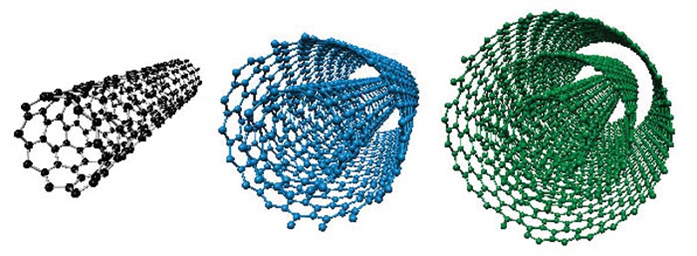
A long study and use of a Nano composite has shown the way to get rid of this serious problem. The Nano tubes has played a great role to stop this crack development problem of plaster on AAC Block. Nano tubes in plaster mortar helps to produce key between cement particles in calcium silicate hydrate gel. The resultant products after reaction between Nano composites and cement produces a Nano particle flow towards the surface of the AAC Block, which makes a key between the plaster and the AAC Blocks. This flow of Nano particles towards the horizontal axis is called horizontal suction. Similarly the vertical suction plays the same role in producing key between the cement particles. This inward flow creates millions of keys to hold the plaster mortar to the AAC Block surface. There are many such evidences which has proved its efficiency and also named as BOND FLOW. The BOND FLOW has a great impact to make the plaster durable on AAC Block. The advantage of the Nano Bond Flow is the faster plastering work and reduced rebound loss. As the Nano composite is an inorganic in nature, it has no degradable property under weather action, after formation of calcium silicate hydrate hydrophobic gel the plaster is formed into a hydrophobic monolithic substrate with AAC Block. The monolithic cover behaves similar expansion contraction property with AAC Block. This exquisite property of the Nano composite is proven successful to stop any crack propagation in hydraulic material like cement and putty. The putty also behaves similarly with Nano composite on AAC Blocks and other non-porous surface. The study is conducted based on a Nano composite product, which is widely used in many constructions built by AAC Blocks. The product has proved its efficacy to prevent these types of cracks and in the field of waterproofing of structure too.
The study conducted on SYLOCON® is analyzed by Scanning Electron Microscope and X-ray diffraction. Also the product is tested on several projects all over India and it is established as an only tool to prevent cracks on plaster and putty on AAC Blocks and non-porous structure.
by Sawon Banerjee | Feb 15, 2021 | Construction Chemicals And Materials
In March 2020, WHO declared COVID-19 a worldwide pandemic, and since then, every country across the globe is fighting to handle outbreaks of the virus. The virus has impacted every aspect of our lives and work. Road safety is no exception. According to statistics, road traffic injuries are the leading cause of death of children and young adults aged 15-29 years. Nearly 1.3 million people are victims of road crashes every year, and an additional 20-50 million are injured or disabled.
Although we are fighting with an existing virus pandemic, we cannot ignore the dangers of the road safety pandemic that has been taking many lives for years, which calls for an immediate step towards prevention. It is pertinent to note that both COVID-19 and road safety share an unfortunate trait – they hit the most vulnerable people the hardest.
Globally, schools fall under the vulnerable road user zone. With Unlock 5.0, the central government has asked the state government to decide on the timing for reopening schools. Given that schools can open anytime in the near or immediate future, it becomes important for us to take this window of opportunity to build safer road conditions around the school.
In India, road safety programs exist in many forms. However, there is a need for a more structured and consistent approach. Addressing the concern of road safety around school premises, 3M India under their community initiative ‘3M Young Change Agents for Road Safety’ (YCARS) developed a robust program in partnership with Concern for Road and Pedestrian Safety (CoRPs) and United Way of Bengaluru (UWBe) and launched the first School Safety Zone at St. Joseph’s School Bengaluru in 2019.
Commenting on the initiative Pawan Kumar Singh, Country Head, Transportation & Electronics Business Group, 3M India, said, “COVID-19 has not been able to control road accidents. Road safety is a global pandemic that claims over 1.3 million lives every year. India, which has less than 1% of global motor vehicles, sees 11% of people killed every year due to road-related fatalities. With YCARS, we are safeguarding our kids with safe school zones and aiming to sensitize future drivers by instilling responsible driving practices in them. We have successfully been able to cover 12 schools during 2019-2020 and we strive towards increasing the number in coming years across the country.”
In its first year working this program, 3M aims to cover 15 -20 schools across five cities – Bangalore, Delhi, Mumbai, Chennai, and Pune. The company aims to reach out to over 50-100 schools in over 30 cities in the subsequent years. 3M has created #ScienceOfSafety for this campaign to encourage people to spread the message of school safety and can also reach out to the company to enrol their schools. In 2019-2020, 3M undertook this initiative across Maharashtra, Karnataka, Delhi and Chennai, where school children across five schools from Pune, five schools from Bangalore, and one school from Delhi and Chennai were trained and educated on road safety issues.
“We value our partnership with 3M to co-create this program, given their expertise in road safety and learnings from global markets that can be implemented here in India. Road safety in India needs immediate attention and proactive measures to reduce human life loss in roadkill. It is high time to move the need from awareness to action. This is exactly what we aim to achieve through our partnership with 3M,” said Sunish Jauhari, Founder, Concern for Road and Pedestrian Safety (CoRPs).
“United Way Bengaluru strives to collaborate with organisations and institutes of global repute to bring innovative and unique solutions to resolve social issues. We are happy to collaborate with 3M who brings in scientific and technical expertise in road safety and CORPS to design and execute an impact-driven Young Change Agents for Road Safety program. The program aims to teach responsible road safety behaviours among school children in India,” said Rajesh Krishnan, Executive Director, United Way of Bengaluru.
With the successful implementation of YCARS initiative, 3M has created an outstanding blueprint for organisations and authorities who plan to work towards a more sustainable road safety model. In countries worldwide, 3M has been leading road safety education initiatives, especially around safe school zones.
The program focuses on creating young change agents by inculcating a sense of responsibility towards roads and empowering them to act as ambassadors of road safety.
The 3M YCARS program includes four hours of interactive theoretical engagement with students between the age group of 10-15 years over three days. The program structure broadly entails- understanding the road and road-users, and important road safety signages; observing road and road-risks and school road safety audit. They also experience road hazards, through a simulated module are then encouraged to illustrate a wish list of Safe Zone for their own schools. On completion, students are certified as 3M Young Change Agents for Road Safety and must take a pledge to commit to spreading the learnings to their families and friends.
3M being the program’s overall sponsor, is responsible for working with local authorities to put up the road safety installations that are an outcome of the recommendations of the school workshops.
For further information,
visit: 3mindia.in/3M/en_IN/company-in
by Sawon Banerjee | Feb 15, 2021 | Construction Chemicals And Materials
|
Meg Davis
Industry Marketing Director,
Roads (Bentley Systems)
|
A key part of any transportation network are bridges, and maintaining these infrastructure assets is important to ensure public safety. Inspections that gauge the structural integrity of bridges as well as information gathered during these inspections give bridge owners and engineers the necessary data to plan for the maintenance, rehabilitation, and bridge replacement.
The problem for bridge owners is that traditional visual inspections are labor intensive, can require expensive equipment, may present safety risks, and can be inaccurate and error prone, depending on accessibility and reporting methods. Collecting data can be difficult and when inspectors lack a detailed understanding of historical change that can affect the time and cost of inspection activities, as well as adversely impact the movement of the general public. And, in some countries, new regulatory compliance rules and associated reporting requirements add another layer of complexity.
Some of Bentley’s most innovative users are reimagining inspections through the lens of digital twins. A digital twin is a digital representation of a physical asset, process or system, as well as the engineering information that allows us to understand and model its performance. A digital twin can combine data from continuous surveys, photogrammetry, LiDAR, and sensors, and track changes to assets on a timeline, enabling owners to view the digital representation of the infrastructure asset and related real-world conditions over time. As DOTs and agencies are being pressed to show the most effective use of their limited funding, taking advantage of digital twins can provide for safer, less expensive, more timely and accurate inspections. Digital twins allow owners to track historical changes and understand information such as the exact size of cracking, corrosion, or section loss, rather than trying to determine this information by looking at pictures taken over time.
We have seen agencies such as Minnesota DOT use drones to assist with their inspections and achieve savings of as much as 40% with these methods. Because bridges have such a long lifecycle, often up to 75 to 100 years, it is important to track change to the structures over time. MNDOT found that by deploying drones and having a digital twin, they were able to see the change over time and have a holistic view of the bridge, including seeing past inspections laid on top of the current data, which can improve efficiency and help predict the future.
There is great opportunity for agencies to use UAVs and drones to complement and augment standard and in-field inspections. The data from these inspections can be reviewed quickly and easily in the office. By reviewing time-lapse comparison of detailed changes, annotating specific areas of concern, and noting anything that needs to be specifically reviewed in the field. Field crews can see all the inspector notes right on the structure, which is more visual, more accurate, and more efficient. All of this is geared toward saving costs, avoiding risks, and reducing the time required for inspections.
Digital twins help you take advantage of innovative ideas, such as the concept of remote inspections. Through a digital twin of an asset, along with immersive inspection capabilities in Microsoft HoloLens, inspectors can conduct significant parts of the inspection while in the office, reducing the time required in the field, which makes the overall inspection quicker, more efficient, safer, and less costly. A digital twin provides flexibility as you can conduct more in-depth inspections without having to schedule expensive equipment and labor for that purpose. Applying digital twins over many large, complex, or signature bridges can lead to significant savings, while increasing safety and providing richer visualization is the ultimate goal.
One of the biggest advancements we see is a reality mesh, the visualization for a digital twin that gives yet another dimension to our understanding of the infrastructure and surrounding topography. As agencies use drones to assist with their inspections, the photos or videos and data they capture can be used to produce a high-resolution reality mesh of the bridge. And, when combined with other relevant data, this provides a great digital twin representation, whether on or off the network, aboveground or belowground. Recording those reality meshes over time can provide better insights into changes within the structures. Using reality meshes for inspections can significantly decrease the amount of time inspectors have to be on and around structures in the field.
Utilizing digital twins and technology including drones and UAVs to collect, process, store, and analyze large amounts of data can reduce time and costs while increasing quality of inspections. The technology can improve safety for inspectors and the public at large and help preserve bridge infrastructure into the future.
For further information,
visit: www.bentley.com/en