by Sawon Banerjee | Jun 6, 2021 | News
ASK Property Investment Advisors (ASK PIA), the real estate private equity arm of the ASK group, has invested ₹200 crore in Kalpataru Group’s mid-income housing project in Baner, Pune which is an an ongoing mid-segment residential project, spanning across 16 acres with a saleable area of around 1.9 million sq. ft. comprising over 1,200 units across 1 to 3 BHK homes. “The project is in line with our strategy of providing funds to mid-income housing projects for mid/last mile execution and completion. This is our maiden exposure to the Kalpataru Group, which fulfils our criteria of strong brand reputation, in-house quality construction capabilities, and timely project delivery track record. We are delighted to partner with them, and we look forward to a long-term, mutually beneficial association,” said Amit Bhagat, CEO and MD, ASK PIA.
“The last couple of years have witnessed a consolidation of demand for homes to reputed, execution-focussed and large-scale developers. Affordable and mid-income housing has seen a substantial recovery and prices have bottomed out in the last one year, which has also led to sustainable demand. Decade-low home loan rates, concessions in stamp duty/premiums, and flexibility by developers have increased the affordability for home purchase,” said Sunil Rohokale, MD and CEO, ASK Group.
by Sawon Banerjee | May 24, 2021 | Sponsored Articles
|
Mr. Vishvaroop Anand
Managing Director,
Titan Crushing Machinery Pvt Ltd.
www.diamondcrusher.in
|
DIAMOND Group is one of the oldest Manufacturing Company of Crushing and Screening Machinery and Turnkey Plant in India, ethically serving the Industry for more than 50 years.
Our Single Toggle Jaw Crushers have a very high reputation for their productivity, performance and durability and are being used by more than 5000 highly satisfied customers pan India.
In the past decade we have designed and developed our Floating Shaft CONE CRUSHERS (In-House) and Fixed Shaft CONE CRUSHERS (JV with CMC, Taiwan), High Performance Vertical Shaft Impactors and Highly Efficient Vibrating screens which are successfully operating in various locations pan India.
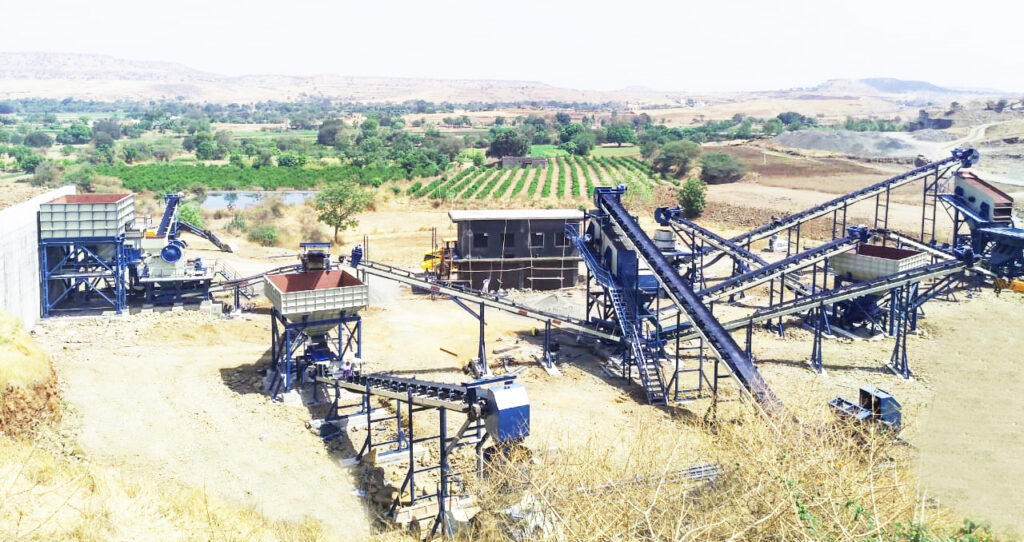
Crushing and Screening Plant
With a huge range of world class designs and engineered machineries, we are very well placed to supply complete 2, 3 and 4 stage crushing, screening and washing plants up to 500 TPH capacity.
Our experienced team of qualified engineers and industry professionals are capable of customizing the plant layouts to the specific requirement of customers land and outputs.
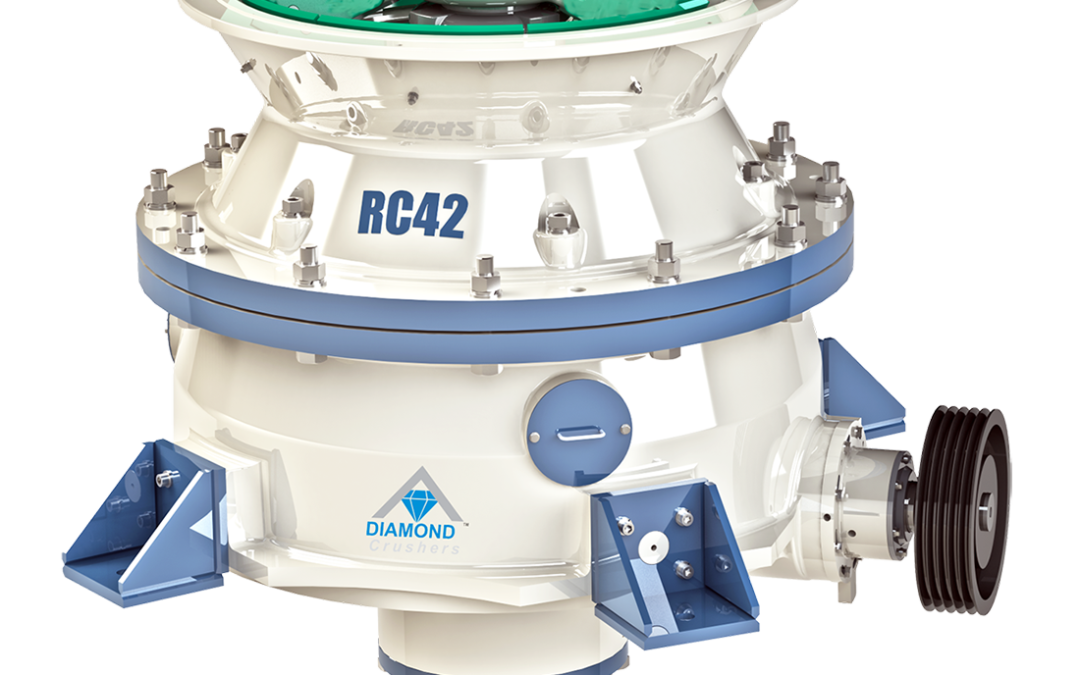
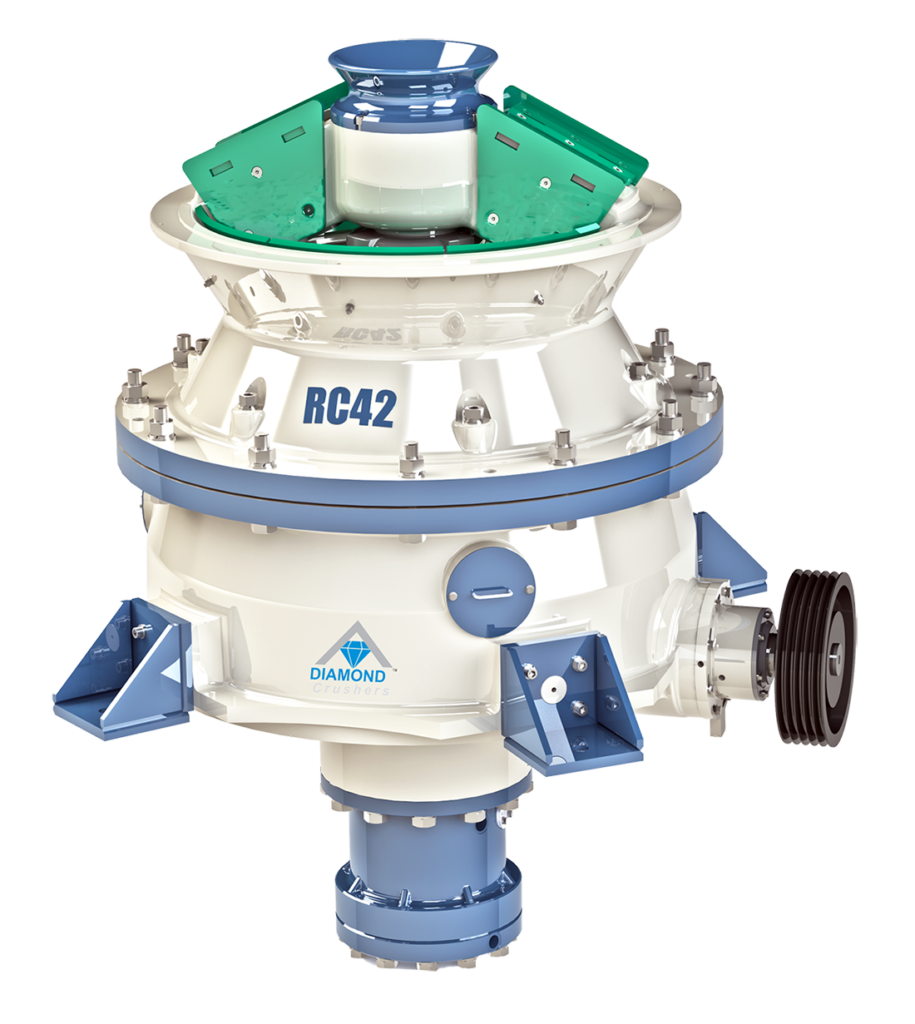
Our FLOATING SHAFT Type RC Series Cone Crushers Are Designed With Below Salient Features:
- Larger feed size
- Long crushing cavity
- No backing compound required for liner fixing, makes liner changes quick and easy
- Versatility – with liner change, crusher can be easily converted for secondary or tertiary operation
- Hard chrome – ground cylinder with excellent sealing
- PLC automation system maximizes production and avoids misuse of the equipment
- Headspin is minimized which helps especially when choke feed conditionsare not possible
- Capacity range from 120 TPH to 300 TPH
RC Series Cone Crushers
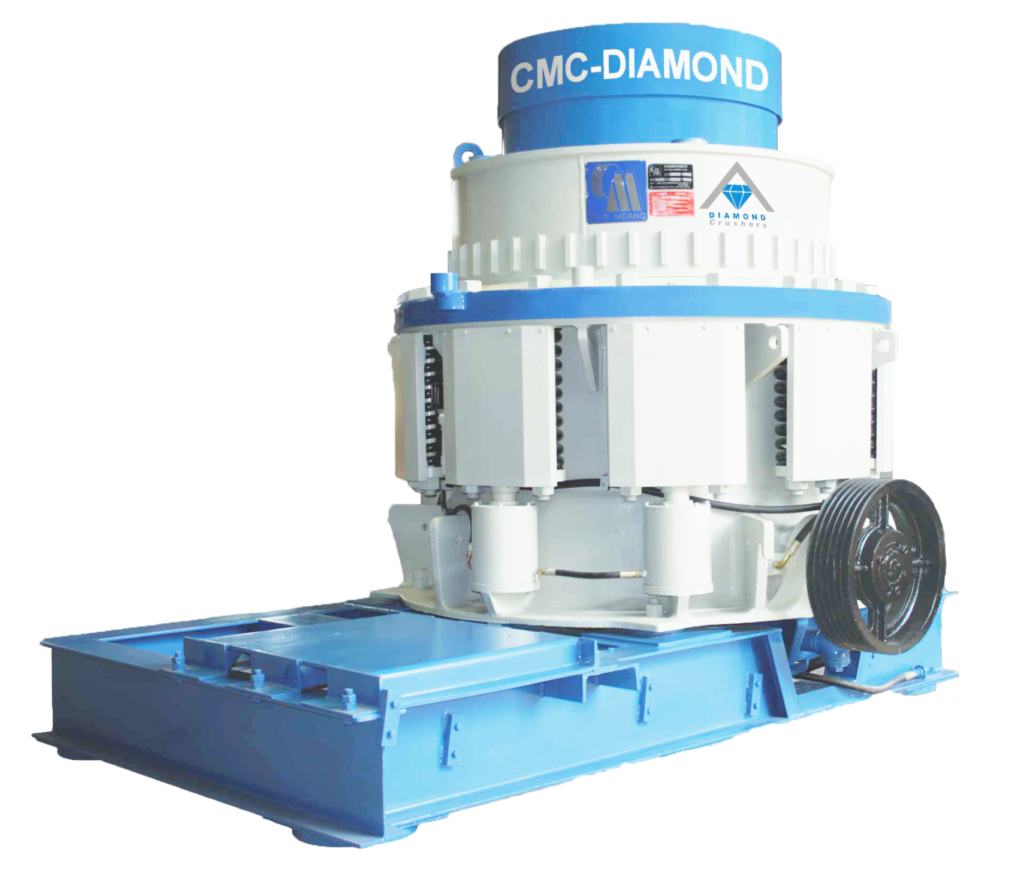
Our FIXED SHAFT DP Series Cone Crushers (JV with CMC, Taiwan) Are Popular Amongst Users For Their Performance For The Past 10 Years With Their Salient Points Such As:
- Close granulometry of product with less oversize.
- Each model has option of coarse, medium, fine and sand operation.
- Depending on customer preference, Automatic hydraulic type or spring type can be provided.
- Capacities from 120 TPH to 600 TPH.
DP Series Cone Crushers
Diamond Group always has had a reputation for large inventory spares and honest service back up with strategically located depots pan India.
Technical advice or consultation is just a phone call away. To ensure service at customer’s doorstep, we have a large team of trained and dedicated service engineers available near the point of utilization of the crushing plants.
by Sawon Banerjee | May 24, 2021 | Construction Equipments
More Possibilities – Layher Products And Services
Layher’s present product characteristics and services help customers achieve long-term success and increase the profitability of their companies. The Layher Allround Scaffolding has been established as a synonym for modular scaffolds in the market. The Allround Scaffolding offers unsurpassed versatility to be used in construction sites, chemical industry, power plants, aircraft, shipyards, event sector, theatres and arenas.
Application Of Allround Scaffolding In Construction Of Cable-Stayed Bridge
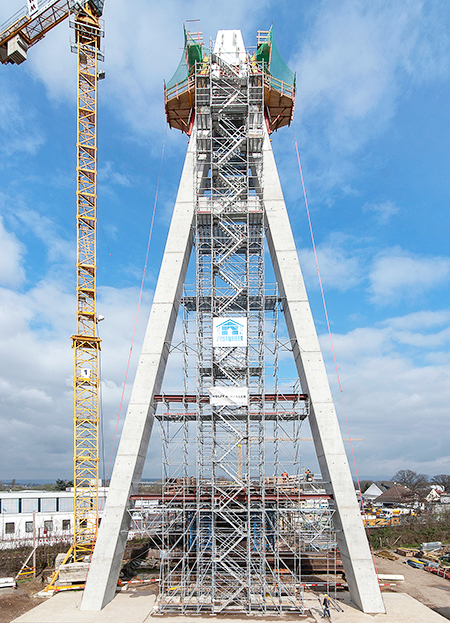
Optimum adaptation to the structure’s geometry – flexibility in use: to build a pylon for a cable-stayed bridge, Allround Scaffolding from Layher proved to be the ideal solution both as the support/work scaffolding and for site access. Using expansion parts such as the innovative Allround TG 60 Shoring Frames, it was possible during concreting work on a binding beam not only to safely disperse high point loads, but also to integrate a platform stairway tower without any problem.
Cable-Stayed Bridge Over A Railway Line In Raunheim, Hesse
Application of Allround Scaffolding is suitable for Shoring, work scaffolding and stairway tower. Engineer in charge concluded during construction of a cable-stayed bridge over a railway line in Raunheim, Hesse. To allow its about 55 metre high pylon to be built safely, both shoring to disperse the high loads in the area of a binding beam in 36 metres up, and birdcage scaffolding optimally adapted to the ‘A’ shape and including work platforms and stairway tower were needed to provide access to the climbing formwork. All these needs were ideally met with only one system – Allround Scaffolding from Layher. This modular system scaffolding permits, with its bolt-free wedge-head connection technology, not only rapid assembly, but also – thanks to a comprehensive range of parts – unlimited applications, even with very difficult ground plans and anchoring conditions or with complex architecture.
A crucial advantage for the construction company, during this project was the use of the Allround Shoring Frame TG 60, which combines with standard parts from the proven Allround range to construct very strong shoring towers. The reduced number of components in the prefabricated shoring frames when compared with single parts, the low component weight of no more than 20 kilograms and variable bay lengths all help to ensure, thanks to their easy assembly, a high degree of efficiency at the site, while compatibility with Allround Scaffolding means high flexibility. Every requirement on a site can be met economically using the Allround construction kit – whether it’s connecting up large shoring structures using Allround ledgers and diagonal braces, adapting to different geometries, or adding work levels and stairway towers.
The construction company, being responsible for formwork and scaffolding as well as for planning and material supplies, developed in cooperation with Layher’s Technical Office and the scaffolding construction company a solution that was both slender and strong: “The basis was an Allround birdcage structure that could be flexibly adapted to the tapering shape as work progressed. Since HEB beams had to be temporarily installed to brace the pylon, our scaffolding erectors also used Layher steel decks and lattice beams to assemble two work platforms, at the 10 and 18 metre levels, for storing and assembling individual parts”, reports of project manager of the company entrusted with assembling the scaffolding.
Cable-Stayed Bridge Over A Railway Line In Raunheim, Hesse
Also integrated was the Allround Shoring Frame TG 60 for dispersing the high point loads during concreting work on the binding beam, plus an Allround platform stairway tower. It ensured access to the climbing formwork during every construction phase. All components are compatible with one another and can be attached quickly and automatically at right angles, using the wedge head connection. The scaffolding erectors also proved resourceful when it came to logistics: for vertical transport of the scaffolding material, they simply used the site crane to cope with the height of the scaffolding. That enabled three erectors to put up the 52 metre high scaffolding structure for the pylon, already visible far and wide. This pylon will be supporting, with its steel cables, the approximately 800 ton weight of the cable-stayed bridge – a sound solution in every respect.
Layher Allround Scaffolding Systems is performing like All-rounder.
by Sawon Banerjee | May 7, 2021 | Construction Chemicals And Materials
What is a roof and what is its function?
In the building industry, a roof is the part of a building that covers and protects the construction underneath it and, in turn, protects the rooms from atmospheric conditions such as rain, snow and cold weather. At the same time, a roof also has to withstand the design stresses and loads acting on it, which depend on what the roof is actually designed for.
A roof may be exploited to serve a number of different purposes: as a simple terrace or balcony, for example, or for more technical applications (such as a place to house a building’s plant and service equipment), to allow the passage of vehicles (such as a rooftop car park on a shopping centre), or else a rooftop garden to greenify densely populated metropolitan areas, etc. Whatever the specific function and purpose of a roof is, it is important to study its stratographic layout very carefully in order to define the most suitable waterproofing system to ensure the roof is able to protect the building and maintains its resistance over the years, thereby ensuring the durability of the entire structure.
Why do we call them “waterproofing systems”?
In order for it carry out its primary function of protecting a building, not only do the best waterproofing products available need to be employed, but also any other accessory items and relative products required; this is why we need to refer to it as a “waterproofing system”.
The Mapei range of waterproofing solutions includes various waterproofing systems. For balconies and terraces, for example, there is the MAPELASTIC line and relative accessory items such as special sealing tapes (MAPEBAND EASY, MAPEBAND SA and MAPEBAND TPE) and drainage items from the DRAIN line.
For roofs, on the other hand, the products available can vary from the AQUAFLEX ROOF range of liquid acrylic membranes to the PURTOP EASY line of polyurethane membranes, or lastly the PURTOP range of polyurea membranes.
Choosing the most appropriate product range depends on the function of a roof.
Iskcon Temple, Mayapur
Is it more effective to apply a waterproofing solution over or underneath the layer that forms a slope?
For a waterproofing solution to last over the years and as a result, enable a roof to also last over the years, it is important that it is applied on a sloping substrate.
With a balcony or terrace, for example, applying the waterproofing layer on a sloping substrate protects the screed and the other underlying layers from water, which in turn prevents water seeping into joints and affecting the functionality of the entire structure. This also allows the water to run off correctly towards drainage points so that it doesn’t remain under the ceramic tiles, which would then lead to the onset of various problems.
In the case of a flat roof with a bituminous membrane, for example, water may collect in any depressions or hollows that have formed in the membrane and provoke the so-called “lens-effect”. In such conditions, heat from the sun causes a dark roof to warm up, which leads to premature deterioration of the waterproof membrane and, as a result, a reduction of the roof’s service life. If a waterproof membrane is installed on a sloping surface, on the other hand, this phenomenon does not occur.
In both cases, and in all similar situations, it is very important to carry out the correct, routine maintenance on guttering, downpipes and runoff channels.
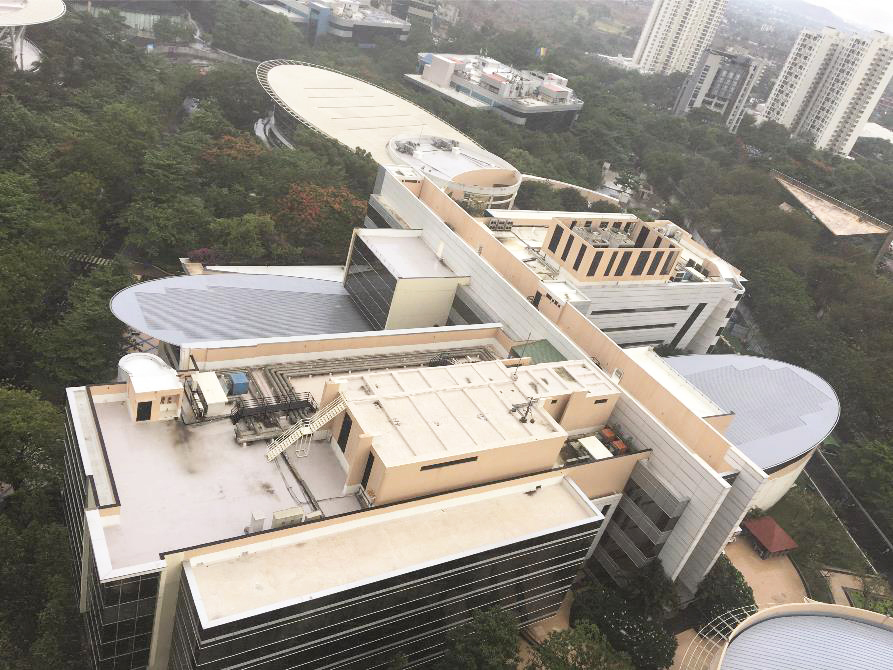
IT Company Building in Pune
What is the minimum thickness required in order to waterproof a surface correctly?
The minimum thickness for a waterproofing system varies and depends on the type of material applied, the characteristics of the material, such as its thixotropy, and the area of use of the structure.
As far as cementitious waterproofing systems are concerned, such as products from the MAPELASTIC line, the total recommended thickness of the layer to be applied is 2 mm. This thickness is easy to achieve by using a notched trowel to apply the product, thanks also to the reinforcement which is sometimes used to improve the product’s performance properties.
In the case of polyurea systems, on the other hand, we suggest applying a 2 mm thick layer. In such cases, the correct thickness can be achieved by using specific tools as thickness guides, especially if skilled, specialised workmen are employed to apply the product.
In the case of polyurethane systems, we suggest applying a single layer (1.2-1.5 mm thick) in order to form a waterproof membrane with excellent mechanical properties, thanks also to the use of specific additives.
And lastly, the final thickness for water-based liquid membranes (such as those belonging the AQUAFLEX ROOF line) is 1 mm, which may be increased according to the area of use of the roof.
Can ceramic tiles be installed directly over a waterproofing system?
They certainly can. If a client wants a terrace, balcony or roof covered with material suitable for external applications, Mapei can offer an extensive range of adhesives available for bonding it to waterproofing systems.
For example, for a cementitious waterproofing system from the MAPELASTIC line, we suggest a class C2 cementitious adhesive according to EN 12004, while for a polyurea waterproofing system, we suggest using an epoxy or epoxy-polyurethane adhesive.
Also, we must not forget that liquid membranes for external applications, such as balconies, terraces and roofs, are covered by EN 14891. This European standard is used to evaluate the conformity, classification and area of use of liquid waterproofing products applied underneath external covering materials. The standard specifies the test methods to be used and the performance levels required for liquid waterproofing products applied underneath a covering material, such as ceramic tiles bonded with adhesives.
Application of Purtop
Is it possible to intervene on an existing bituminous membrane? And if so, how?
Absolutely. In this case, too, it is important to clarify various aspects before starting, such as the area of use or the final finish required by the client. So, we should ask ourselves: is the flat roof with the bituminous waterproofing system used to house plant or service equipment? Will vehicles need to pass over the roof? Or is it for a terrace that needs to be renovated?
Whatever the situation, Mapei has just the right solution to give any roof a new waterproofing system without having to remove the old bituminous membrane.
Mapei can offer liquid acrylic membranes from the AQUAFLEX ROOF line, polyurethane membranes from the PURTOP EASY line or polyurea membranes from the PURTOP line. In such cases, once the substrate has been prepared correctly with special primers, the waterproofing product may be applied. These solutions should be adopted in the case of exposed roofs used for technical purposes.
If, on the other hand, we need to work on a roof with a bituminous membrane and turn it into a terrace with ceramic flooring, we suggest creating a sloping screed with just the right amount of slope, applying a cementitious waterproofing system from the MAPELASTIC line over the screed and then install the ceramic tiles over the membrane.
The indications above are just a general guide, because with building work there are a multitude of variables and variations that need to be carefully considered for which there is always the right solution.
What does routine maintenance consist of and how important is it?
Maintaining and maintenance are synonyms for “conserving a good level of efficiency”. Maintenance work on a roof is essential for the durability of the structure itself.
Mapei products, which are certified according to European standard EN 1504-2, already play an important part in protecting structures and, as a result, they maintain their durability over the years. If, however, these products are not used correctly, or if they are not stored in the right conditions, it will be the roof that suffers by gradually losing its overall efficiency.
For further information,
visit: www.mapei.com