by Sawon Banerjee | Sep 7, 2021 | News
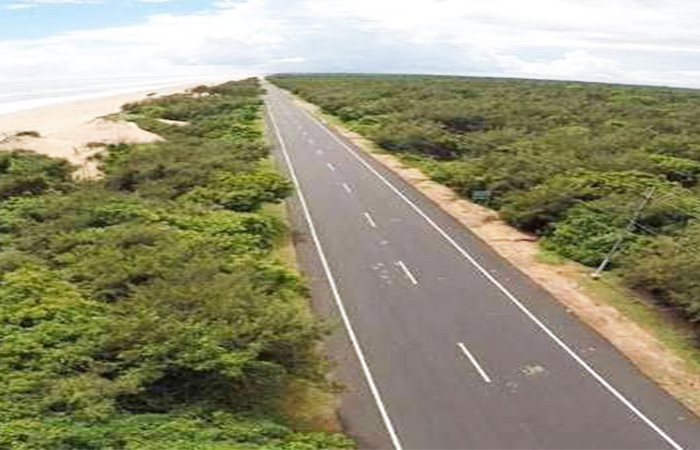
The 382 km coastal highway project has got its consent from Odisha government for the new alignment proposal. As per the revised alignment, the highway will now begin from Tangi in Khurda instead of Satapada in Puri district, bypass Chilika lake and culminate at Digha touching Brahmagiri, Puri, Konark, Astarang, Naugaon, Paradip Port, Ratanpur, Satabhaya, Dhamra, Basudevpur, Talapada, Chandipur and Chandaneswar.
The highway project has received a general permission from the state government. “Initially, it will be constructed as a two-lane highway and later expanded to four-lane depending on traffic. We will conduct the survey to estimate the areas coming under forest, CRZ, government and private categories,” he said. Estimated at ₹8,000 crore, the construction cost is likely to be escalated up to ₹10,000 crore as more bridges and culverts will be required to avoid the eco-sensitive areas.
by Sawon Banerjee | Sep 7, 2021 | News
The construction equipment industry could expand up to a fourth in 2021 on the back of the government’s infrastructure spends and could likely regain the past peak sales of 2018 next year, JCB India said.
The industry underwent a development of 65% throughout January-June of 2021 in comparison with the earlier 12 months regardless of the second wave of Covid-19 impacting gross sales for a few months, stated Deepak Shetty, managing director, JCB India.
“The second half of last year was very strong, but I would still estimate around 20-25% improvement (in sales) this year. The industry, and JCB, should also be seeing our peak (sales) again by 2022,” Shetty said.
About 63,500 models of building equipment have been bought in India in 2020 of which JCB accounted for about 35,300 models, stated JCB. There was some reluctance in the market from financiers in the direction of lending for the acquisition of latest building equipment, Shetty stated, affecting gross sales to an extent.
by Sawon Banerjee | Sep 5, 2021 | International News
The developer of a 28,000 sq. km. resort on Saudi Arabia’s Red Sea coast, (TRSDC) The Red Sea Development Company, has become the first asset owner in the world to achieve the BIM Project Kitemark for its digital project delivery and adoption of BIM aligned to ISO 19650, awarded by the British Standards Institution (BSI).
John Pagano, CEO of TRSDC, said: “This certification is a remarkable achievement and demonstrates how serious we are about setting new standards throughout the design, construction and operations of our destinations. This way of working is an increasingly important part of the global design and construction marketplace and we look forward to sharing our knowledge with other projects around the world.”
Susan Taylor Martin, chief executive at BSI, said: “We are delighted to have worked with TRSDC on its adoption of international standards and specifically its market-leading BIM implementation.” The attainment of the Kitemark by TRSDC represents “an important milestone as the world’s first BIM Project Kitemark to be achieved by an asset owner”, she added.
by Sawon Banerjee | Aug 6, 2021 | Construction Chemicals And Materials
|
Mr. Paul Wallett
Regional Director, Middle East and India
Trimble Solutions
www.trimble.com |
The Union Budget this year has presented a strategic roadmap towards the vision of ‘Atma Nirbhar Bharat,’ with a much-needed focus on the infrastructure and construction industry. The budget speech mentioned the expansion of India’s ₹111 Lakh Crore (or US$1.5 Trillion) National Infrastructure Pipeline (NIP), from 6,835 projects to 7,400 projects. Of this pipeline, around ₹44 Lakh Crore or 40% worth of projects are currently under implementation, while another 50% are either under conceptualization or development stage, as per government data.
The budget also announced a new Development Finance Institution (DFI) to be set up with a planned initial investment of INR 200 billion, which will debt finance the infrastructure construction industry. This strong backing from the union government has opened up an enormous opportunity for the construction sector to contribute to the continued economic growth and well-being of the country, by building new infrastructure or rebuilding and replacing old and aging infrastructure. However, in order to maximize this opportunity, the Indian construction industry will necessarily have to boost its capacities and capabilities, and also overcome its own inherent weaknesses.
Digitalization and embracing of cutting-edge construction technologies by Indian construction players is a critical part of strengthening their organizational capabilities. However, only a very tiny fraction of Indian companies has made significant progress in their journey towards digitalization. This resistance to change and accept modernization is unfortunately going to prevent the majority of Indian construction firms from rising to the occasion and the infrastructure opportunity.
Around the world, we see owners of mega infrastructure projects proving time and again that technology-based organizational transformation not only improves project delivery, but also reduces costs and wastage. Improvements in task-level productivity are today enabling predictable and on-time delivery of discrete tasks. At the same time, integration and seamless sharing of information between a project’s stakeholder groups throughout the project’s lifecycle is widely proven to help in on-time and on-budget delivery of the final project. Digital transformation of construction is the key agent that will drive the nation’s progress towards ‘Atma- Nirbhar’ India.
We believe that a concerted effort is needed across the construction industry to accelerate technology adoption and digital transformation. By harnessing the technologies available to us right now, we can make long-overdue productivity improvements, overcome the labor shortage, and most importantly, transition to the much larger role that our nation needs us to play in expanding or modernizing the most critical pillar of our economy.
Connected Construction: A Digital Future For Infrastructure
The infrastructure industry is akin to the skeletal system of our country; however, it also stands apart as one of the most inefficient industries around. Analysis of data shows that a whopping 90% of all projects run late, 40% projects go over budget, and in every project as much as 10% of raw materials are wasted.
To build a smart and sustainable skeletal system, all of its stakeholders must work more efficiently and collaboratively. They must also appreciate the role modern tech-enabled construction, or ‘Connected Construction’ can play in improving the five key pillars of their operations: productivity, quality, transparency, safety and sustainability.
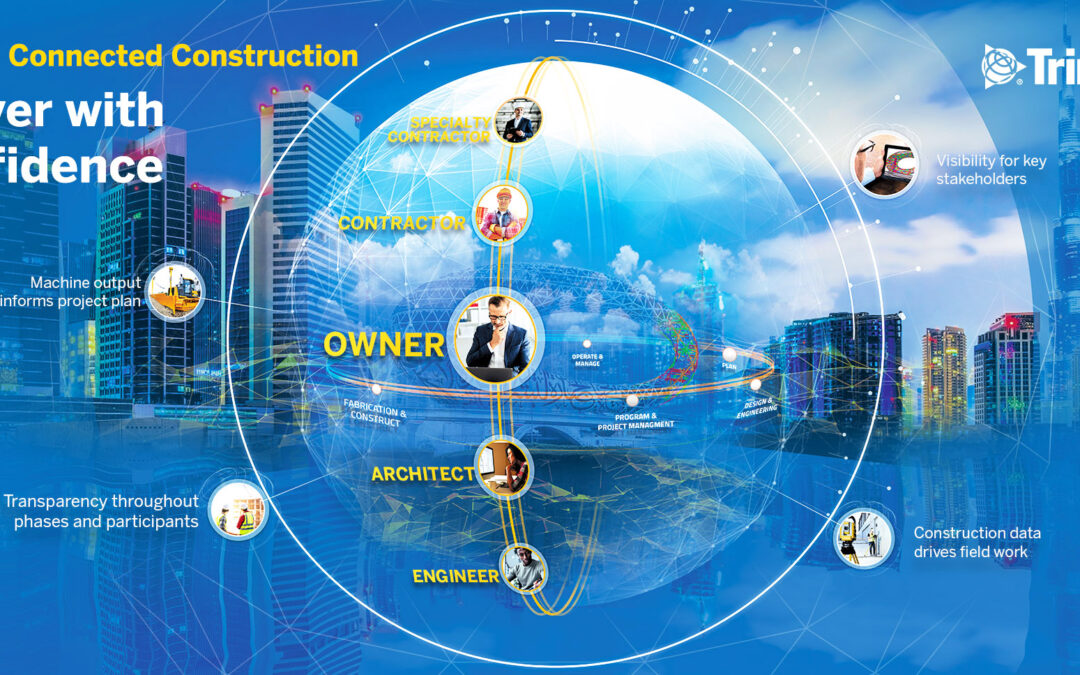
Connected construction refers to the unification of the people, processes and phases involved in each project by taking advantage of cutting-edge hardware, software, and services. It is a whole new way of executing a construction project as it simultaneously connects the digital world of modeling, imagery, measurement and data with the physical world of contractors, work crews, equipment and the jobsite at each phase of construction.
Connected construction also helps manage a project end-to-end, starting with pre-construction planning and continuing through its final handover, operations and maintenance. A ‘connected’ jobsite makes it possible for construction companies to manage with full confidence the sheer volume and scale of moving parts involved in large infrastructure projects through technology. This confidence stems from the tighter integration of hardware, software and services, which in turn enables unprecedented levels of collaboration among all stakeholders and at each level of construction lifecycle.
By embracing connected construction, industry players can build the smart, connected infrastructure that India today needs to carry us into the future. Imagine new expressways or highways that double as WiFi hotspots to facilitate real-time truck and vehicular movements and thus improve business efficiencies; or are able to collect rainwater and divert runoff to retain and preserve groundwater in communities. Connected construction thus holds the key to turning our infrastructure visions into reality by creating collaborative workflows.
Rebuilding The Indian Infrastructure
While the after-effects of the pandemic linger on, India’s economy is now firmly in the middle of a V-shaped recovery and will bounce back to register 11% growth in GDP, as per the estimates of the Economic Survey for 2020-21. Still, the realization of our stated goal of becoming a Five Trillion Dollar economy by 2025 rests firmly on the timely completion of critical infrastructure under the NIP.
What’s needed to upgrade our country’s infrastructure today and enable the innovations of the future is full-scale digital transformation and a transition to connected construction. This change is no longer a distant prospect—the foundations have been laid, proven technologies are available and best practices already exist among progressive construction companies around the world. All we need is a concerted and determined push from the leadership.
by Sawon Banerjee | Aug 6, 2021 | Construction Chemicals And Materials
There are enormous opportunities presented in the construction industry in India. In recent years, the southern cities in India have become the focal point for future real estate developments because of its robust infrastructure, strong growth in IT and start-ups and retail sector. Aurobindo Realty & Infrastructure is one of the frontrunners.
Aurobindo Realty & Infrastructure, the daughter company of Aurobindo pharmaceutical corporation founded four years ago, has envisaged construction projects for the next 10 years and beyond. With the up-beating prospects in the market, the company is also faced with daunting challenges.
Technology Is The Solution For Big Volume Construction
Considering the volume of projects which Aurobindo Realty had to construct, traditional methods of construction is clearly not the way to go. New technology and solutions are needed. Among different options, offsite precast construction technology has clear advantages. It can enable faster project execution twice the speed of traditional construction, and over 50% reduction in labour requirements. Thus, to assure them speed and control over the project timeline and efficient use of labour.
In addition, precast concrete also offers many environmental benefits when compared with cast-in-situ construction method. It can help buildings to meet the increasingly important LEED (Leadership in Energy and Environmental Design) criteria.
When evaluating potential precast technology suppliers, Aurobindo Realty management appreciated the fact that Elematic does not only offer reliable state-of-the-art plants with wide range of references across India, but also has a comprehensive support from feasibility study, to plant planning and design, to the final turnkey installation of the plant and after sales services.
“I should say that on the techno-commercial grounds we shortlisted Elematic, and we went ahead with them,” says Kumar VJ.
Aurobindo Plant Hollow Core Production Overview
Aurobindo’s precast factory is situated on a land area of 21 acres, 40km from Hyderabad city in Sanga Reddy district, in Southern India.
In building this world-class precast factory, Aurobindo Realty opted for a turnkey installation of the plant, where Elematic’s project team started with factory layout plan, structural design engineering support, to the supervision of casting of the foundations, the machinery installation, to the final handover of all machinery and production training.
The Force Of Nature
When the project started, it was India’s monsoon season. The rain seemed endless and the factory site was situated in
far-flung area, which made even arranging small things during installation seemed to be herculean task. Extensive knowledge in building precast factory and rich local experience about the conditions in India, are the fundamentals for the project team to foresee possible future problem and know when to be patient and how to handle those situations successfully.
India is known to be a country faced with high seismic activity, and the structural design in seismic areas is more complex and demanding than for ordinary buildings.
In building Aurobindo’s precast factory, the foundation was the most critical and time taking activity. One dedicated person from Elematic’s team was supervising the civil foundation, and an execution team for the fabrication and installation of the structure to ensure the success of the project completion.
“We know all the parameters in building the required precast factory, we know all the limits and conditions in India, what is the tolerance level, so we install all the structures accordingly, then we also supervise all the civil work. All these kinds of support were given to the client right from the start till the completion of the project,” explains Potdar.
Aurobindo Plant Hollow Core Production Elematic Extruder
Newcomer Can Feel At Ease When Accompanied With An Expert
Building a precast factory is not an independent activity, a lot of things are going on simultaneously. Coordination with all the agencies and getting materials on the right time is very critical.
Aurobindo Realty might be new to the construction industry, but their management and staff team have good knowledge about the precast technology and are willing to learn and apply their learning in the field. When teamed up with experts, who have built dozens of precast factory from scratch in various locations in India, and know precast factory and technology inside out, a successful outcome of the project is not in question.
With a high priority project, the Galaxy office building, to deliver, Aurobindo wanted to partially start the plant to produce precast elements needed for it.
Clear communication ensured a good understanding of the requirements and what would be needed first. A start-up plan was then made accordingly to ensure all the activities go hand in hand.
Galaxy Office Building Structure
“There were many meetings during and before the project’s finalization to ensure clear communication between us. Aurobindo’s project team has been taking care of the challenges very well and provided us with great support,” comments Potdar.
According to Aurobindo’s requirement, the beam and column line was made operational first to produce the precast elements needed for the Galaxy project while the rest of the plant is still under construction.
“The team was very supportive and able to make needed adjustments along the way. It’s not that easy!” comments Allwyn Ronald Fernandes, Head of Precast Plant, Aurobindo Realty & Infrastructure Pvt. Ltd.
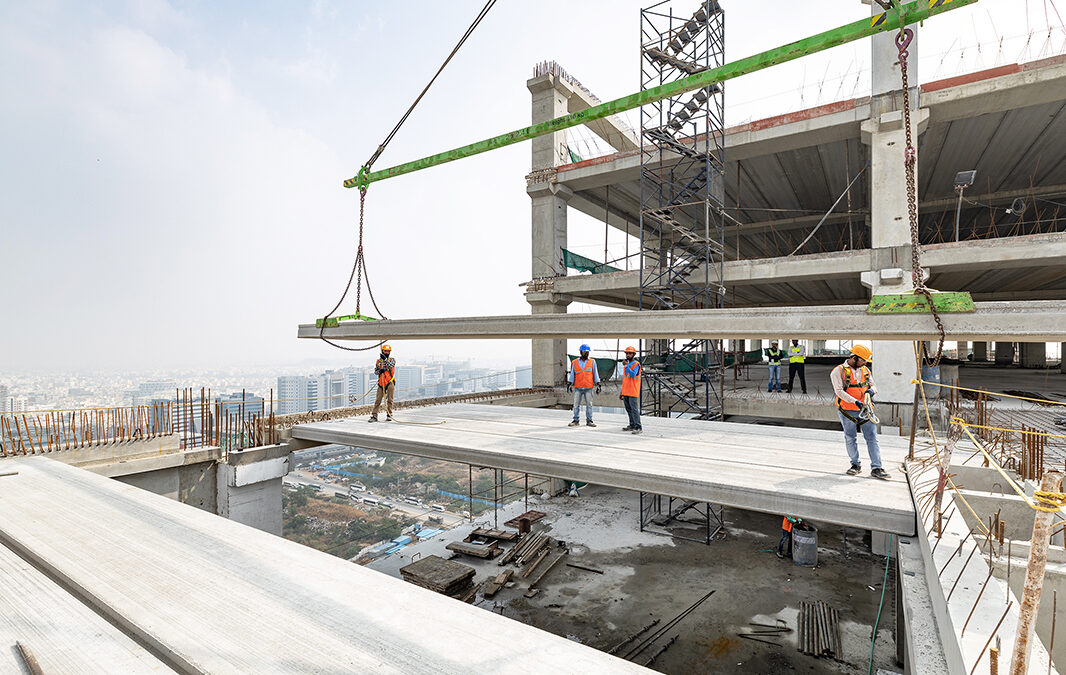
Galaxy Office Building HollowCoreSlab Installation
In March 2019, the factory was in full operation with automation in place. All installation, material delivery was delivered according to schedule. By the middle of 2020, the 105m Galaxy building made history to be the tallest office building built with precast technology in India. This year, Aurobindo is set to complete another iconic landmark in Hyderabad, a 25-floor IT building by the name Orbit.
Aurobindo is extremely happy with cooperation with Elematic and the precast products produced in the factory. They even presented Elematic with a written letter of appreciation, stating “We are very happy to work with Elematic, and only with the support of Elematic we were able to complete this factory within our schedule time.”
What To Look For When Choosing A Prefabrication
“I would advise anyone entering the business to see the current and future plan, in which segment they are going to be strong and then accordingly select the machinery of that particular segment. Then, they should be able to see the return from the investment for they have made,” says Kumar VJ.
Establishing a precast factory is not about the cost: having a right partner is crucial in ensuring the project success. The impact of this decision will remain for many decades and it shows in cash flow that far surpasses the initial capital outlay that they paid for the equipment.
“We would suggest to the prospective newcomers to the precast industry to select their technology partner with much care and scrutiny. The team should understand the precast technology and understand the situation in India,” says Rao.
For further information,
visit: www.elematic.com